
Madrid homophobic attack complainant admits lying
The young man who reported a homophobic attack in Malasaña confesses that the injuries were consensual, reopening the debate on false accusations.
English · Original discussion in Spanish · Published
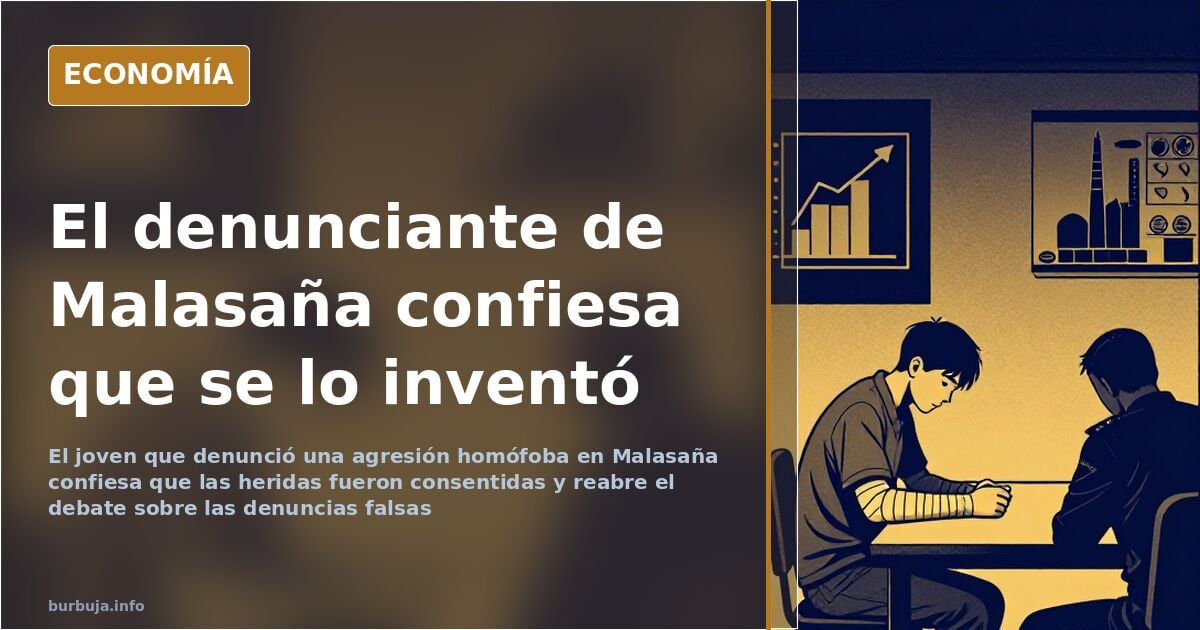
Malasaña homophobic attack collapses: complainant confesses
The report was false. Or at least, that's what the person who filed it has just admitted. The 20-year-old who claimed to have been attacked by a group of hooded individuals in Madrid's Malasaña neighborhood the previous weekend has reportedly confessed to the Police that the injuries he sustained were consensual. Hours earlier, half of Spain had accepted the story as fact: non-stop news coverage, statements from the Prime Minister, and a demonstration called in the wake of the case. The denial fell like a stone on the planned narrative.
What the complainant confessed and why the story fell apart
According to the testimony recorded in the police report, the young man broke down in the interrogation room when officers began to probe deeper. The official version of events spoke of an organized gang targeting the LGTBI collective in the center of Madrid; the real story, of a domestic incident he himself wanted to disguise as an attack to avoid losing his new partner.
The district commissioner, a veteran with years of service, reportedly came down in person to take his statement. It was there that the narrative split in two: the young man admitted that he had made it all up and that no gang dedicated to attacking anyone in Malasaña existed. The sentence that left half the forum speechless was his apology: he regretted the damage to his neighborhood's fruta. Little consolation for a community that had been in the spotlight for days.
Hooded figures in August: the detail almost no one noticed
Before the complainant confessed, the story already felt off. Balaclavas, hoodies, and masks in the middle of summer are not the most discreet attire for moving around an area with crowded outdoor seating. The word allegedly scrawled on the body also didn't fit the modus operandi of an organized gang.
Some argue that credibility was automatically granted to the complainant without cross-referencing basic facts. The counterargument is that the presumption of veracity protects real victims and should not be weakened by fraud. The problem, others point out, is that a single false case contaminates the perception of those who genuinely suffer an attack, and that damage cannot be repaired with a fine.
From headline to news bulletin: the political reaction that can't be undone
The machinery kicked into gear within hours. The Government had announced a meeting to address the supposed escalation of homophobic violence, and the Ministry of the Interior had even pointed to an opposition party as a possible instigator. When the report collapses, that footage has already been shot and cannot be rewound.
This leaves the uncomfortable question: will anyone correct the headline with the same prominence they published it? The likely answer is no. In the distribution of damages, the neighborhood, the Police, and the LGTBI collective come out worse than the person who invented the story.
What punishment for a false report? Article 456 of the Penal Code
Falsely reporting a crime is not without consequences on paper. Article 456.1 of the Penal Code provides for between six months and two years in prison and a fine of twelve to twenty-four months if a serious crime is falsely accused; a fine of twelve to twenty-four months if it is less serious, and three to six months if it is minor.
The question is whether this scale will be applied here. With precedents in mind, more than one person bets that the matter will remain in limbo. That perceived impunity is, for many analysts, the reason the pattern repeats.
The noise that doesn't stop: from Devermut to Torre Pacheco
This is not an isolated case. The same weekend, a nightlife venue disproved with its security footage two content creators who, with nearly a million trinc, had reported being expelled for their sensual orientation. The video showed the opposite: there was no violence or discrimination.
These episodes add bitter parallels to other events of the year, with no evidence connecting them beyond similar narratives. Each debunked hoax reopens the same wound: what coverage does a report deserve before it's verified, and what is the cost of being wrong on the front page.
Given these precedents, the predictable outcome is that the case will fade without an exemplary sentence, and the next report will once again hit the headlines before being verified. The desirable outcome is just the opposite. But a narrative that has already mobilized an entire government has rarely been corrected in time.
The report was false. Or at least, that's what the person who filed it has just admitted. The 20-year-old who claimed to have been attacked by a group of hooded individuals in Madrid's Malasaña neighborhood the previous weekend has reportedly confessed to the Police that the injuries he sustained were consensual. Hours earlier, half of Spain had accepted the story as fact: non-stop news coverage, statements from the Prime Minister, and a demonstration called in the wake of the case. The denial fell like a stone on the planned narrative.
What the complainant confessed and why the story fell apart
According to the testimony recorded in the police report, the young man broke down in the interrogation room when officers began to probe deeper. The official version of events spoke of an organized gang targeting the LGTBI collective in the center of Madrid; the real story, of a domestic incident he himself wanted to disguise as an attack to avoid losing his new partner.
The district commissioner, a veteran with years of service, reportedly came down in person to take his statement. It was there that the narrative split in two: the young man admitted that he had made it all up and that no gang dedicated to attacking anyone in Malasaña existed. The sentence that left half the forum speechless was his apology: he regretted the damage to his neighborhood's fruta. Little consolation for a community that had been in the spotlight for days.
Hooded figures in August: the detail almost no one noticed
Before the complainant confessed, the story already felt off. Balaclavas, hoodies, and masks in the middle of summer are not the most discreet attire for moving around an area with crowded outdoor seating. The word allegedly scrawled on the body also didn't fit the modus operandi of an organized gang.
Some argue that credibility was automatically granted to the complainant without cross-referencing basic facts. The counterargument is that the presumption of veracity protects real victims and should not be weakened by fraud. The problem, others point out, is that a single false case contaminates the perception of those who genuinely suffer an attack, and that damage cannot be repaired with a fine.
From headline to news bulletin: the political reaction that can't be undone
The machinery kicked into gear within hours. The Government had announced a meeting to address the supposed escalation of homophobic violence, and the Ministry of the Interior had even pointed to an opposition party as a possible instigator. When the report collapses, that footage has already been shot and cannot be rewound.
This leaves the uncomfortable question: will anyone correct the headline with the same prominence they published it? The likely answer is no. In the distribution of damages, the neighborhood, the Police, and the LGTBI collective come out worse than the person who invented the story.
What punishment for a false report? Article 456 of the Penal Code
Falsely reporting a crime is not without consequences on paper. Article 456.1 of the Penal Code provides for between six months and two years in prison and a fine of twelve to twenty-four months if a serious crime is falsely accused; a fine of twelve to twenty-four months if it is less serious, and three to six months if it is minor.
The question is whether this scale will be applied here. With precedents in mind, more than one person bets that the matter will remain in limbo. That perceived impunity is, for many analysts, the reason the pattern repeats.
The noise that doesn't stop: from Devermut to Torre Pacheco
This is not an isolated case. The same weekend, a nightlife venue disproved with its security footage two content creators who, with nearly a million trinc, had reported being expelled for their sensual orientation. The video showed the opposite: there was no violence or discrimination.
These episodes add bitter parallels to other events of the year, with no evidence connecting them beyond similar narratives. Each debunked hoax reopens the same wound: what coverage does a report deserve before it's verified, and what is the cost of being wrong on the front page.
Given these precedents, the predictable outcome is that the case will fade without an exemplary sentence, and the next report will once again hit the headlines before being verified. The desirable outcome is just the opposite. But a narrative that has already mobilized an entire government has rarely been corrected in time.
Summary of a discussion on Burbuja.info - Foro de economía, actualidad y política., translated from Spanish and reviewed before publication. Read the full discussion (707 replies).
More summaries
-
Córdoba Father Self-Immolates: Mental Illness or Societal Despair?
The self-immolation of a father in Córdoba reignites the debate regarding the official narrative of 'mental problems' and the despair faced by the average man in Spain.
-
Euthanasia in Old Age: Autonomy vs. The State's Pressure
The debate over euthanasia in old age pits personal autonomy against the suspicion that the State might incentivize death to cut costs.
-
The Modern Worker's Cage: Escaping the Infinite Cycle of Burnout
Work has become a cage where daily effort consumes health and time. Discover why we push ourselves so hard and how to break the cycle.
-
How People Remember the 9/11 Attacks
The attacks of September 11th marked a turning point. Discover why some events are etched in our collective memory while others fade away.
-
Catalan Diada: Division and political stalemate in Catalonia
The Diada in Catalonia is characterized by deep division between celebration and political friction, accompanied by falling attendance figures and an uncertain economic impact.
-
Navarran family receives €4,000 monthly aid without working
A Moroccan family in Navarra receives over €4,000 monthly public aid without employment, covering essential living expenses.