
Madrid holds more residents than all of depopulated Spain combined
23 of Europe's most densely populated spots are in Spain, yet only 13% of the territory is inhabited. The map illustrating urban concentration.
English · Original discussion in Spanish · Published
[
There are more people in Madrid than in all of sparsely populated Spain combined
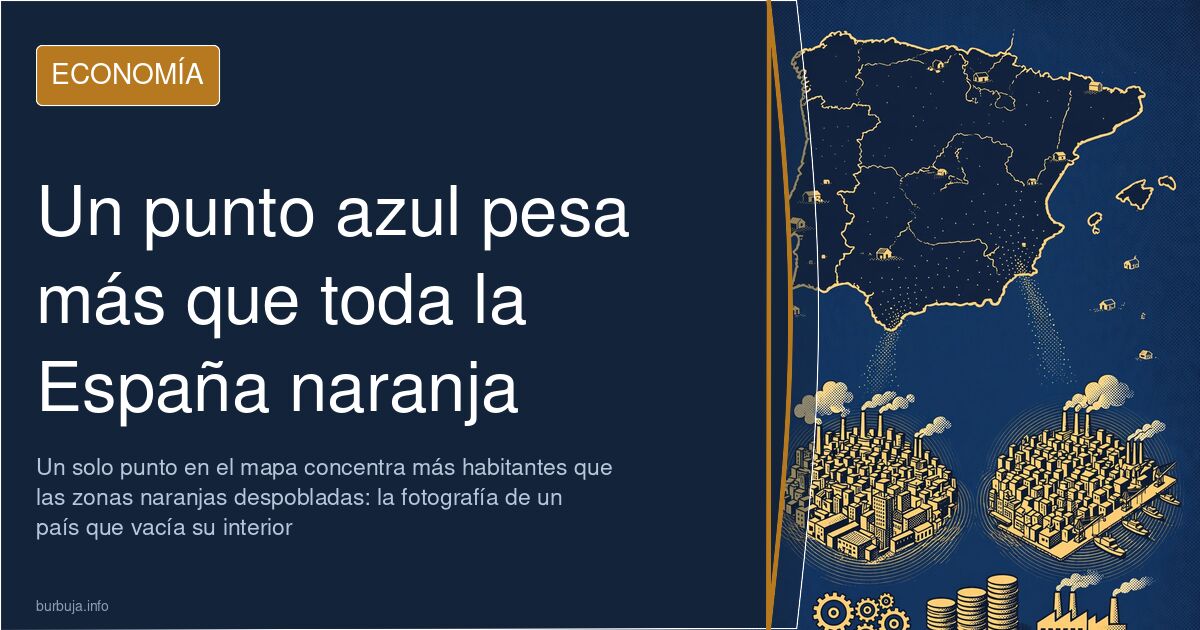
Spain has a fruta for being an empty country, and on paper, it is. Inside, however, it hides an unparalleled anomaly in Europe: 23 of the 33 points per square kilometer with over 40,000 inhabitants found across the continent are located in Spanish territory. Just over 13% of the country is inhabited. The rest, colored orange on the map, is plateau, mountain, and arid land. The contrast between that single blue point and the rest of the map is the economic portrait of a country that decided where to live.
The map explaining where Spain truly lives
The graphic that lays out the matter is simple and brutal: the blue point concentrates more population than the sum of all the orange areas. Translated: inland Spain, that which does not touch the coast or the Ebro corridor, has been left behind while the Madrid metropolitan area grows every year.
There is a geographical reading that should not be overlooked. The orange Spain is, in large part, mountain or dry plateau, poorly suited for high densities. Attempts at irrigation in the interior have been costly and inefficient. The blue Spain, conversely, accumulates employment, universities, hospitals, and airports.
The second blue point that almost no one mentions
The exercise reproduces itself when done with Barcelona. The metropolitan area of the Condal city has barely a million fewer inhabitants than Madrid's. This is not a phenomenon exclusive to the capital or its peculiarity: it is the pattern of a country that has decided that only two or three poles deserve industry and services.
And you don't have to go far to see it. Alcalá de Henares has exceeded 203,208 inhabitants according to the Institute of Statistics of the Community of Madrid, with a municipal registry reaching 208,943 and adding up more than 5,300 residents in a year.
Why isn't industry distributed across the territory
The comparison with Northern Europe is uncomfortable. In Germany and Austria, it is common to see large factories, sometimes larger than the municipality itself, located in small towns. Industry is distributed, and that sustains the population. In Spain, the opposite occurs.
The local examples cited are not always up to scrutiny. Illescas has an Airbus and Alovera factory in Guadalajara; it houses the Mahou factory. But both are stone's throw from Madrid: they are industrial periphery of the blue point, not a policy of distribution. Distributing activity would also require multiplying investment in infrastructure and services in areas that currently lack the critical mass to sustain them.
The intermediate cities sustaining the rest of the map
Outside the Madrid-Barcelona axis is a network of medium-sized cities that holds up: Murcia approaches 479,000 inhabitants; Palma de Mallorca approaches 434,000; Las Palmas de Gran Canaria approaches 380,000; Alicante approaches 366,000; and Bilbao approaches 351,000. Below them, Córdoba, Valladolid, and Vigo complete a dozen centers between 200,000 and 500,000 inhabitants.
These are the ones that sustain much of the territory and those that remain outside almost any conversation about industrial distribution or public investment.
The cost of living where everyone wants to live
The price of housing, the saturation of the metro—with messages on the platform floors to regulate entry and exit—and public services pushed to the limit are the other side of the blue point. Some argue that such a graph is drawn deliberately to justify impossible prices in the capital.
The data that breaks the catastrophist narrative is another: the Community of Madrid appears as the region with the highest life expectancy in Europe in reports citing official data. The densest and the longest-lived city coexist. No one has fully explained how.
France distributes its population among Lyon, Nantes, Strasbourg, or Bordeaux. Spain does not have an equivalent second urban level, and every year passes with less of it. Is it a geographical fatality or a political decision that no one wants to review?
There are more people in Madrid than in all of sparsely populated Spain combined
Spain has a fruta for being an empty country, and on paper, it is. Inside, however, it hides an unparalleled anomaly in Europe: 23 of the 33 points per square kilometer with over 40,000 inhabitants found across the continent are located in Spanish territory. Just over 13% of the country is inhabited. The rest, colored orange on the map, is plateau, mountain, and arid land. The contrast between that single blue point and the rest of the map is the economic portrait of a country that decided where to live.
The map explaining where Spain truly lives
The graphic that lays out the matter is simple and brutal: the blue point concentrates more population than the sum of all the orange areas. Translated: inland Spain, that which does not touch the coast or the Ebro corridor, has been left behind while the Madrid metropolitan area grows every year.
There is a geographical reading that should not be overlooked. The orange Spain is, in large part, mountain or dry plateau, poorly suited for high densities. Attempts at irrigation in the interior have been costly and inefficient. The blue Spain, conversely, accumulates employment, universities, hospitals, and airports.
The second blue point that almost no one mentions
The exercise reproduces itself when done with Barcelona. The metropolitan area of the Condal city has barely a million fewer inhabitants than Madrid's. This is not a phenomenon exclusive to the capital or its peculiarity: it is the pattern of a country that has decided that only two or three poles deserve industry and services.
And you don't have to go far to see it. Alcalá de Henares has exceeded 203,208 inhabitants according to the Institute of Statistics of the Community of Madrid, with a municipal registry reaching 208,943 and adding up more than 5,300 residents in a year.
Why isn't industry distributed across the territory
The comparison with Northern Europe is uncomfortable. In Germany and Austria, it is common to see large factories, sometimes larger than the municipality itself, located in small towns. Industry is distributed, and that sustains the population. In Spain, the opposite occurs.
The local examples cited are not always up to scrutiny. Illescas has an Airbus and Alovera factory in Guadalajara; it houses the Mahou factory. But both are stone's throw from Madrid: they are industrial periphery of the blue point, not a policy of distribution. Distributing activity would also require multiplying investment in infrastructure and services in areas that currently lack the critical mass to sustain them.
The intermediate cities sustaining the rest of the map
Outside the Madrid-Barcelona axis is a network of medium-sized cities that holds up: Murcia approaches 479,000 inhabitants; Palma de Mallorca approaches 434,000; Las Palmas de Gran Canaria approaches 380,000; Alicante approaches 366,000; and Bilbao approaches 351,000. Below them, Córdoba, Valladolid, and Vigo complete a dozen centers between 200,000 and 500,000 inhabitants.
These are the ones that sustain much of the territory and those that remain outside almost any conversation about industrial distribution or public investment.
The cost of living where everyone wants to live
The price of housing, the saturation of the metro—with messages on the platform floors to regulate entry and exit—and public services pushed to the limit are the other side of the blue point. Some argue that such a graph is drawn deliberately to justify impossible prices in the capital.
The data that breaks the catastrophist narrative is another: the Community of Madrid appears as the region with the highest life expectancy in Europe in reports citing official data. The densest and the longest-lived city coexist. No one has fully explained how.
France distributes its population among Lyon, Nantes, Strasbourg, or Bordeaux. Spain does not have an equivalent second urban level, and every year passes with less of it. Is it a geographical fatality or a political decision that no one wants to review?
Summary of a discussion on Burbuja.info - Foro de economía, actualidad y política., translated from Spanish and reviewed before publication. Read the full discussion (131 replies).
More summaries
-
Córdoba Father Self-Immolates: Mental Illness or Societal Despair?
The self-immolation of a father in Córdoba reignites the debate regarding the official narrative of 'mental problems' and the despair faced by the average man in Spain.
-
Euthanasia in Old Age: Autonomy vs. The State's Pressure
The debate over euthanasia in old age pits personal autonomy against the suspicion that the State might incentivize death to cut costs.
-
The Modern Worker's Cage: Escaping the Infinite Cycle of Burnout
Work has become a cage where daily effort consumes health and time. Discover why we push ourselves so hard and how to break the cycle.
-
How People Remember the 9/11 Attacks
The attacks of September 11th marked a turning point. Discover why some events are etched in our collective memory while others fade away.
-
Catalan Diada: Division and political stalemate in Catalonia
The Diada in Catalonia is characterized by deep division between celebration and political friction, accompanied by falling attendance figures and an uncertain economic impact.
-
Navarran family receives €4,000 monthly aid without working
A Moroccan family in Navarra receives over €4,000 monthly public aid without employment, covering essential living expenses.