
Madrid Arrest for Delivery Driver Who Killed Two Cyclists
The driver arrested for the fatal hit-and-run of two cyclists in Monserrat was an undocumented worker employed by a subcontractor.
English · Original discussion in Spanish · Published
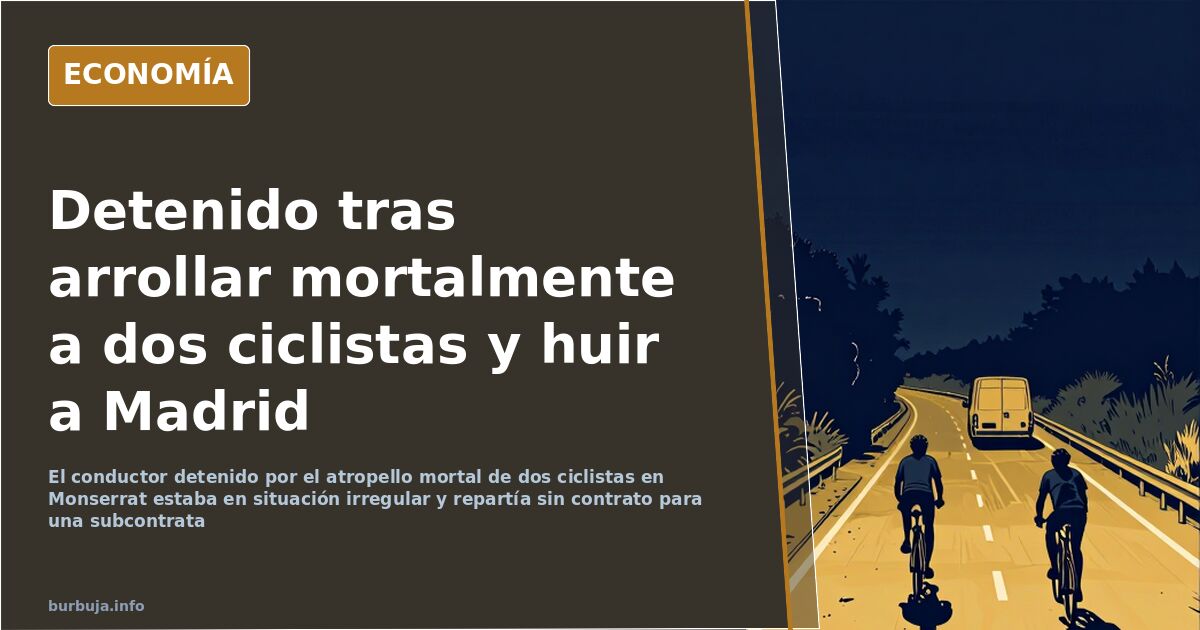
Delivery Driver Arrested in Madrid After Fatally Hitting Two Cyclists in Monserrat
The van did not stop after the impact, and the driver failed to return to his workplace. He fled to Madrid, where he was arrested: a 25-year-old man with irregular status in Spain, charged with two counts of negligent homicide and one count of leaving the scene of an accident. The two cyclists struck, aged 64 and 73 according to available data, were riding on road CV-405 in Monserrat (Valencia) when the parcel delivery van hit them at around 8:45 a.m.
What Peine on Road CV-405
A third companion riding with the victims identified the delivery company's logo painted on the van. This detail was key to identifying the vehicle and led to a driver who was not on the payroll. The incident occurred early in the morning.
None of this explains the flight. He didn't stop and didn't show up for work: two decisions, not one, pointing in the same direction. Leaving the scene is precisely one of the charges against him.
Parcel Company Manager Arrested for Cover-Up
The driver's arrest was the first chapter. The second was the arrest of the parcel company manager, accused of covering up the homicide, according to published reports. The third is the most troubling: the detainee worked without a contract within a network of transport subcontractors.
This is where the case shifts from an accident to a labor issue. The chain—main company, subcontractor, driver—also distributes responsibility. Those demanding consequences for the contracting firm argue that having someone deliver packages without registration or safeguards is not an administrative oversight: it is the model upon which margins are calculated.
Can One Work in Spain with Irregular Status?
Generally, no: authorization and a contract are required. But this case describes parcel delivery without a contract, revealing the gap. Without a payroll record, there is no Social Security registration, no contributions, and no trace to audit.
Several users describe a known mechanism in the sector: someone with residency or citizenship rents the van or route, while others deliver for a percentage per package. The figures suggest very high personnel savings compared to a compliant workforce, around 60% according to circulating estimates. That differential, not anyone's benevolence, is what perpetuates the system.
License, Insurance, and Civil Liability: What Remains Unclear
Here lies the uncomfortable question. If there was no contract, was there a validated driving license? Did the vehicle have valid insurance? Who bears civil liability for two deaths if the driver is insolvent?
Published information does not answer this. It is important not to confuse deduction with fact: the available material confirms irregular status and lack of contract, but not the rest. However, the doubt has concrete economic consequences: without insurance, or with a policy that does not cover an unauthorized driver, compensation for families becomes a list of creditors with no assets.
Criticism Also Directed at Cyclists
There is a recurring opinion after every fatal collision: a road without a shoulder is no place for a bicycle, and riding on it early in the morning assumes avoidable risk. One driver recounts it plainly: on a narrow road at about 60 km/h, he looked away for a second to read a sign and found a group of cyclists occupying half the lane ahead. He had time to swerve.
Opposing this, the argument is simpler and harder to refute: overtaking safely or waiting behind is the duty of the driver. The location does not explain the collision. The person behind the wheel does.
With these elements, the prognosis is uncomfortable. A conviction for the driver—served or suspended—is likely, and if pressure holds, sanctions for the company employing him without a contract. What rarely changes is the structure: subcontracting, no payroll, no trace. If anything moves after this case, it will not be the penalty. It will be the bill.
The van did not stop after the impact, and the driver failed to return to his workplace. He fled to Madrid, where he was arrested: a 25-year-old man with irregular status in Spain, charged with two counts of negligent homicide and one count of leaving the scene of an accident. The two cyclists struck, aged 64 and 73 according to available data, were riding on road CV-405 in Monserrat (Valencia) when the parcel delivery van hit them at around 8:45 a.m.
What Peine on Road CV-405
A third companion riding with the victims identified the delivery company's logo painted on the van. This detail was key to identifying the vehicle and led to a driver who was not on the payroll. The incident occurred early in the morning.
None of this explains the flight. He didn't stop and didn't show up for work: two decisions, not one, pointing in the same direction. Leaving the scene is precisely one of the charges against him.
Parcel Company Manager Arrested for Cover-Up
The driver's arrest was the first chapter. The second was the arrest of the parcel company manager, accused of covering up the homicide, according to published reports. The third is the most troubling: the detainee worked without a contract within a network of transport subcontractors.
This is where the case shifts from an accident to a labor issue. The chain—main company, subcontractor, driver—also distributes responsibility. Those demanding consequences for the contracting firm argue that having someone deliver packages without registration or safeguards is not an administrative oversight: it is the model upon which margins are calculated.
Can One Work in Spain with Irregular Status?
Generally, no: authorization and a contract are required. But this case describes parcel delivery without a contract, revealing the gap. Without a payroll record, there is no Social Security registration, no contributions, and no trace to audit.
Several users describe a known mechanism in the sector: someone with residency or citizenship rents the van or route, while others deliver for a percentage per package. The figures suggest very high personnel savings compared to a compliant workforce, around 60% according to circulating estimates. That differential, not anyone's benevolence, is what perpetuates the system.
License, Insurance, and Civil Liability: What Remains Unclear
Here lies the uncomfortable question. If there was no contract, was there a validated driving license? Did the vehicle have valid insurance? Who bears civil liability for two deaths if the driver is insolvent?
Published information does not answer this. It is important not to confuse deduction with fact: the available material confirms irregular status and lack of contract, but not the rest. However, the doubt has concrete economic consequences: without insurance, or with a policy that does not cover an unauthorized driver, compensation for families becomes a list of creditors with no assets.
Criticism Also Directed at Cyclists
There is a recurring opinion after every fatal collision: a road without a shoulder is no place for a bicycle, and riding on it early in the morning assumes avoidable risk. One driver recounts it plainly: on a narrow road at about 60 km/h, he looked away for a second to read a sign and found a group of cyclists occupying half the lane ahead. He had time to swerve.
Opposing this, the argument is simpler and harder to refute: overtaking safely or waiting behind is the duty of the driver. The location does not explain the collision. The person behind the wheel does.
With these elements, the prognosis is uncomfortable. A conviction for the driver—served or suspended—is likely, and if pressure holds, sanctions for the company employing him without a contract. What rarely changes is the structure: subcontracting, no payroll, no trace. If anything moves after this case, it will not be the penalty. It will be the bill.
Also available in: Deutsch
Summary of a discussion on Burbuja.info - Foro de economía, actualidad y política., translated from Spanish and reviewed before publication. Read the full discussion (196 replies).
More summaries
-
Spain's 20% demographic group grows and organizes in Valencia and Madrid
A growing 20% of Spain's population is organizing collectively. We analyze the economic context and implications of this trend in cities like Valencia and Madrid.
-
Foreign tenants: over half in Spain, 70% in three regions
More than 5.2 million tenants in Spain were born abroad. In Madrid, Valencia and Murcia the share reaches 70%. Data and analysis of...
-
Madrid records 37 injuries in August as crime rises 24.6%
Madrid closed August with 37 injured, while crime rose 24.6%. In 2022, the city recorded 27 homicides compared to Barcelona's 11.
-
Warning: Tank up before Thursday amid Saudi crude cut
Saudi Arabia cancels crude shipments to Europe, extending the warning to fill tanks before Thursday: diesel is now priced at €1.8/L.
-
Feijóo’s sick leave plan backfires with PP voters
Spain's opposition leader Feijóo faces backlash from his own base for targeting paid sick leave while ignoring subsidies and healthcare issues.
-
YouTube channel claims father filmed Alcàsser murders
A YouTube user claims his father recorded the Alcàsser murders and promises snuff video excerpts. No evidence provided, only narrative and technical analysis.