
Madrid 1987: 50-peseta sandwiches and one paycheck per household
In 1987 one salary supported a house, a car and three children; a calamari sandwich cost 50 pesetas. Comparison with today's wages doesn't add up.
English · Original discussion in Spanish · Published
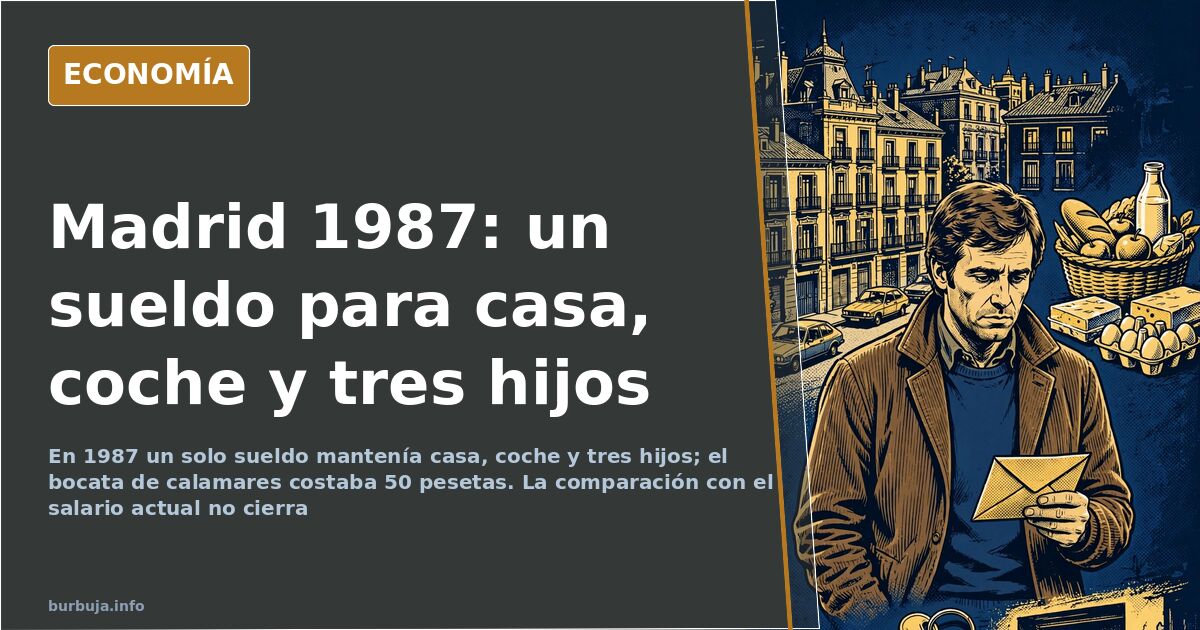
Madrid in 1987: one salary, three children and the car paid off
A man in his early thirties, three children —the youngest just born—, a paid-off house, a paid-off car and a single paycheck at home. His vvife didn't need to work. No mortgage and no loans, and he was still considering buying an apartment at the beach. That scene, as those who lived it remember it, works as a yardstick for Madrid in 1987 and has ended up, unintentionally, as a debate about the real wage in Spain.
How far one salary went in 1987 Madrid
The description doesn't come from a period novel. A thirty-something father, with three children and a stable job, kept the entire household on one salary: house paid off, car paid off and without going to the bank. The bar was high enough to consider a second home at the beach. The question running through the whole comparison is simple: what counts as normal today.
Then comes the first shock. Some place the peak of the Spanish real wage in 1983/84 and argue that since then it fell and has remained there, stagnant. It's a calculation that circulates without statistical support within the conversation itself, but it explains why nostalgia has such a hold on people who didn't experience it firsthand.
1986: PSOE absolute majority and Barranco's Madrid
An objection cuts the nostalgic story in half: in 1986 the PSOE governed with 187 seats, Juan Barranco was mayor of Madrid and Leguina presided over the Community of Madrid. That is, the year portrayed is not alien to socialism, but its first crop. The reply is that twelve months are not enough to transform a country, and that the Madrid in the image is no longer that of Tierno Galván, who had died earlier, but that of Barranco, el descamisao, whom almost no one remembers. The debate over whether that was freedom or simple inertia remains, however, exactly where it was.
Cars of 1987 Madrid: from the Seat 1500 to the Audi 100
The era's vehicle fleet works as a social X-ray. In a quick review, an Audi 100 appears as the only standout car, alongside the Mercedes W124 and the Citroën CX, an expensive car for well-to-do people. For popular transport, a Citroën 2CV van parked in front of a market. The aesthetics of those vehicles —and the clothes of those driving them— still seem more accomplished than today's, even if objectively they were archaic iron. The proof is that a Seat 1500 monofaro seen downtown gets anyone out of the bar to take a photo. And you could drive through Sol and the Palacio Real.
1987 prices: 50 pesetas for a sandwich and 100 duros for hashish
Concrete prices are the best measure of distance. A calamari sandwich in the Plaza Mayor cost 50 pesetas, according to someone who was there. A liter of beer was paid at 70 or 80 pesetas, according to whoever tries to remember the bill. Drugs, bad and scarce, were around 100 duros. Those who lived it insist that churros were churros and the sandwiches authentic, though without the salary of the time next to it, that list says little.
Renta antigua (old protected rents) and crumbling facades: the fine print
Madrid in 1987 also had leaks. Entire neighborhoods of Centro, Chamberí or Salamanca showed crumbling facades, windows from another era and renta antigua tenants paying a pittance while the building sank around them. From that come the strict municipal ordinances on facade tonalidad and materials that are applied in France and that here are conspicuously absent.
It was, moreover, a country almost without foreigners: some claim, without providing data, that by 1990 the percentage was around 1%. The bitterest testimonies recall muggings to steal a Walkman and a student strike in January 1987, when a stray bullet hit a girl. Part of the conversation lets rejection of immigration creep in as a cause of urban decay. The thread's own testimonies point to another cause: the problems of the historic center came from renta antigua and lack of investment, not from the arrival of new neighbors.
Where the comparison gets stuck
You could drink alcohol in the street, camp in the Sierra, and helmets and seatbelts were not yet mandatory. Those who champion that year read it as freedom; those who contest it reply that the bill was paid by the traffic casualty. The point where the analysis gets stuck is the same as always: whether the well-being of 1987 was a real peak of the Spanish wage or a filter of memory. Without a series measured with the same yardstick, the comparison doesn't close. And it doesn't look like it will close soon.
A man in his early thirties, three children —the youngest just born—, a paid-off house, a paid-off car and a single paycheck at home. His vvife didn't need to work. No mortgage and no loans, and he was still considering buying an apartment at the beach. That scene, as those who lived it remember it, works as a yardstick for Madrid in 1987 and has ended up, unintentionally, as a debate about the real wage in Spain.
How far one salary went in 1987 Madrid
The description doesn't come from a period novel. A thirty-something father, with three children and a stable job, kept the entire household on one salary: house paid off, car paid off and without going to the bank. The bar was high enough to consider a second home at the beach. The question running through the whole comparison is simple: what counts as normal today.
Then comes the first shock. Some place the peak of the Spanish real wage in 1983/84 and argue that since then it fell and has remained there, stagnant. It's a calculation that circulates without statistical support within the conversation itself, but it explains why nostalgia has such a hold on people who didn't experience it firsthand.
1986: PSOE absolute majority and Barranco's Madrid
An objection cuts the nostalgic story in half: in 1986 the PSOE governed with 187 seats, Juan Barranco was mayor of Madrid and Leguina presided over the Community of Madrid. That is, the year portrayed is not alien to socialism, but its first crop. The reply is that twelve months are not enough to transform a country, and that the Madrid in the image is no longer that of Tierno Galván, who had died earlier, but that of Barranco, el descamisao, whom almost no one remembers. The debate over whether that was freedom or simple inertia remains, however, exactly where it was.
Cars of 1987 Madrid: from the Seat 1500 to the Audi 100
The era's vehicle fleet works as a social X-ray. In a quick review, an Audi 100 appears as the only standout car, alongside the Mercedes W124 and the Citroën CX, an expensive car for well-to-do people. For popular transport, a Citroën 2CV van parked in front of a market. The aesthetics of those vehicles —and the clothes of those driving them— still seem more accomplished than today's, even if objectively they were archaic iron. The proof is that a Seat 1500 monofaro seen downtown gets anyone out of the bar to take a photo. And you could drive through Sol and the Palacio Real.
1987 prices: 50 pesetas for a sandwich and 100 duros for hashish
Concrete prices are the best measure of distance. A calamari sandwich in the Plaza Mayor cost 50 pesetas, according to someone who was there. A liter of beer was paid at 70 or 80 pesetas, according to whoever tries to remember the bill. Drugs, bad and scarce, were around 100 duros. Those who lived it insist that churros were churros and the sandwiches authentic, though without the salary of the time next to it, that list says little.
Renta antigua (old protected rents) and crumbling facades: the fine print
Madrid in 1987 also had leaks. Entire neighborhoods of Centro, Chamberí or Salamanca showed crumbling facades, windows from another era and renta antigua tenants paying a pittance while the building sank around them. From that come the strict municipal ordinances on facade tonalidad and materials that are applied in France and that here are conspicuously absent.
It was, moreover, a country almost without foreigners: some claim, without providing data, that by 1990 the percentage was around 1%. The bitterest testimonies recall muggings to steal a Walkman and a student strike in January 1987, when a stray bullet hit a girl. Part of the conversation lets rejection of immigration creep in as a cause of urban decay. The thread's own testimonies point to another cause: the problems of the historic center came from renta antigua and lack of investment, not from the arrival of new neighbors.
Where the comparison gets stuck
You could drink alcohol in the street, camp in the Sierra, and helmets and seatbelts were not yet mandatory. Those who champion that year read it as freedom; those who contest it reply that the bill was paid by the traffic casualty. The point where the analysis gets stuck is the same as always: whether the well-being of 1987 was a real peak of the Spanish wage or a filter of memory. Without a series measured with the same yardstick, the comparison doesn't close. And it doesn't look like it will close soon.
Summary of a discussion on Burbuja.info - Foro de economía, actualidad y política., translated from Spanish and reviewed before publication. Read the full discussion (248 replies).
More summaries
-
Euthanasia in Old Age: Autonomy vs. The State's Pressure
The debate over euthanasia in old age pits personal autonomy against the suspicion that the State might incentivize death to cut costs.
-
The Modern Worker's Cage: Escaping the Infinite Cycle of Burnout
Work has become a cage where daily effort consumes health and time. Discover why we push ourselves so hard and how to break the cycle.
-
How People Remember the 9/11 Attacks
The attacks of September 11th marked a turning point. Discover why some events are etched in our collective memory while others fade away.
-
Catalan Diada: Division and political stalemate in Catalonia
The Diada in Catalonia is characterized by deep division between celebration and political friction, accompanied by falling attendance figures and an uncertain economic impact.
-
Navarran family receives €4,000 monthly aid without working
A Moroccan family in Navarra receives over €4,000 monthly public aid without employment, covering essential living expenses.
-
Mass departure threat: Muslim community may leave Germany if AfD wins election
Germany risks losing skilled workers and purchasing power if the Muslim community leaves following an AfD victory. We analyze the economic implications.