
Madonna's selfie with her daughter exposes the price of growing older
A selfie of Madonna and her daughter sparks thousands of reactions about cosmetic procedures, the passage of time, and the demand for eternal youth
English · Original discussion in Spanish · Published
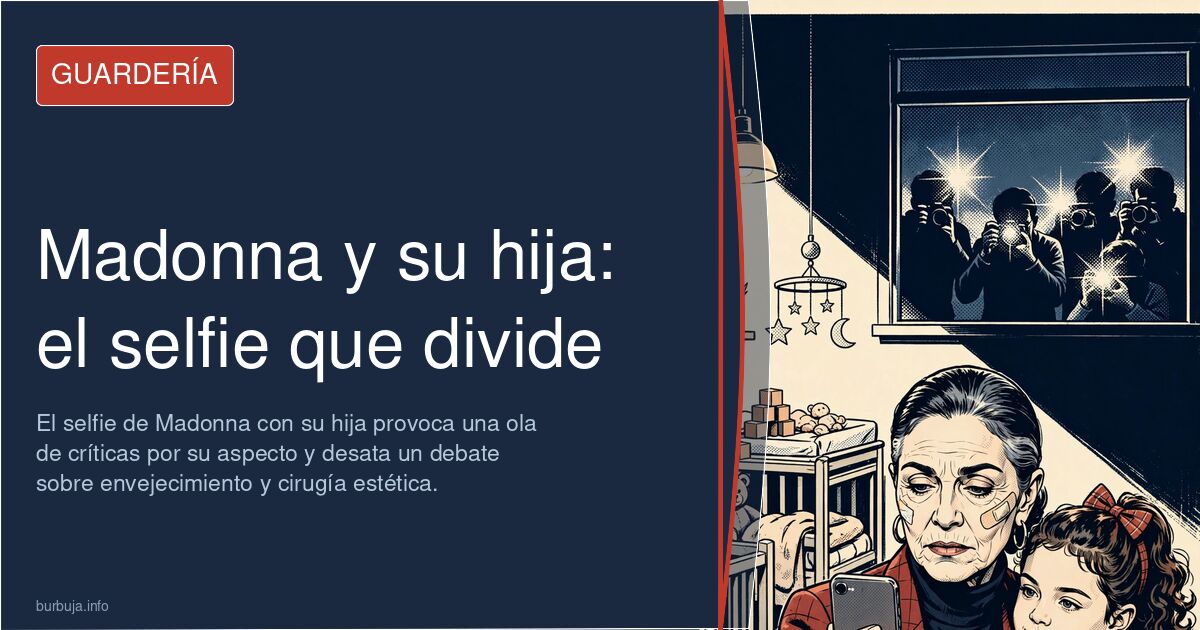
Madonna's selfie with her daughter: the passage of time as an impossible job
A selfie of Madonna with her daughter, with no news behind it, no statement, and no more context than two people smiling at the camera, is enough to unleash a flood of reactions. The photo adds nothing new to the world. What it offers is an uncomfortable mirror: an entire era's difficulty in looking at a face that has been through surgery without asking anyone's permission. The photo of Madonna and her daughter thus becomes the latest episode in a debate that keeps repeating itself.
What the photo of Madonna and her daughter shows
The image is domestic and simple: mother and daughter in close-up. From there, however, comes a full catalogue of judgments about someone else's body. The skin, the face, the arms. One of the most repeated reactions is confusion: some people look at the photo and claim they cannot recognize the woman in it, cannot tell who is who. That doubt sums up the heart of the matter better than any other comment.
Some argue the snapshot works as an involuntary statement: the price of aging in the public shop window is to stop looking like yourself. Against that stands an argument not to be dismissed lightly: they chose that shop window, and they make a living from it. Both arguments hold up at the same time. That is why the discussion moves not a single inch.
The passage of time as an aesthetic sentence
The core of the rejection is not aesthetic, it is temporal. What bothers people is not a particular face, but the proof that there is an age at which the body stops being profitable. "How sad not to accept the passage of time," sums up one of the most repeated conclusions. Another goes further and describes a transformation in which a different person is glimpsed beneath the one who was there before.
The background is old, older than the protagonist herself. Literature wrote it before social media did: there is a classic tale in which the inhabitants of a coastal town begin, over the years, to change in appearance until they no longer look human. Brought into a selfie, the comparison says less about the subject of the photo than about the one looking. And hardly anyone ever talks about the one looking.
From sens symbol to caricature of herself
In the eighties and nineties, Madonna built her career on the provocation of the body, calculated scandal, and the use of her own image as merchandise. That strategy worked for decades. Now that same material — the body as product — is being turned against her with a cruelty no one saw coming back then. The contract of being looked at included no retirement clause.
The paradox is that the public who made her a star now demands consistency from someone who never promised it. Artificiality is held against the woman who made artificiality her brand. Naturalness is demanded of the woman who turned artifice into a business. The result is a circular discussion in which everyone is right and no one is entirely right.
The daughter's body as a battlefield
Alongside the mother's face, the controversy shifted to her daughter's body. Minimal, natural details of no real significance — the presence of body hair, the shape of her arms — became fertile ground for opinions. The conversation went from judging a mature woman for not being young to judging a young woman for not shaving according to some standard. The subject changes. The nitpicking does not.
And there appears the fact that throws everything off: the harshest reaction was not against the surgery, but against its absence. The same public that punishes the scalpel punishes naturalness. The demand is contradictory by definition, and for that reason it admits no answer. No one can meet it.
The business that lives off eternal youth
Behind the selfie there is an industry. The image industry, the entertainment industry, and the industry of all the products that promise to stop what cannot be stopped. Every famous face that goes under the knife is, besides a personal decision, free advertising for a market that profits by selling exactly the opposite of the natural.
The trap is that this market needs models who age badly in order to keep selling. A celebrity who accepts her years without intervention makes no money for anyone: it makes onlookers cringe. Hence the same audience that mocks the scalpel eagerly consumes everything that promises eternal youth.
Why does a photo with no news in it generate so much conversation?
Because no news is needed. The image of an aged celebrity works as a collective reminder of something people prefer not to look at. Every selfie of this kind is a bill someone presents: the bill for the years, for the exposure, for the business built on the desire never to age.
Some even tried to extract a generational sarracena from all this, reading in the photograph a metaphor for the cultural shift of recent decades. It sounds exaggerated for two people smiling at the camera. Or maybe it is exactly what it is: an era handing back its own portrait.
And what do you do with the mirror when you don't like the reflection? The question remains, without a headline and without an answer.
Also available in: Deutsch
Summary of a discussion on Burbuja.info - Foro de economía, actualidad y política., translated from Spanish and reviewed before publication. Read the full discussion (82 replies).
More summaries
-
Macarena Olona posts topless selfie on the beach
Olona posts a topless selfie on the beach and the conversation focuses on sun damage, age and scrutiny of politicians' bodies
-
The Most Aesthetic Sports: Which Discipline Sculpts the Ideal Body?
We analyze which sports produce aesthetically pleasing bodies according to public opinion: swimming, gymnastics, or decathlon.
-
Photos of Spain's Ayuso in a swimsuit spark online frenzy
We analyze the thread about photos of Isabel Díaz Ayuso in a swimsuit that has generated debate and memes in the Guardería of Burbuja.info.
-
Why we always fall for the same type of person
The mere exposure effect explains why we're always drawn to the same features. A look at the pattern shared by Emily Perkins, Sally Hawkins and Lacey Chabert.
-
Half a bottle of whisky straight the night before work
Half a litre of whisky neat, four hours of sleep and the promise of rowing the next day: the other side of alcohol consumption that awareness campaigns never mention
-
Racial stereotypes about appearance persist in online debates
A thread on a Spanish forum sparks a debate on beauty and race filled with pseudoscientific comments and stereotypes. The silence about the very framework of the comparison speaks volumes.