
Macron calls for order after riots and admits young people's anguish
Macron calls for order after the riots and acknowledges the anguish of French youth as his prime minister speaks of a point of no return
English · Original discussion in Spanish · Published
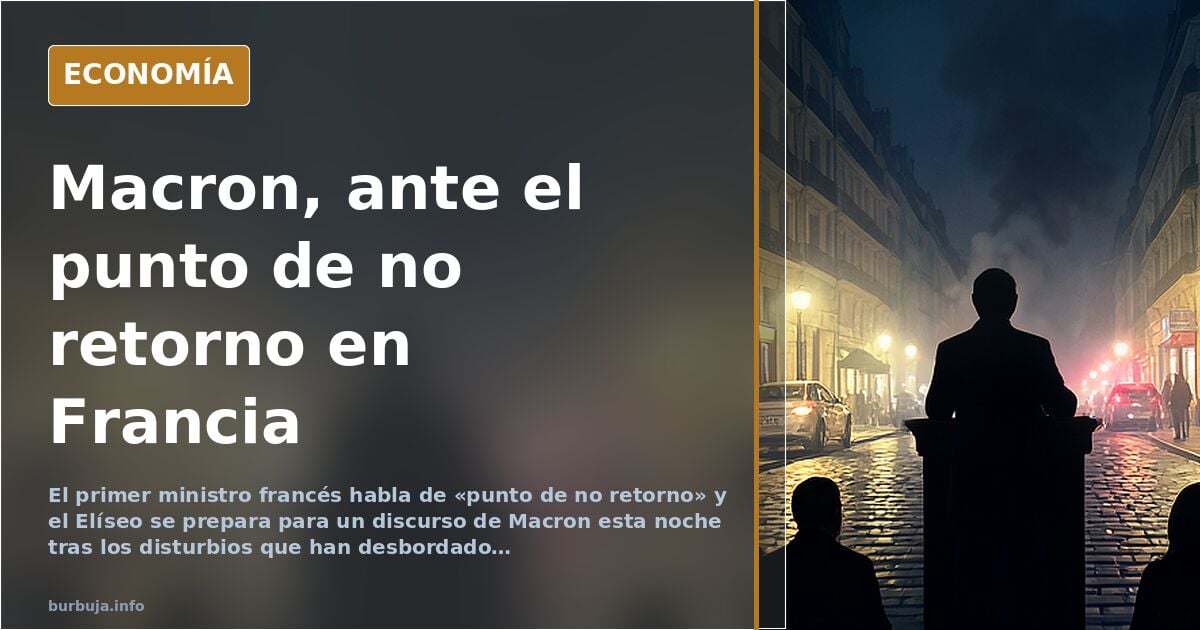
Macron promises order as France burns and his prime minister speaks of a point of no return
The French prime minister has uttered the phrase nobody wanted to hear: the point of no return has been passed. That is the backdrop to Emmanuel Macron's address to the nation after a night of riots, looting and ransacked shops, with the Élysée admitting concern and a country that, according to the narrative taking hold on the street, is slipping out of control. The president's appearance has reassured hardly anyone: he called for order and acknowledged that French youth are expressing "great anguish and concern about the future".
The sequence has something of a loop about it. First the chaos, then the solemn message, and in the background the suspicion that order is invoked to manage the crisis, not to solve it. Macron's power is at stake; the other players, on the most cynical reading, have nothing to lose. And in the middle, an economy already battered by inflation now adding the cost of the destruction.
What peine and why people talk of a point of no return
The previous night's riots left a trail of looting in luxury shops and scenes that spread across social media: an elderly couple in their eighties stripped of everything in the middle of the street, left nearly naked, according to the most widely shared image. It is no small detail for the economic debate. Every night of disorder translates into closures, lost business and risk premiums for shops in the affected areas.
The expression "point of no return" was not coined by an armchair analyst: it was put on the table by the prime minister. That changes the nature of the matter. It is no longer a question of whether there is a public order problem, but of whether the state retains the capacity to reverse it. Some claim the government created the chaos in order to then apply control measures; others see simple incompetence. Neither reading can be proven, and both circulate just as freely.
Macron's speech: a call for order and recognition of the discontent
Macron addressed the nation to demand order while also calling for attention to what young people are saying. The tone has its own political logic: if he only talks of repression, he feeds the narrative of division; if he only talks of anguish, he loses control of the security narrative. The problem is that the combination, coming from a president with his accumulated wear, sounds more like damage control than leadership.
The comparison hovering in the air is that of a speech with less practical use than a Christmas message. The uncomfortable question left hanging is: what concrete measures accompany the call for order? Without figures for police reinforcement, without a timetable and without a budget cost, the announcement remains in the realm of intention.
The army as a way out: the proposal gaining ground on the street
Part of the debate is directly calling for the army to intervene, starting with the Élysée itself. It is the classic reaction when public order is perceived as overwhelmed, and also the most delicate institutionally: in an established democracy, putting soldiers on the streets amounts to admitting the police are not enough. Some see it as the only solution, others interpret it as the planned script to later justify a state of emergency.
The argument gaining weight is a different one: deportation alone solves nothing when many of those involved are second- and third-generation, already French nationals. It is a nuance that breaks the easy solution. If the problem cannot be fixed by closing borders, the discussion shifts to far more uncomfortable territory: integration, nationality and social cohesion.
The economic cost of a crisis measured in more than broken shopfronts
Beyond the shop windows, the episode has a financial reading. France arrives at this crisis with strained public finances and an open debate on spending. Every episode of instability makes financing more expensive and complicates the narrative of a government that needs credibility with the markets. Monetary policy and inflation, already targets of criticism, become the backdrop to every appearance.
The spreading feeling is that policymakers live in an exhausted mental framework. They are credited with a management style that prioritises containing the damage over solving the problem. Meanwhile, the bill is paid by small businesses, the taxpayer and that middle class with neither a loudspeaker nor a barricade.
The comparison with Spain and the contagion effect
Gaze turns to Spain with a mixture of warning and fatalism. Some predict equivalent riots in Barcelona or Madrid within months, while others point out that the migratory phenomenon and social tension are not exclusive to France. The comparison with the Spanish case is used as a mirror: if it peine there, it can happen here.
Contagion, in any case, is not automatic. It depends on institutional factors, response capacity and the degree of deterioration of public space. What does travel fast is the narrative: the idea that European governments are on one side and citizens on the other. That framework, more than the specific riots, is what spreads.
What may happen next
The immediate scenario comes down to whether the call for order translates into measures or remains rhetoric. A police crackdown without a social plan can put out the fire one night and reignite it the next. A turn towards integration policies collides with a political calendar that leaves time for nothing.
The open question is not whether France will restore order, but at what price and with what legitimacy. Because the point of no return, if it exists, is not marked by a speech: it is marked by a state's ability to convince its own population that it is still in charge.
Also available in: Deutsch
Summary of a discussion on Burbuja.info - Foro de economía, actualidad y política., translated from Spanish and reviewed before publication. Read the full discussion (369 replies).
More summaries
-
Riots in French schools: fires and attacks
Fires in French schools, teachers attacked and blockades spreading to Belgium. The unrest is attributed to the education strike and radical groups.
-
‘Macron mobilises the Army’: the supposed announcement with no source
The supposed announcement of Macron mobilising the Army in France is circulating without a verifiable source, between hoax and conspiracy theory.
-
Ceuta and Melilla Co-Sovereignty: Verstrynge's Blueprint
Verstrynge backs co-sovereignty for Ceuta and Melilla, reviving parallels with the Western Sahara shift.
-
TVE hosts Podemos candidate dressed as a firefighter: coincidence or propaganda?
RTVE hosts a Podemos candidate dressed as a firefighter to discuss the Madrid wildfires. Journalism or propaganda? Criticism and analysis.
-
A parish's icy silence reveals why rural Spain is emptying out
A post on a Spanish parish's Facebook page sparked a chilling reaction that illustrates the economic cost of social ostracism in small villages and its role in rural depopulation.
-
The 'tradwife' economy: reality or propaganda?
Feeding 11 children on €15 a day: reality or myth? We look at the economics behind the 'tradwife' phenomenon and why the numbers just don't add up.