
Mac Mini vs Dell: Is the $60 Apple Premium Worth It?
A Mac Mini M2 costs €600 while a comparable Dell runs €540. This price and performance comparison divides Mac and PC buyers.
English · Original discussion in Spanish · Published
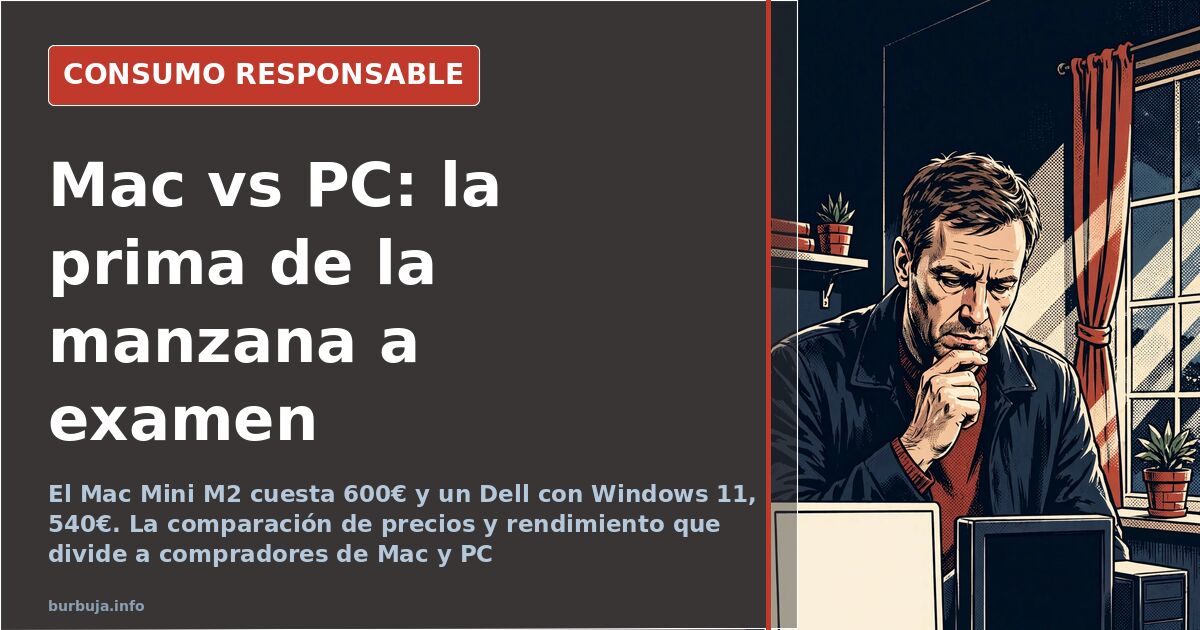
Mac or PC: Is the Apple premium justified?
Is it worth paying the premium Apple charges for its computers? Every time prices are compared, the same doubt arises. A Mac Mini with an M2 chip running macOS Ventura costs €600; a Dell Vostro with Windows 11, an Intel i3-12100 processor, 8 GB of DDR5 memory, and a 256 GB SSD sells for €540. Sixty euros separate two opposing views on home computing. From there, consensus breaks down.
The real cost of a Mac compared to a PC
Price comparisons open the debate. The mentioned Dell antiestéticatures a 12th-generation Intel chip with 4 cores and 8 threads, scoring 2034 points in single-core and 5389 in multi-core on the Geekbench 6.1 test. No score appears for the Mac Mini in the discussion, which is where the trap lies: some measure on paper, others in real-world usage on the operating system. These two things do not always match.
Reality hits hard with upgrades. Increasing memory or storage on an Apple device spikes the bill much more than on a custom-built clone. That extra cost, rather than the entry price, tips the scales for many buyers. Ironically, the base unit does play in the same price league as a basic PC.
Operating system: The deciding factor
The true battlefield is macOS versus Windows, and opinions here allow no nuance. One camp argues that Apple’s software performs better with less hardware, boots quickly, and avoids fighting pre-installed programs. Another counters that Windows dominates due to sheer inertia and that its software catalog remains far superior, especially in professional environments.
The discussion gets heated over security. Against the idea that macOS protects devices better, critics point out that recent reports attribute more vulnerabilities to Apple than to Windows. No one in the conversation closes the issue with data satisfying both sides. Nor does it help that much of the exchange ends in personal insults, which never fails to happen.
Durability as a buying argument
The most repeated argument favoring Apple is not performance, but longevity. An iMac bought for €800 has been running for 15 years, with the DVD reader being the only failure and a solid-state drive swap the only fix. Another desktop chains 13 years always on, without crashes or breakdowns, and its owner confesses they have been waiting for it to fail to justify replacing it.
The counterpoint is sharp: a 2009 iMac cannot update beyond High Sierra and becomes useless clutter when the manufacturer withdraws support. Hardware longevity does not always accompany software longevity. It is exactly the same problem plaguing any old Windows PC.
Closed ecosystem and hidden costs
This is where the defense cracks. Some argue users get trapped in an ecosystem where everything is paid separately: a charger at jewelry prices, a monitor stand, apps that are free on other systems. The figure of the Mac Mini at €600 falls short once accessories start adding up.
The usual reply is that this happens with any brand and that the real cost dilutes over the years. The complete calculation, summing upgrades and peripherals over the device's life, is exactly what each side stretches in their favor. No one shows the whole sheet.
M1 and M2 chips: The performance-per-watt shift
The architectural shift toward proprietary ARM chips has moved the ground the most. Laptops with M1 or M2 offer a performance-to-battery-life ratio that even critics admit has no rival in its range. Those coming from Intel rub their eyes at the battery life.
But when comparing high-end Macs against high-end PCs, many argue the PC wins in graphics performance and storage for the same money. Apple’s advantage concentrates in laptops and power consumption, not raw desktop power. And that distinction is usually forgotten in bar-stool debates.
In the end, the question of whether it’s worth it clashes with something no benchmark resolves: whether the buyer will use the computer to work or to justify to others that they paid for the apple. Twelve statistics later, we still don’t know how many tabs each person opens.
Is it worth paying the premium Apple charges for its computers? Every time prices are compared, the same doubt arises. A Mac Mini with an M2 chip running macOS Ventura costs €600; a Dell Vostro with Windows 11, an Intel i3-12100 processor, 8 GB of DDR5 memory, and a 256 GB SSD sells for €540. Sixty euros separate two opposing views on home computing. From there, consensus breaks down.
The real cost of a Mac compared to a PC
Price comparisons open the debate. The mentioned Dell antiestéticatures a 12th-generation Intel chip with 4 cores and 8 threads, scoring 2034 points in single-core and 5389 in multi-core on the Geekbench 6.1 test. No score appears for the Mac Mini in the discussion, which is where the trap lies: some measure on paper, others in real-world usage on the operating system. These two things do not always match.
Reality hits hard with upgrades. Increasing memory or storage on an Apple device spikes the bill much more than on a custom-built clone. That extra cost, rather than the entry price, tips the scales for many buyers. Ironically, the base unit does play in the same price league as a basic PC.
Operating system: The deciding factor
The true battlefield is macOS versus Windows, and opinions here allow no nuance. One camp argues that Apple’s software performs better with less hardware, boots quickly, and avoids fighting pre-installed programs. Another counters that Windows dominates due to sheer inertia and that its software catalog remains far superior, especially in professional environments.
The discussion gets heated over security. Against the idea that macOS protects devices better, critics point out that recent reports attribute more vulnerabilities to Apple than to Windows. No one in the conversation closes the issue with data satisfying both sides. Nor does it help that much of the exchange ends in personal insults, which never fails to happen.
Durability as a buying argument
The most repeated argument favoring Apple is not performance, but longevity. An iMac bought for €800 has been running for 15 years, with the DVD reader being the only failure and a solid-state drive swap the only fix. Another desktop chains 13 years always on, without crashes or breakdowns, and its owner confesses they have been waiting for it to fail to justify replacing it.
The counterpoint is sharp: a 2009 iMac cannot update beyond High Sierra and becomes useless clutter when the manufacturer withdraws support. Hardware longevity does not always accompany software longevity. It is exactly the same problem plaguing any old Windows PC.
Closed ecosystem and hidden costs
This is where the defense cracks. Some argue users get trapped in an ecosystem where everything is paid separately: a charger at jewelry prices, a monitor stand, apps that are free on other systems. The figure of the Mac Mini at €600 falls short once accessories start adding up.
The usual reply is that this happens with any brand and that the real cost dilutes over the years. The complete calculation, summing upgrades and peripherals over the device's life, is exactly what each side stretches in their favor. No one shows the whole sheet.
M1 and M2 chips: The performance-per-watt shift
The architectural shift toward proprietary ARM chips has moved the ground the most. Laptops with M1 or M2 offer a performance-to-battery-life ratio that even critics admit has no rival in its range. Those coming from Intel rub their eyes at the battery life.
But when comparing high-end Macs against high-end PCs, many argue the PC wins in graphics performance and storage for the same money. Apple’s advantage concentrates in laptops and power consumption, not raw desktop power. And that distinction is usually forgotten in bar-stool debates.
In the end, the question of whether it’s worth it clashes with something no benchmark resolves: whether the buyer will use the computer to work or to justify to others that they paid for the apple. Twelve statistics later, we still don’t know how many tabs each person opens.
Summary of a discussion on Burbuja.info - Foro de economía, actualidad y política., translated from Spanish and reviewed before publication. Read the full discussion (202 replies).
More summaries
-
Tablets with Pen and Keyboard: What to Buy for €300-400 Without Apple
Looking for a tablet with a pen and keyboard for €300-400? Explore Windows Surface and Lenovo IdeaPad options for office tasks, but note Procreate and Goodnotes are iPad-exclusive.
-
Windows 11 Leaked: Centered Taskbar Sparks 'Rehash' Criticism
Leaked Windows 11 images show a centered taskbar, prompting early reactions that dismiss the update as merely a Windows 10 restyle.
-
Lidl's 2.24 kWh home battery at €299 shakes up the solar market
Lidl sells a 2.24 kWh solar battery for €299. We analyse whether it is profitable for self-consumption, how much it saves and what drawbacks it has.
-
Fixing a 400,000 km BMW: €2,000 vs €10,000 used car
A 400,000 km BMW E39 faces a €2,000 repair while decent used cars rarely drop below €10,000.
-
Citroën Ami price rises 11.3% in two years to €7,790
The Citroën Ami quadricycle has seen an 11.3% price hike since launch. Financing costs add over €2,000 at an APR of 11%, challenging its affordable mobility promise.
-
Prison for Cannabis Users: A Divisive Debate in Spain
The debate on prison sentences for cannabis users pits prohibitionists against regulators, citing high incarceration costs and the failure of drug wars.