
Louvre Heist: Viral Photo of Noir Detective Sparks Debate
A photo of a detective in noir attire goes viral amid the unsolved Louvre crown jewels theft, raising questions about AI generation and investigation details.
English · Original discussion in Spanish · Published
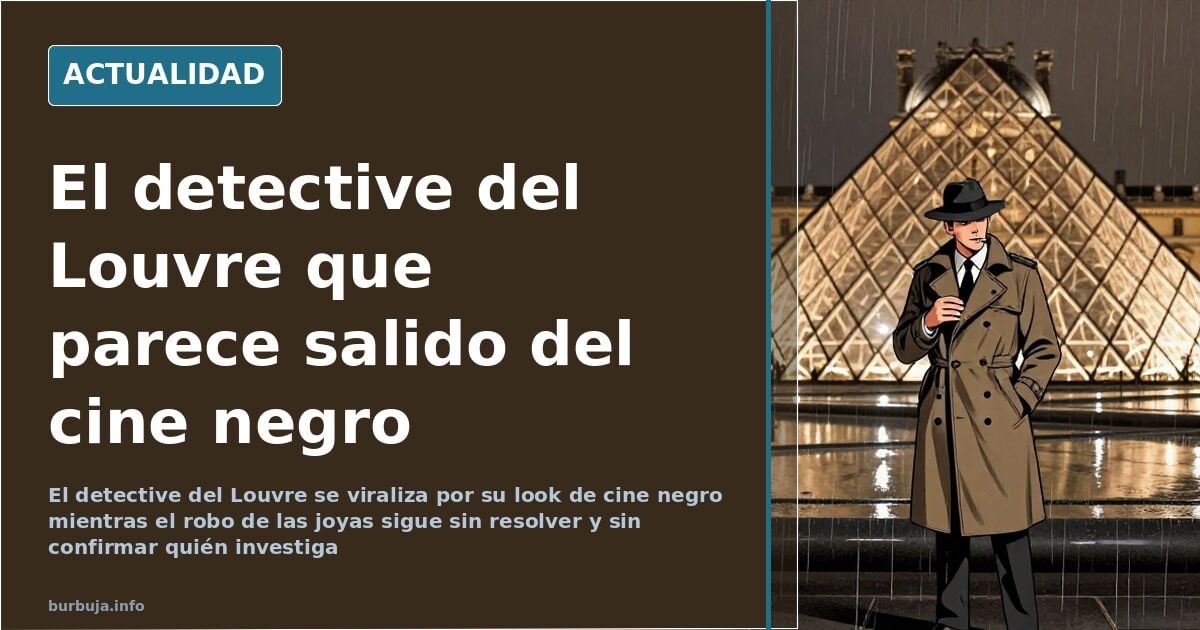
The Louvre detective who looks like he stepped out of a noir film
A man wearing a fedora, trench coat, and carrying an umbrella crosses the scene of the most talked-about theft at the Louvre. The image circulates on social media and news outlets, but the majority reaction isn't about the case: it's about the outfit. The issue is that the photograph went viral as if it were the lead investigator in the crown jewels theft, yet there is no confirmation that this individual is handling the case. What exists is a debate on aesthetics, plausibility, and whether the image is real or AI-generated.
What is known about the theft and the detective photo
The starting point are two tweets. One attributes a 1940s noir vibe to the detective; the other ironically suggests the man in the fedora is a real French police officer investigating the Louvre crown jewels theft. From there, the narrative spirals out of control. Some argue that the original news report does not state this person is the investigator. Others directly claim the image was recreated with artificial intelligence. The consequence is typical: an aesthetic scene becomes news before anyone confirms the basic facts.
The detective's look: from Clouseau to The Untouchables
The fedora and trench coat have triggered every possible comparison. Some see Inspector Clouseau; others, the villain from The Untouchables whom Kevin Costner throws off a balcony. Some also link him to Alain Delon. A recurring irony is that if the detective were British, the character would be complete. Another current defends the obvious: he is well-dressed, which is already news in a world where sweatpants are the official uniform. The underlying complaint isn't about the suit, but the contrast: if you don't dress like a reggaeton star or a teenager, you seem ridiculous.
Is the image real or AI-generated?
Doubts about authenticity run through the entire conversation. It is suggested that the man in the hat could be real, but the overall composition seems recreated. The suspicion is significant: if the photo is a montage, the entire story rests on a set piece. In parallel, the classic warning appears: we shouldn't believe everything published on social media. The mix of skepticism and aesthetic fascination fuels the discussion.
The advertising stunt theory
One of the most repeated hypotheses is that the whole episode is a publicity operation. The idea: attract tourists to the Louvre, give the museum a movie aura, and divert attention from more sensitive issues. There is no proof of this, and it should be said. But the suspicion fits a known pattern: when an event becomes an aesthetic, the aesthetic becomes a product. The theft takes a back seat, and the hat steals the show.
Peter Falk, Peter Sellers, and the detective who never existed
The cinephile homage is widespread. People call for the originals: Peter Sellers, Peter Falk, the real detectives. Nostalgia works as an argument: when men dressed like that, the world was different. The phrase is repeated with conviction and without nuance. Some also assert that reality exceeds fiction and they don't want to imagine what goes through the protagonist's head. The Louvre detective has become a character before solving anything.
Context: an unsolved theft and a diverted conversation
While the aesthetic debate pogre, the central fact remains open: the theft of the crown jewels at the Louvre. There are no confirmed arrests in the material, no resolution, and no official confirmation of who is investigating. The only verifiable thing is that the image circulates, is attributed to a French police officer, and nobody has proven he is responsible for the case. The conversation has drifted toward props. That is cinema: the plot matters less than the shot.
With these elements, it is predictable that the image will continue to circulate and that the theft will be solved —or not— through other channels. If an official confirmation appears, the character will deflate. If it doesn't, the fedora will remain the true protagonist of the case.
A man wearing a fedora, trench coat, and carrying an umbrella crosses the scene of the most talked-about theft at the Louvre. The image circulates on social media and news outlets, but the majority reaction isn't about the case: it's about the outfit. The issue is that the photograph went viral as if it were the lead investigator in the crown jewels theft, yet there is no confirmation that this individual is handling the case. What exists is a debate on aesthetics, plausibility, and whether the image is real or AI-generated.
What is known about the theft and the detective photo
The starting point are two tweets. One attributes a 1940s noir vibe to the detective; the other ironically suggests the man in the fedora is a real French police officer investigating the Louvre crown jewels theft. From there, the narrative spirals out of control. Some argue that the original news report does not state this person is the investigator. Others directly claim the image was recreated with artificial intelligence. The consequence is typical: an aesthetic scene becomes news before anyone confirms the basic facts.
The detective's look: from Clouseau to The Untouchables
The fedora and trench coat have triggered every possible comparison. Some see Inspector Clouseau; others, the villain from The Untouchables whom Kevin Costner throws off a balcony. Some also link him to Alain Delon. A recurring irony is that if the detective were British, the character would be complete. Another current defends the obvious: he is well-dressed, which is already news in a world where sweatpants are the official uniform. The underlying complaint isn't about the suit, but the contrast: if you don't dress like a reggaeton star or a teenager, you seem ridiculous.
Is the image real or AI-generated?
Doubts about authenticity run through the entire conversation. It is suggested that the man in the hat could be real, but the overall composition seems recreated. The suspicion is significant: if the photo is a montage, the entire story rests on a set piece. In parallel, the classic warning appears: we shouldn't believe everything published on social media. The mix of skepticism and aesthetic fascination fuels the discussion.
The advertising stunt theory
One of the most repeated hypotheses is that the whole episode is a publicity operation. The idea: attract tourists to the Louvre, give the museum a movie aura, and divert attention from more sensitive issues. There is no proof of this, and it should be said. But the suspicion fits a known pattern: when an event becomes an aesthetic, the aesthetic becomes a product. The theft takes a back seat, and the hat steals the show.
Peter Falk, Peter Sellers, and the detective who never existed
The cinephile homage is widespread. People call for the originals: Peter Sellers, Peter Falk, the real detectives. Nostalgia works as an argument: when men dressed like that, the world was different. The phrase is repeated with conviction and without nuance. Some also assert that reality exceeds fiction and they don't want to imagine what goes through the protagonist's head. The Louvre detective has become a character before solving anything.
Context: an unsolved theft and a diverted conversation
While the aesthetic debate pogre, the central fact remains open: the theft of the crown jewels at the Louvre. There are no confirmed arrests in the material, no resolution, and no official confirmation of who is investigating. The only verifiable thing is that the image circulates, is attributed to a French police officer, and nobody has proven he is responsible for the case. The conversation has drifted toward props. That is cinema: the plot matters less than the shot.
With these elements, it is predictable that the image will continue to circulate and that the theft will be solved —or not— through other channels. If an official confirmation appears, the character will deflate. If it doesn't, the fedora will remain the true protagonist of the case.
Also available in: Deutsch
Summary of a discussion on Burbuja.info - Foro de economía, actualidad y política., translated from Spanish and reviewed before publication. Read the full discussion (138 replies).
More summaries
-
Hondarribia officer who shot man claimed 'serious risk'
A Hondarribia local police officer fired at least three times and said his Ertzaintza colleague was in 'serious risk'. His gun has been seized.
-
Lanbide publishes 41,400 notices to track down RGI recipients
Lanbide has published 41,400 notices in the BOPV after failing to locate RGI recipients. Only 1.13% come to collect the letter. The control system, in...
-
Non-Hierarchical Polyamory Video Exposes Power Imbalance
A viral video on non-hierarchical polyamory reveals asymmetry: she has multiple partners, he one. Debate on consent and power.
-
Spanish streamer Ibai Llanos loses 52 kg in one year
Ibai Llanos drops below 100 kg a year after starting his fitness journey: 52 kg lost, 3,650 km walked, and 240 strength sessions.
-
Spanish School Allows Vegan Lunchbox for Five-Year-Old
A five-year-old in Mallorca secured a vegan lunch option after his school refused to serve meat-free meals.
-
British Couple Claims €70,000 Theft in Bilbao Car
A British couple reports a €70,000 theft from their car in Bilbao. Their account contains inconsistencies that raise doubts.