
López blames communication for youth vote; forum cites housing and wages
Patxi López attributes the left's disconnect with young voters to poor communication. The debate shifts focus to housing costs, low wages, and inheritance as the real causes.
English · Original discussion in Spanish · Published
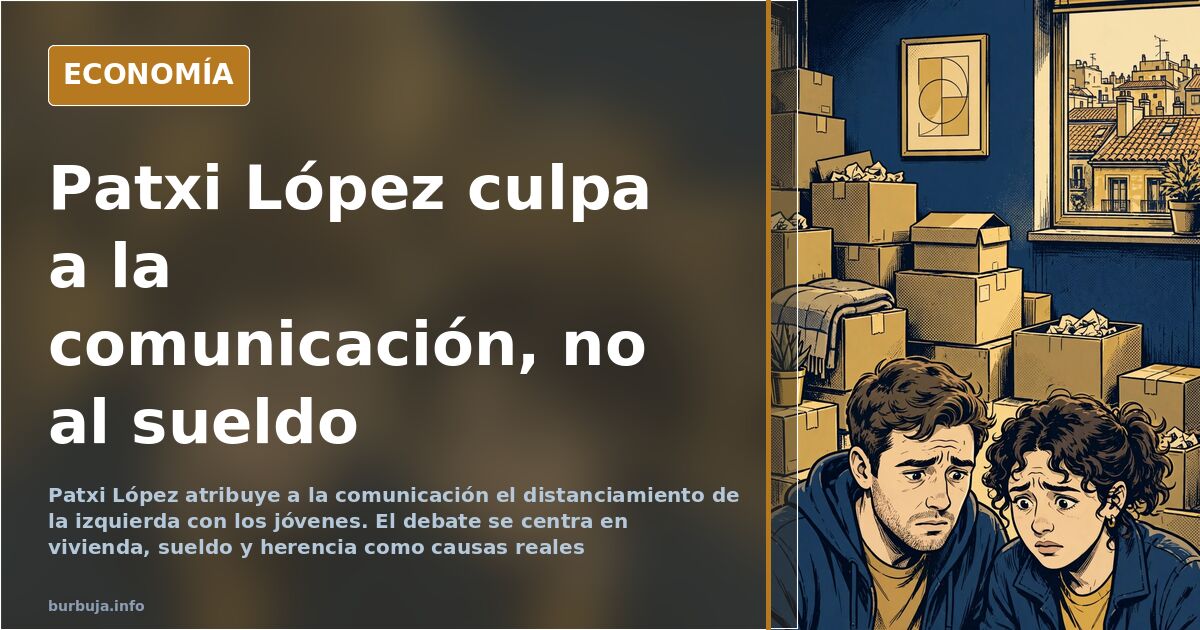
López blames communication for youth vote; forum cites housing and wages
Patxi López admits the left's failure with young people: "We are failing in communication." This statement, reported by El HuffPost, sparked a debate that quickly shifted from messaging to economic grievances. The prevailing diagnosis is different: no narrative can hide the fact that a twenty-year-old will likely never afford a home, according to one of the most repeated comments. Housing, wages, and inheritance have replaced the message.
What Patxi López said and why it became the trigger
The starting point was a brief declaration: the Socialist leader acknowledged that the left does not connect with young people, attributing this to a communication failure. The majority reaction rejects this interpretation. Arguments state that the problem is not the packaging but the content: a generation watching their parents and grandparents access jobs and homes at a young age, while they aspire only to a rental room that consumes nearly their entire salary.
A formulation summarizes the mood, appearing in various forms throughout the conversation: if young people prefer what has been presented as the worst possible past, what concept do they have of the present managed by them? The repeated conclusion is that the failure lies not in the message but in the economic policy supporting it.
Why do young people vote the way they do?
The most repeated explanation is material, not cultural. A twenty-year-old will not be able to buy an apartment in their lifetime, summarizes one of the most cited messages. From there, grievances unfold: taxes taking more than half of a meager salary, rents absorbing the rest, and a feeling that public policies are designed to make escaping poverty impossible.
Two other theses coexist with this view. One argues that youth is naturally rebellious and that today, rebellion means voting right-wing. Another points to saturation effects: fifteen years of identity politics and institutional feminism would have displaced the economic axis, leaving the left without arguments to address true concerns. In any case, the result is the same: communication cannot fix a message that fails to land.
The calculation nobody makes public
Comparisons between eras mixing taxes, housing access, and savings capacity circulate in the discussion. Some claim that during late Francoism, indirect taxes were lower and bank money was accessible without current restrictions. These assertions lack statistical verification in the material but serve as an emotional framework: nostalgia is not for the regime, but for purchasing power.
The fine detail—breaking down exactly how much the State keeps versus what reaches the young person's pocket—is what gives meaning to the entire discussion. Without this breakdown, any promise of improvement sounds like propaganda.
The PSOE response and the limits of the narrative
The acknowledgment of communication failure is read internally: a party that built its advantage on propaganda and agitation admits these tactics no longer work. The irony running through the debate is that those who best sold their discourse for decades now attribute to marketing what is actually a management problem.
The uncomfortable conclusion for the Government is clear: as long as housing access remains the bottleneck for an entire generation, no slogan will compete with the end-of-month paycheck. The analysis stalls exactly there, at the point where communication stops being the problem and starts being the alibi.
Also available in: Deutsch
Summary of a discussion on Burbuja.info - Foro de economía, actualidad y política., translated from Spanish and reviewed before publication. Read the full discussion (168 replies).
More summaries
-
Patxi López asks why Spain's PSOE is hated: the answer lies in its policies
Over 100 new taxes, soaring housing costs and controversial regional governance: the key drivers of the discontent that exasperates Patxi López.
-
Spain's PSOE sues Vox leader Abascal for hate speech
The Spanish Socialist Workers' Party (PSOE) has filed a complaint with the Prosecutor's Office against Santiago Abascal and Vox for alleged hate crimes.
-
PSOE knew of Ábalos scandal years ago, López implies
Patxi López admits the party sought accountability for years, implying prior knowledge of the Koldo García case.
-
Spain's housing problem needs more supply and legal certainty, not a frozen market
A viral post sets out five proposals for housing in Spain based on increasing supply and giving landlords legal certainty. We explain what each idea would involve.
-
ETA was more anti-capitalist than anti-Spanish, just as Francoism turned capitalist
ETA was founded in 1959, the same year as the Stabilization Plan that opened Spain's economy to international capitalism. Its Marxism came later.
-
Benito Lopera slams Javier Milei over his economic policies
Benito Lopera has attacked Javier Milei on social media over his economic management. We look at what he said and why his message has caused such a stir.