
Loneliness Hits Young Adults Harder Than Seniors
Gallup and Meta report 27% of young adults feel lonely, surpassing the 17% of seniors. AI threatens to worsen isolation.
English · Original discussion in Spanish · Published
Unwanted Loneliness Strikes Young Adults, Not Retirees
The group reporting the most loneliness globally isn't the elderly living alone. It's young people aged 19 to 29. A survey by Gallup and Meta across 142 countries between June 2022 and February 2023 confirmed this: 27% of the youngest cohort reported feeling lonely, compared to 17% of those over 65. This single statistic challenges a common assumption.
Feeling Alone vs. Being Alone
The confusion between these two concepts is at the heart of the misunderstanding. A retiree might live alone, maintain a routine, interact with neighbors, and have family nearby; a young person might be surrounded by people daily but lack anyone to confide in about serious matters. What surveys measure is not the physical absence of others, but unwanted loneliness, the kind that creeps in uninvited.
And this loneliness has a cost. It worsens health, one diagnosis suggests; it damages the mind of those who suffer it, adds another. Those who have experienced it firsthand describe it plainly: years of conversations that bring no satisfaction, as friends move on to their own lives—partners, children, careers—and the weekly meetup dwindles to a game of paddle tennis and a quick drink. In a forum where many boast about going months without speaking to anyone, admitting otherwise marks one as different.
Family, Friends, and Community Are Fraying
One perspective attributes the problem's origin to the breakdown of traditional ties. Previously, there were family, friends, and a community with shared values; today, this argument goes, each of these supports has weakened. Some analyses even point to a shift in educational and cultural models, where conformity is no longer prized over showcasing individuality.
Another interpretation shifts the focus to economics. Investing in relationships that eventually break seems unrewarding: growing up as an only child with absent parents and no siblings creates adults who never saw a family model worth replicating. Loneliness ceases to be an accident and becomes an inheritance.
Phones First, AI Later
The major accelerator cited most frequently is screens. Not technology itself, they clarify, but its use: in gyms and on terraces, some spend half an hour on a machine staring at their phone instead of talking to the person next to them. The issue isn't how you use things, but the importance you give them. And the most definitive verdict is blunt: the phone has destroyed society.
What comes next is truly frightening. If we are already isolated, AI promises to multiply disconnection across generations: adults lose their role as transmitters and can teach almost nothing to their children and grandchildren, while conversations with a machine replace those not had with anyone. Some already compare it to a new religion: you remain alone like a mole at noon, except now something responds.
Do We Need a Ministry of Loneliness?
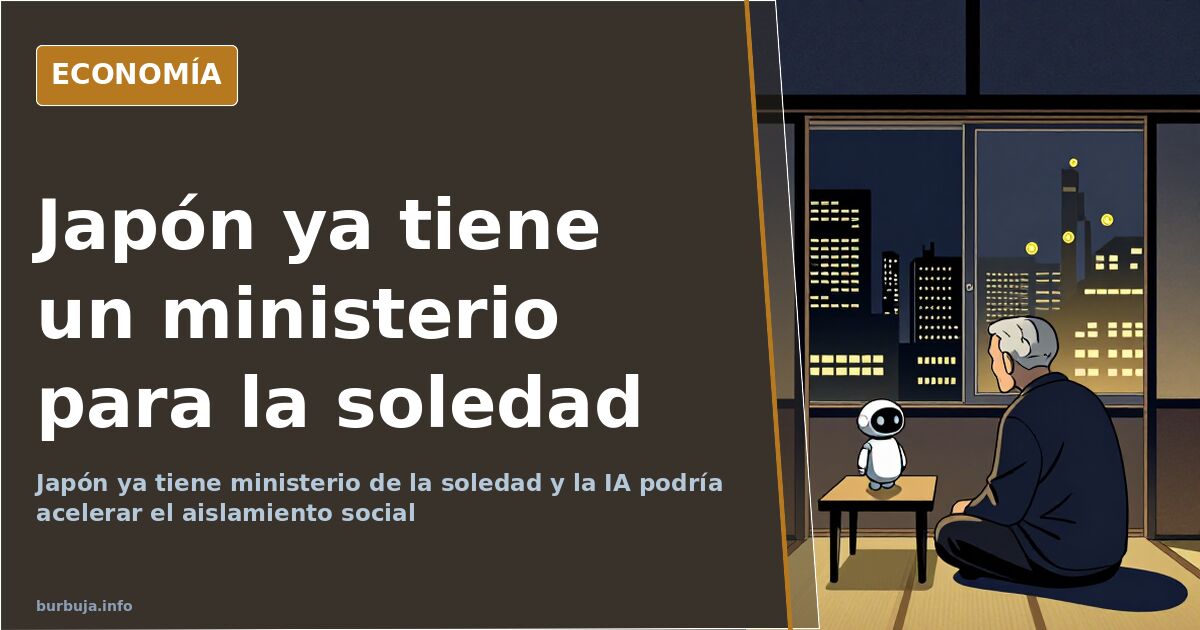
This isn't just idle chatter. Japan already has a dedicated ministry to combat unwanted loneliness, and the idea of replicating it here is circulating, with citizen platforms like soledades.es in focus. The fundamental question divides opinion: is it combated with public policy, or is it a problem no ministry can solve?
Because opposed to this is the uncomfortable thesis that loneliness is not an epidemic, but a privilege. Those who cannot stand being with themselves—the argument goes—have a personal problem, not a social one; the wealthy move to mansions with neighbors as far away as possible. Between these two poles, the only figure no one disputes remains that 27% of young adults who report feeling lonely. And the lingering question has no easy answer: if youth already feel lonely in their twenties, what awaits them at sixty?
The group reporting the most loneliness globally isn't the elderly living alone. It's young people aged 19 to 29. A survey by Gallup and Meta across 142 countries between June 2022 and February 2023 confirmed this: 27% of the youngest cohort reported feeling lonely, compared to 17% of those over 65. This single statistic challenges a common assumption.
Feeling Alone vs. Being Alone
The confusion between these two concepts is at the heart of the misunderstanding. A retiree might live alone, maintain a routine, interact with neighbors, and have family nearby; a young person might be surrounded by people daily but lack anyone to confide in about serious matters. What surveys measure is not the physical absence of others, but unwanted loneliness, the kind that creeps in uninvited.
And this loneliness has a cost. It worsens health, one diagnosis suggests; it damages the mind of those who suffer it, adds another. Those who have experienced it firsthand describe it plainly: years of conversations that bring no satisfaction, as friends move on to their own lives—partners, children, careers—and the weekly meetup dwindles to a game of paddle tennis and a quick drink. In a forum where many boast about going months without speaking to anyone, admitting otherwise marks one as different.
Family, Friends, and Community Are Fraying
One perspective attributes the problem's origin to the breakdown of traditional ties. Previously, there were family, friends, and a community with shared values; today, this argument goes, each of these supports has weakened. Some analyses even point to a shift in educational and cultural models, where conformity is no longer prized over showcasing individuality.
Another interpretation shifts the focus to economics. Investing in relationships that eventually break seems unrewarding: growing up as an only child with absent parents and no siblings creates adults who never saw a family model worth replicating. Loneliness ceases to be an accident and becomes an inheritance.
Phones First, AI Later
The major accelerator cited most frequently is screens. Not technology itself, they clarify, but its use: in gyms and on terraces, some spend half an hour on a machine staring at their phone instead of talking to the person next to them. The issue isn't how you use things, but the importance you give them. And the most definitive verdict is blunt: the phone has destroyed society.
What comes next is truly frightening. If we are already isolated, AI promises to multiply disconnection across generations: adults lose their role as transmitters and can teach almost nothing to their children and grandchildren, while conversations with a machine replace those not had with anyone. Some already compare it to a new religion: you remain alone like a mole at noon, except now something responds.
Do We Need a Ministry of Loneliness?
This isn't just idle chatter. Japan already has a dedicated ministry to combat unwanted loneliness, and the idea of replicating it here is circulating, with citizen platforms like soledades.es in focus. The fundamental question divides opinion: is it combated with public policy, or is it a problem no ministry can solve?
Because opposed to this is the uncomfortable thesis that loneliness is not an epidemic, but a privilege. Those who cannot stand being with themselves—the argument goes—have a personal problem, not a social one; the wealthy move to mansions with neighbors as far away as possible. Between these two poles, the only figure no one disputes remains that 27% of young adults who report feeling lonely. And the lingering question has no easy answer: if youth already feel lonely in their twenties, what awaits them at sixty?
Summary of a discussion on Burbuja.info - Foro de economía, actualidad y política., translated from Spanish and reviewed before publication. Read the full discussion (231 replies).
More summaries
-
Hard Work No Longer Buys a Home: The Social Elevator Has Stopped
A degree no longer guarantees a good job, inheriting a flat pays more than working, and the social contract is broken, according to debate participants.
-
Ketty Garat Claims She Is Close to Pegasus Content
A former second-in-command of Moroccan intelligence allegedly infected Sánchez's mobile and is willing to provide the content. Journalist Ketty Garat confirms...
-
Euthanasia in Old Age: Autonomy vs. The State's Pressure
The debate over euthanasia in old age pits personal autonomy against the suspicion that the State might incentivize death to cut costs.
-
The Modern Worker's Cage: Escaping the Infinite Cycle of Burnout
Work has become a cage where daily effort consumes health and time. Discover why we push ourselves so hard and how to break the cycle.
-
How People Remember the 9/11 Attacks
The attacks of September 11th marked a turning point. Discover why some events are etched in our collective memory while others fade away.
-
Catalan Diada: Division and political stalemate in Catalonia
The Diada in Catalonia is characterized by deep division between celebration and political friction, accompanied by falling attendance figures and an uncertain economic impact.