
Living on 600 Euros a Month: Why the Math Fails Without a Paid-Off Home
With a paid-off home, 604 euros of Spain's IMV may suffice, but experts warn that unexpected costs make this frugal margin an illusion for many.
English · Original discussion in Spanish · Published
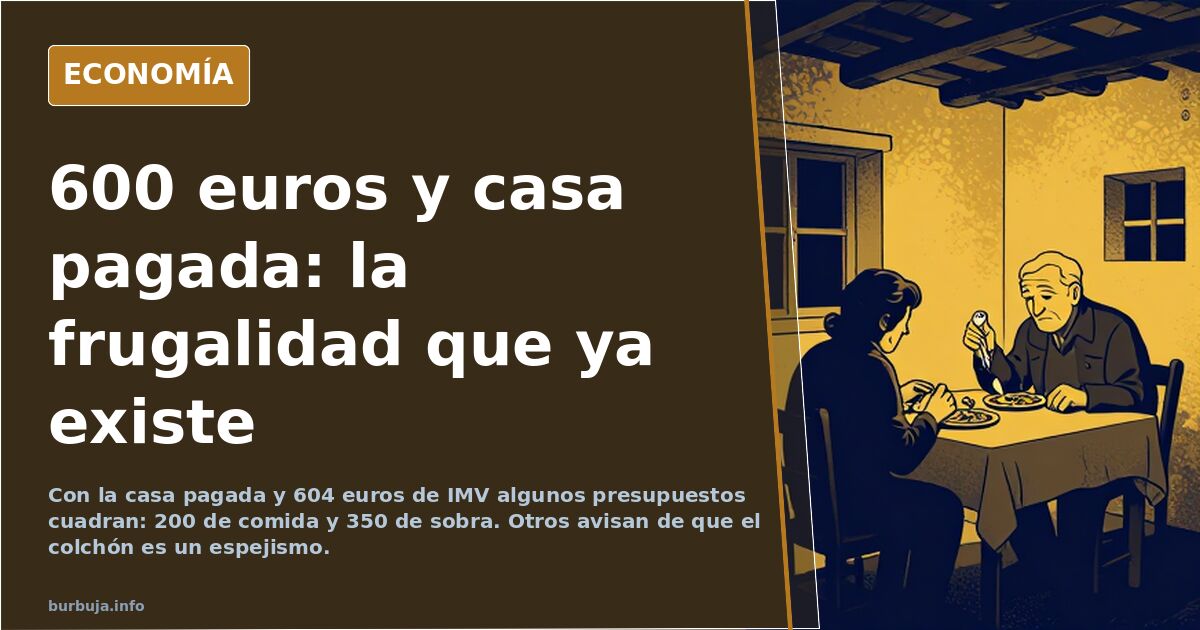
Living on 600 Euros a Month with a Paid-Off Home: The Frugality Already Practiced
A resident of a village in Castile and León earns that amount or less and claims to save. No magic is involved: he receives firewood for free from the town hall, maintains a vegetable garden, slaughters his own pig, and milks two goats that graze on public land. His leisure consists of gardening in summer, gathering firewood in winter, and daily coffee with locals. Living on 600 euros a month with a paid-off home is not a laboratory hypothesis: some people actually do it. The question is at what price and with what margin.
The figure has an official name in Spain: 604 euros. This is the amount of the Minimum Vital Income (IMV) for a single person, and upon it, a manual of domestic survival has been constructed, broken down item by item.
The budgets that add up: food, social vouchers, and 350 euros left over
The most optimistic budgets are not improvised. A detailed calculation sums 200 euros for food, 10 for electricity with a social voucher, 5 for water, 21 for transport passes, and 15 for social rates for internet and mobile. Total: 251. With the 604 from the IMV, there remain 350 for luxuries. "With a paid-off home, you are free," summarizes those who propose it, pointing to housing as the true shackle: that is where people get trapped.
The same applies to Catalonia's Guaranteed Income (Renda Garantida), 770 euros per month. Another breakdown sums 20 for social vouchers, 250 for food, 30 for car insurance, 25 for home insurance, 30 for property tax (IBI) and trash, 30 for vehicle inspection and maintenance, and 100 for gasoline. Total: 485. There are 285 left over. A third budget adds 100 for emergency savings, 50 for clothing, 50 for transport, and 10 for the dentist. No luxuries, no hunger, but without a safety net.
Why do 600 euros stop adding up as soon as an emergency arises?
Here begins the sustancia ilegal. The property tax (IBI) for a home can be around 300 euros a year, building insurance 200, and boiler maintenance exceeds 1,000. A broken boiler costs 1,300 euros in a lump sum. Clothing, footwear, community fees, cleaning, private dentistry —a cleaning, 300 euros— and family weddings swell a column that never appears in folio budgets.
Some argue that the old photo no longer applies. A weekly grocery shop of 50 or 60 euros for one person allowed living on 600, with the heart in a fist and no bad habits. Now it would require double, nearly 1,000, to do exactly the same. And a car that drives 8,000 kilometers a year consumes tires, brake pads, batteries, timing belts, and circulation tax, even if it barely leaves the garage.
Paid-off home: the line separating frugality from suffocation
It is not the same to live on the IMV in Madrid as in a village of the hollowed-out Spain (España vaciada). With a mortgage or rent, 600 euros do not even get you started; without them, a pension of 1,000 to 1,100 euros supports three people. A retiree with 500 euros in pension and rural life spent less than 100 per month: he cultivated, had chickens and pigs, and bought little, except fish, oil, and churros on Sunday markets. The key is not eating. It is everything else.
The cost not shown on the statement: time and mind
Much of the disagreement is not about figures, but about the life behind them. Some call it hermit life without the habit, while others remember that cheap pleasures —reading, walking, gardening, calisthenics, chess— require patience and self-knowledge, not a wallet. The most repeated quote in this field attributes to Pepe Mújica an uncomfortable idea: what you buy is not paid with money, but with the time you dedicated to earning it. And time, remember, is spent.
Aid, vouchers, and rules that may change overnight
The framework —electricity social voucher, water voucher, social internet rate, public dentistry for those at risk of exclusion— depends on regulations remaining as they are. A municipal social dentistry service in Barcelona accumulated more than 24,000 visits and attended to about 3,000 people in four locations between 2018 and 2021, including fillings, prosthetics, and root canals. Outside these vulnerability windows, dental care is paid separately.
The underlying risk is regulatory: a reform could turn aid into a non-contributory pension upon retirement, tighten requirements, or link payments to not owning real estate. Those who accept depending on a third party are subject to its will. And the plan collapses without warning.
The macroeconomic picture is disconcerting. Nearly half the world's population lives on less than 5.50 dollars a day, about 165 dollars, or around 150 euros a month, according to World Bank data cited regarding this issue. That 600 euros with a paid-off home is debated in Spain as a first-world problem says much about the starting point. And much about what is truly being discussed: not how much it costs to live, but how much it is worth spending life earning it.
Also available in: Deutsch
Summary of a discussion on Burbuja.info - Foro de economía, actualidad y política., translated from Spanish and reviewed before publication. Read the full discussion (254 replies).
More summaries
-
Spanish 50-year-old in the Philippines: €400 a month and a twenty-something girlfriend
A 50-year-old diabetic Spaniard moves to the Philippines: he lives on €400 a month, is looking for land, and already has a twenty-something girlfriend. The story that divides opinion.
-
Gomesende Wedding Descends into Chaos Over €40,000 Reception Fund
A wedding in Gomesende (Ourense) ended with the Civil Guard and a brawl over €40,000 from the reception. The groom denies claims of a marriage of convenience...
-
Chaos in Portsmouth as protesters block buses carrying migrants
Protesters in Portsmouth have blocked buses transporting migrants, causing traffic chaos and clashes with police. Officers are negotiating with protest leaders.
-
Social worker's behaviour with migrants sparks online controversy
Why is the work of social workers with migrants being questioned? A gesture captured in a photo is fueling debate.
-
Police and military actively collaborate with the invader. Modern Witizans.
The economic debate over migrants, their impact on jobs and public services. We look at the data.
-
South Africans gather to hunt undocumented migrants
Unrest in South Africa against undocumented migrants. Social tensions are hitting the country's economy. Understand the context.