
Living in a campsite costs 30 euros a day and gets you no registered address
A campsite pitch costs 30 euros a day, with no municipal registration or doctor, and seasonal sites evict residents once the cold weather arrives
English · Original discussion in Spanish · Published
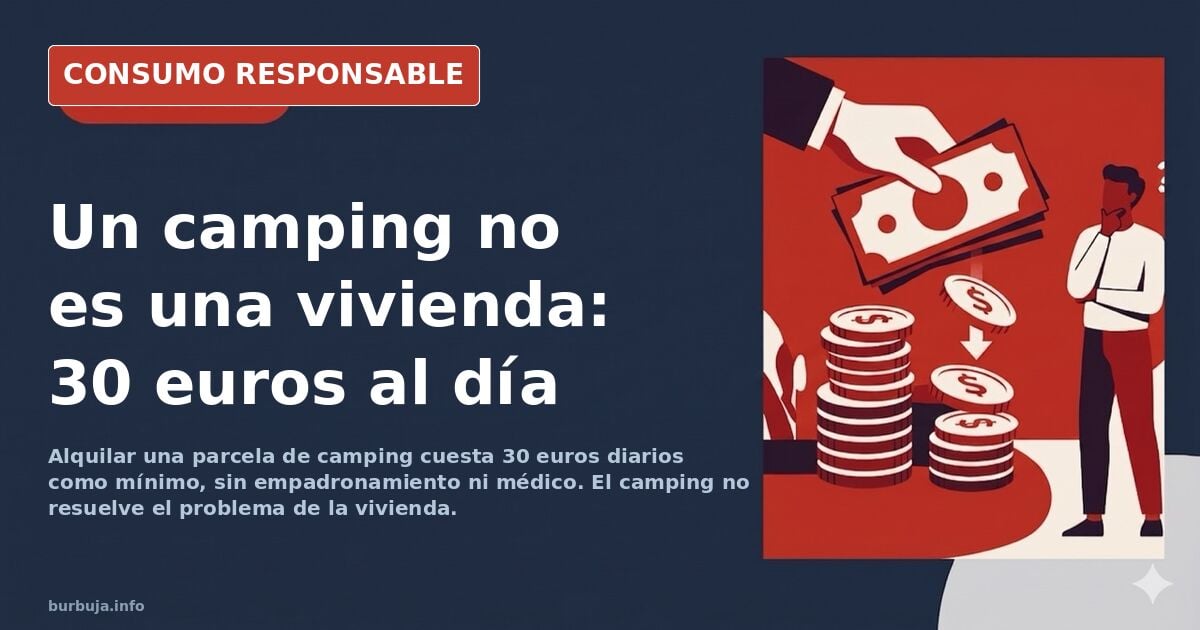
Renting a campsite pitch costs 30 euros a day
How much does it cost to live on a campsite? Around 30 euros a day, and that's just the pitch. The figure circulates as a supposedly cheap alternative to renting, but it falls apart as soon as you read the site's fine print.
A pitch is not exactly cheap
Thirty euros a day is almost 900 a month, before adding electricity, water and community fees. The result is pretty similar to sharing a flat, but with fewer comforts. On paper, sleeping under canvas should cost next to nothing. In practice, the pitch is billed as if it were an apartment in high season.
Then there's the location. The campsites closest to the city sit on the outskirts. In Valencia, the Albufera park or the Pinedo area are the nearest options, and none of them is next to the centre. Scarce public transport, long commutes and an added work problem for anyone without a car.
No municipal registration means no doctor or school
Seasonal campsites stick to their calendar and show residents the door as soon as the cold sets in. That's where the supposed housing ends. Those that open all year apply pitch rates, utility charges and community fees that make a stay comparable to a conventional rental, but without the administrative benefits of a proper home.
The most awkward consequence isn't financial, it's bureaucratic: without a proper municipal registration (empadronamiento) there's no GP, no school and no clean access to benefits. A plastic roof grants no rights unless it hangs off a recognised address. That detail rules out camping as a stable housing solution, no matter how reasonable the pitch price seems in summer.
Camping as housing in fiction and in the United States
The idea isn't new. A Spanish TV series a few years back had a group of people who had fallen on hard times living on a campsite after the housing bubble burst. Today that script wouldn't even hold up. In the United States, Canada or the UK there are large trailer parks where many people live permanently and cheaply, but they respond to a different reality: land is available and local authorities look the other way.
In Spain, residential land is controlled by a handful of players and camping is a seasonal business, not a housing model. Debating whether six million people could be housed this way within five years isn't planning, it's propaganda to paper over the lack of alternatives. The realistic route lies elsewhere: social services and social housing waiting lists, the only channel where someone failed by the system can scrape something together.
Joining a protest camp, emulating those demonstrating over rent prices and seeking shelter has its logic, but it doesn't fix a case file. A campsite in winter and a banner in the Puerta del Sol last only so long: they're stopgaps. You'll have to keep summering, just all year round.
Also available in: Deutsch
Summary of a discussion on Burbuja.info - Foro de economía, actualidad y política., translated from Spanish and reviewed before publication. Read the full discussion (15 replies).
More summaries
-
Castellón, Spain's coast that turns sour in August
A stay on the Castellón coast in Spain ends in complaints about heat, LED lights and services. The debate pits the paradise being sold against the real summer experience.
-
Neighborhood venue rental in Spain runs €80-150 per slot, forum users say
According to a forum user, renting a neighborhood venue in Spain costs €80 to €150 per slot, with a €100-200 deposit refunded if the space is left undamaged
-
How many litres of milk can you get from 1 kg of condensed milk?
A forum calculation says a 1 kg can yields 6.6 to 10 litres, but others warn it's not milk but added sugar.
-
Valve extenders: 10 grams that can make your wheel vibrate
A short valve hidden under the hubcap makes it impossible to inflate the tyre at the petrol station. The 10-gram fix can unbalance the wheel and cause vibrations.
-
The sheet war: calling one side of a page a 'page' sparks outrage
Confusion between 'sheet' and 'page' has triggered a linguistic war among Spanish academics. One side of a sheet or a page? The debate reveals generational tensions and regional divides.
-
Wojciechow chair survives 1944 Soviet bombing
A Tsarist-era chair from the Wojciechow factory (1872-1933), damaged in a 1944 Soviet bombing raid and restored in Estonia.