
Letter challenges Franco-era myth: women’s experiences varied
A letter attributed to Mª Luisa Chiscano depicts Francoist Spain, reigniting debate on whether women lived better then.
English · Original discussion in Spanish · Published
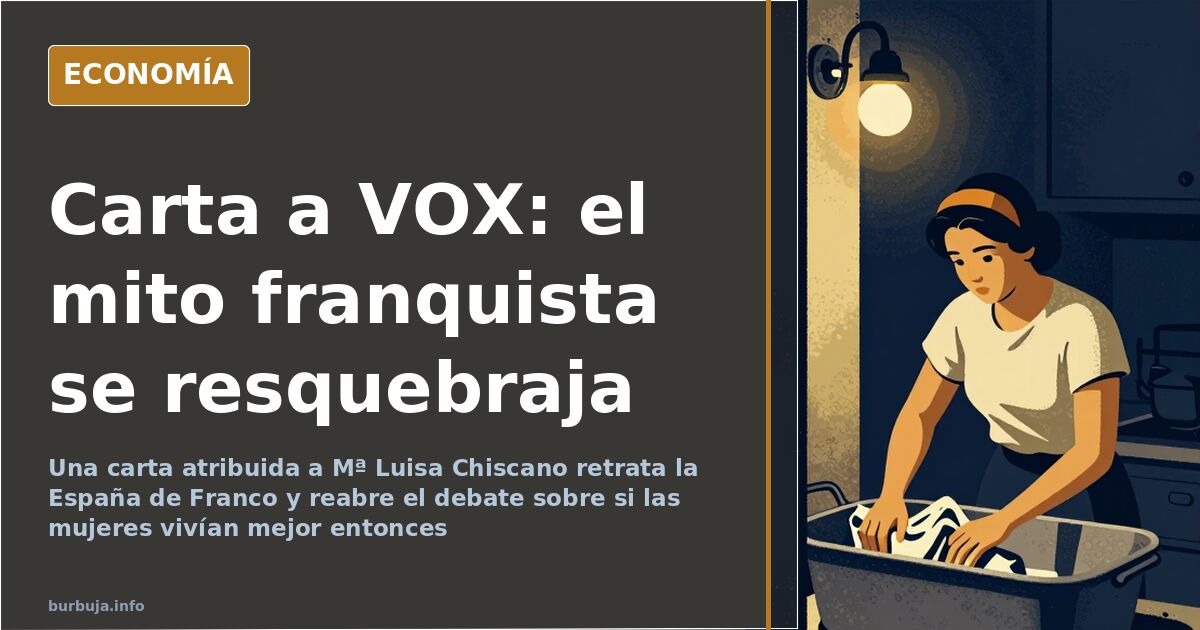
Grandmother's letter against the Francoist myth divides generations
"It is very easy to praise past times from ignorance, hypocrisy, or lies." The text attributed to Mª Luisa Chiscano and addressed to young VOX supporters has become one of those documents shared to end a discussion but which ultimately reopens it. Against those who idealize pre-1975 Spain, the author presents an unadorned portrait of what it meant to be a woman then. Subsequent debate added an uncomfortable nuance: not everyone in the country experienced the same reality, nor was misery invented.
What does the grandmother's letter to young VOX members say?
The review is meticulous. Women did not go out alone, to parties, trips, or the beach without their husbands. They wore long skirts and stockings year-round, showing no arms, cleavage, or back, with no tattoos, piercings, dyes, or makeup. The author argues that men used them for sens and as servants, stating that a slap was enough to "straighten them out" if they protested. They could not smoke, buy an apartment, drive, or divorce.
The list continues: only giving birth, mass every Sunday, dolls and mops as toys —pink for her, blue for him—, black when widowed and white for life if a man "wanted" her. In winter, a brazier; in summer, a fan. They ate lots of rice, potatoes, and bread with oil, garlic, and salt, because beef or salmon were things for the rich. The closing is a jab: it is easy to boast about lucidity with a latest-model mobile phone, a full fridge, and a visa in your wallet.
Was life better under Franco? The repeated argument
Here the ground becomes slippery, because two different things are mixed. Part of the analysis recalls that Spain was a poor country impoverished further by the war, taking decades to approach European levels. The opposing reading points to the alternative of the time: becoming a Soviet satellite republic, with a prosperity balance more than debatable. Under this prism, the dictatorship remains the lesser evil in a brutal context.
Supporters of the friendly narrative highlight full employment, a dismissal cost of 60 days, lifetime jobs, and cheap rents protected by old tenancy laws (renta antigua), repealed in 1985. Also, child benefits granted by the regime. The objection raised on the other side is simple: almost all of that was typical of a closed economy and a late-industrializing country, not an exportable achievement. Fridges and televisions arrived across Europe at the same time.
Women in Europe: husband's permission and late suffrage
A geographic correction is advisable. That women needed their husband's consent for almost everything was not exclusive to Spain. In France, until well into the sixties, spousal permission was required to work, study for a degree, or open a bank account. Female suffrage in Switzerland did not arrive at the federal level until the vote on February 7, 1971, and in some cantons had to wait until 1990. The Church weighed more heavily here, making the process slower, but the starting point was continental.
Not the same Spain, not the same family
The other objection to the text is that it generalizes an experience. Some recall relatives who barely fit that mold: women who remained single, studied, worked as flight attendants, traveled, and asked no one's permission. Others describe a mother born in 1930 who studied and spent summers with an ordinary family, without being the Alba family. A third line insists on geography: rural and industrial Spain did not live the same way, and a farming family could end up with the same economic level as a middle-class one. Details on how industrial incentives were distributed and which zones received more investment would fill another entire article.
From this arises the most repeated reproach: if every house has its own grandmother, history is not written with just one. Global data and particular memories do not always align, and whoever tries to sell one as proof of the other is mistaken.
What remains of that country
Almost half a century after Franco's death, the text still functions as a mirror where each generation sees what it wants to see. The letter does not lie about women, but neither tells the whole truth about the country. With these materials, it is predictable that the myth of the past —that it was always better— will continue to spark conversation, even though the numbers still do not support it.
"It is very easy to praise past times from ignorance, hypocrisy, or lies." The text attributed to Mª Luisa Chiscano and addressed to young VOX supporters has become one of those documents shared to end a discussion but which ultimately reopens it. Against those who idealize pre-1975 Spain, the author presents an unadorned portrait of what it meant to be a woman then. Subsequent debate added an uncomfortable nuance: not everyone in the country experienced the same reality, nor was misery invented.
What does the grandmother's letter to young VOX members say?
The review is meticulous. Women did not go out alone, to parties, trips, or the beach without their husbands. They wore long skirts and stockings year-round, showing no arms, cleavage, or back, with no tattoos, piercings, dyes, or makeup. The author argues that men used them for sens and as servants, stating that a slap was enough to "straighten them out" if they protested. They could not smoke, buy an apartment, drive, or divorce.
The list continues: only giving birth, mass every Sunday, dolls and mops as toys —pink for her, blue for him—, black when widowed and white for life if a man "wanted" her. In winter, a brazier; in summer, a fan. They ate lots of rice, potatoes, and bread with oil, garlic, and salt, because beef or salmon were things for the rich. The closing is a jab: it is easy to boast about lucidity with a latest-model mobile phone, a full fridge, and a visa in your wallet.
Was life better under Franco? The repeated argument
Here the ground becomes slippery, because two different things are mixed. Part of the analysis recalls that Spain was a poor country impoverished further by the war, taking decades to approach European levels. The opposing reading points to the alternative of the time: becoming a Soviet satellite republic, with a prosperity balance more than debatable. Under this prism, the dictatorship remains the lesser evil in a brutal context.
Supporters of the friendly narrative highlight full employment, a dismissal cost of 60 days, lifetime jobs, and cheap rents protected by old tenancy laws (renta antigua), repealed in 1985. Also, child benefits granted by the regime. The objection raised on the other side is simple: almost all of that was typical of a closed economy and a late-industrializing country, not an exportable achievement. Fridges and televisions arrived across Europe at the same time.
Women in Europe: husband's permission and late suffrage
A geographic correction is advisable. That women needed their husband's consent for almost everything was not exclusive to Spain. In France, until well into the sixties, spousal permission was required to work, study for a degree, or open a bank account. Female suffrage in Switzerland did not arrive at the federal level until the vote on February 7, 1971, and in some cantons had to wait until 1990. The Church weighed more heavily here, making the process slower, but the starting point was continental.
Not the same Spain, not the same family
The other objection to the text is that it generalizes an experience. Some recall relatives who barely fit that mold: women who remained single, studied, worked as flight attendants, traveled, and asked no one's permission. Others describe a mother born in 1930 who studied and spent summers with an ordinary family, without being the Alba family. A third line insists on geography: rural and industrial Spain did not live the same way, and a farming family could end up with the same economic level as a middle-class one. Details on how industrial incentives were distributed and which zones received more investment would fill another entire article.
From this arises the most repeated reproach: if every house has its own grandmother, history is not written with just one. Global data and particular memories do not always align, and whoever tries to sell one as proof of the other is mistaken.
What remains of that country
Almost half a century after Franco's death, the text still functions as a mirror where each generation sees what it wants to see. The letter does not lie about women, but neither tells the whole truth about the country. With these materials, it is predictable that the myth of the past —that it was always better— will continue to spark conversation, even though the numbers still do not support it.
Summary of a discussion on Burbuja.info - Foro de economía, actualidad y política., translated from Spanish and reviewed before publication. Read the full discussion (195 replies).
More summaries
-
The Future of the Catholic Church: Priests Marrying and Having Children
The Catholic Church might relax celibacy for priests, allowing marriage and parenthood in response to the vocation crisis.
-
Self-employed worker, 68, crushed to death by hay bales in Garciaz
A 68-year-old self-employed man dies in Garciaz when several hay bales fall on him during unloading. Another farm accident without safety protocol.
-
Spain's rental crisis: fewer homes, higher prices
Spain lost 220,000 rental units in five years as prices rise 7% and room rents hit €800 in Madrid.
-
Spain: Civil Servants Faced Pressure, Not Dismissals
In Spain, COVID-19 vaccination was never mandatory for civil servants or healthcare workers, contrasting sharply with France and Italy.
-
Six internal complaints against Lugo provincial president
Six women accuse José Tomé, head of Lugo's Provincial Council, of offering public jobs in exchange for sex. He denies the allegations and threatens legal action.
-
James Watson, DNA Nobel Laureate Stripped of Honors, Dies at 97
James Watson, the Nobel laureate who co-discovered DNA's double helix, died at 97 after losing his titles over race and intelligence remarks.