
LED light under suspicion: the blue that steals our sleep
LED light emits more blue component than incandescent bulbs and disrupts sleep. The technical debate over color temperature, flicker and street lighting.
English · Original discussion in Spanish · Published
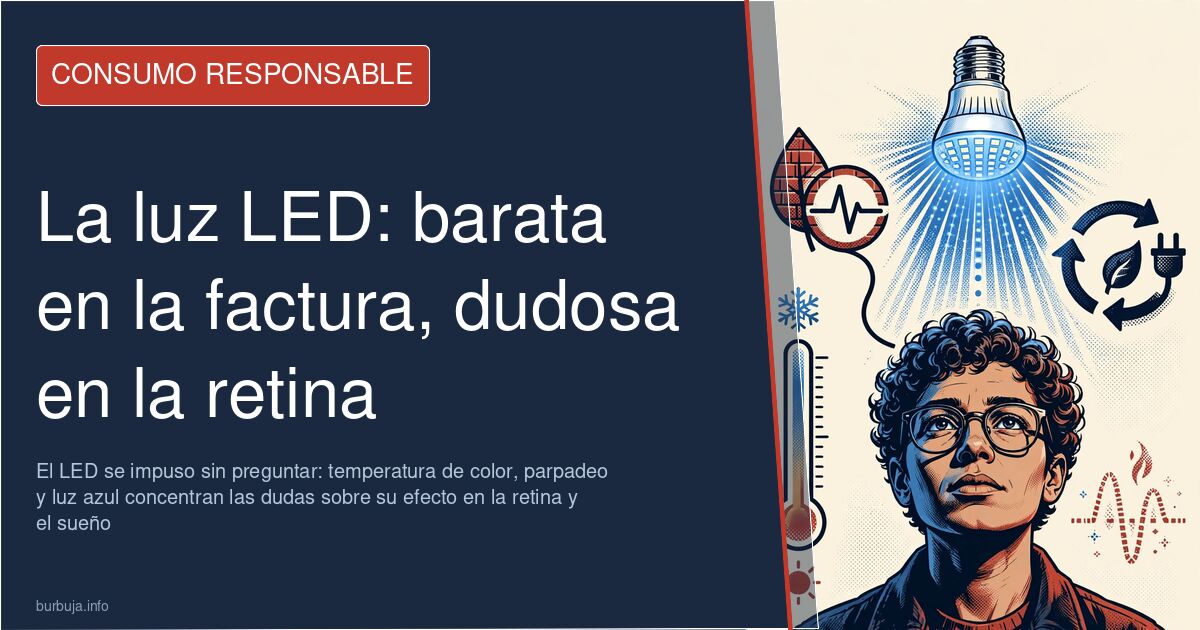
LED light and the excess blue that disrupts sleep
Is LED light at home and on the street a public health problem or a piece of tech folklore? The discussion, which kicks off with the complaint that streetlights "no longer illuminate, they just flicker," mixes real data about emission spectra with 5G conspiracy theories. The starting point is uncomfortable: most bulbs sold today emit a higher proportion of blue light than the old incandescent ones, and that has documented effects on the circadian rhythm. But from there to blaming it for every ailment of the century is a stretch that the debate itself ridicules.
The spectrum you don't see on the label
The strongest technical argument running through the discussion is that LED light always has an excess of blue component, whether warm (3000K) or cool (6000K). It's not an opinion: you can see it in the emission spectrum. High-frequency blue light suppresses melatonin and throws off sleep cycles, something the European Commission itself acknowledges in its reports on adverse effects on the retina. That's where the consensus ends.
Because the solution proposed by part of the debate — going back to incandescent — collides with the reality of energy consumption. Incandescent bulbs use up to five times more energy for the same light, and their lifespan is a fraction of an LED's. The user defending the traditional bulb admits he uses less electricity than "the neighborhood gossip holding court with four buddies," which gives you a sense of the level of the discussion.
Warm, neutral or cool: which tonalidad temperature to choose
Tonalidad temperature is the practical core of the matter. 3000K or less is warm light; 4000K is neutral; above 5000K is cool. The recommendation that keeps coming up is to use warm light in bedrooms and rest areas, neutral in bathrooms and kitchens, and cool only in garages or warehouses. Some people have their whole house at 6000K and draw complaints from neighbors for looking like "a tacky mansion."
The problem isn't the technology, it's the installation. Dimmable LED bulbs with adjustable tonalidad temperature exist and can emulate sunlight throughout the day. In Germany, as the story goes, offices already use systems that adapt intensity and temperature to the circadian cycle. In Spain, the standard remains swapping a blown bulb for the cheapest one on the shelf.
Flicker and 5G: where the debate loses the plot
Flicker — the invisible flickering — is another of the accusations. The latest generation of fluorescent lights already eliminated the 50 Hz from the mains with electronic circuits, and quality LEDs control it too. The problem shows up with cheap fixtures and modulation-based dimming systems, which can affect mood. It's a studied effect, but from there to claiming that 5G and LED light "destroy your health every day" is a leap the thread itself calls "peak nonsense."
The mention of 5G is, in fact, the point where the discussion loses all rigor. 5G operates at far lower frequencies than visible light, it's non-ionizing and has nothing to do with the light spectrum. Mixing the two is what discredits the rest of the arguments, which do have a basis.
The business of public lighting
Municipal lighting is where the criticism has the most traction. The mass switch to LED was done without public debate and based on energy-saving criteria. The result on many streets is a brighter, cooler light that dazzles pedestrians and creates light pollution. The old sodium vapor lamps, monochromatic and orange, performed worse but didn't disrupt sleep in the same way.
The paradox is that wealthy neighborhoods keep warm lighting while housing estates and outskirts fill up with 6000K white lights. It's not a conspiracy: quality warm light simply costs more. As with almost everything, the problem isn't the technology, but who can afford the good stuff.
In the end, the most honest conclusion comes from one participant: the best light is the one that's never switched on. And the second best is the one chosen with care. Everything else is just selling snake oil.
Also available in: Deutsch
Summary of a discussion on Burbuja.info - Foro de economía, actualidad y política., translated from Spanish and reviewed before publication. Read the full discussion (58 replies).
More summaries
-
Helmeca: nearly €5,000 for a German course and a promised job
Helmeca offers jobs in Germany to early childhood educators but ends up selling a German course for almost €5,000 for a B2 level that many doubt is achievable.
-
Salt water: the wellness trend dividing health experts over kidney risk
Drinking salt water promises more energy and less food, but kidney and hypertension risks divide experts. Data, testimonials and the science behind it…
-
Giving Up Alcohol: Healthy Choice or Radical Puritanism?
Quitting alcohol brings health, savings, and mental clarity, but the debate between teetotalers and moderate drinkers has turned radical. Data and opinions…
-
Aging gracefully: surgery vs. genetics at 64
Madonna and Susanna Hoffs, both 64, illustrate two opposite ways of facing aging: surgery and gym versus habits and good spirits.
-
Teetotaler vs drunk: the moral line in alcohol consumption
Two crates of beer and wine in a garden separate the model teetotaler from the irresponsible drinker; consumption depends on who is looking.
-
Biomass boilers promise savings but raise doubts
A forum debates whether biomass really saves money: pellet prices have doubled to €0.23/kg and some calculate an installed boiler can cost up to five times more than oil.