
Le Pen and Mélenchon's Inflationary Debt Solution
Far-right and far-left French politicians propose inflating away national debt, a move that could penalize Spain and Germany within the Eurozone.
English · Original discussion in Spanish · Published
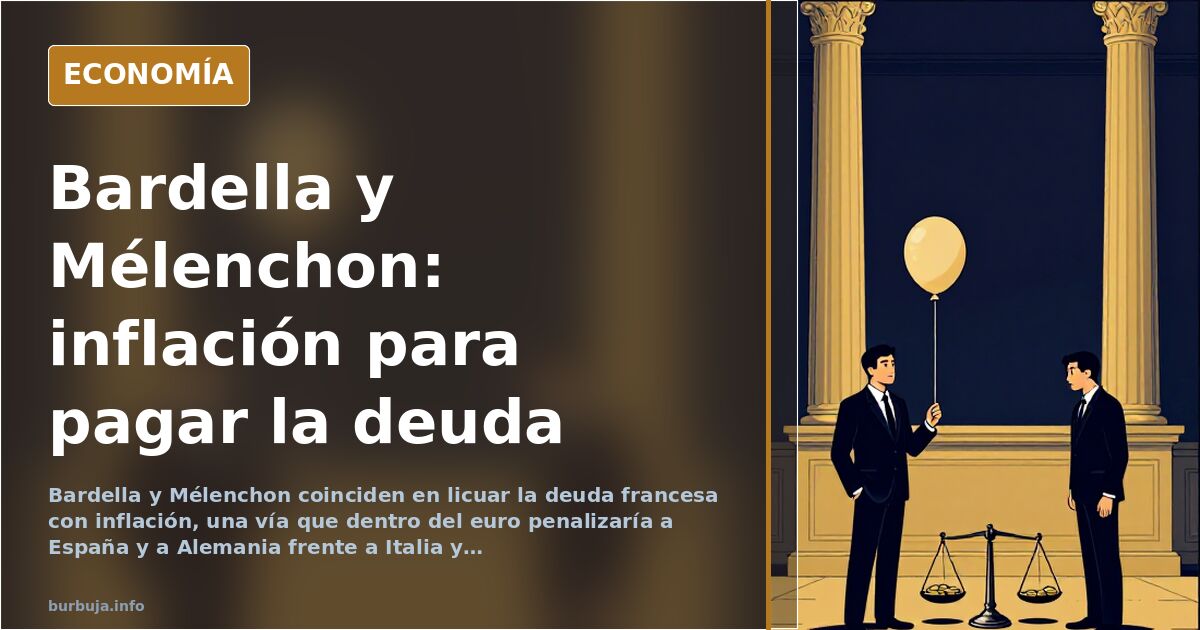
Bardella and Mélenchon: Inflating Away French Debt
How long does it take for public debt to disappear? Much less than the creditor thinks, if the central bank starts printing money. In France, two opposing political figures who refuse to sit together have arrived at the same prescription for their national debt. Economist Luis Garicano recently pointed out in a publication that the European Central Bank has been dismantling market discipline, and populism of all stripes has taken note. Jordan Bardella, Marine Le Pen's right-hand man, is calling for the ECB to buy French debt. Jean-Luc Mélenchon, leader of La France Insoumise, has been demanding something even more drastic for longer: directly cancelling French debt held by the euro system, which in practice amounts to the Banque de France. Hyperinflation emerges here not as an accident, but as the instrument.
What Monetizing a Country's Debt Means
The mechanism is straightforward, even if it's marketed as magic. If the central bank buys public debt by creating new money, the state finances itself without going through the market and without anyone demanding a punitive interest rate. The downside lands in everyone's pocket: more money chasing the same goods, rising prices, and a currency that is worth less. With soaring inflation, the real value of what is owed shrinks on its own. Those who had euros saved see them shrink along with it.
This is why talk turns to shifting the bill from debtors to creditors and savers. A loaf of bread doesn't go up by 5%: in the scenario described, it reaches 20 euros, and in the worst-case calculation, it hits 50. The recurring comparison is with Argentina or Turkey, economies where a day's wages stopped covering a day's groceries.
Who Pays the Piper Within the Euro
The Eurozone is not a homogeneous club, and therein lies the problem. Of the major players, only four truly matter: Germany, France, Italy, and Spain. Of these four, Spain has the second-lowest debt relative to its GDP. A generalized debt write-down would reward the most indebted and penalize those who owe the least. The result would not be a rescue with a flag and commissioners, but something more discreet and harder to explain during a campaign: a silent transfer from frugal countries to those dragging the burden, without any minister signing a check.
Spanish Debt and Its Discrepant Figures
Quantifying Spanish debt appears to be an exercise in faith. Some analyses suggest the official figure falls short, and that the real debt is already around 160% of GDP. Another school of thought places it directly above 180%. In between lies the memory of the housing bubble: public debt exceeded 100%, but private debt, held by households and businesses, soared to 300% or 400%. That private mountain has been gradually reduced since then, though it remains above the European average. The figures don't align; what they do share is the suspicion that the official picture is overly favorable.
Hyperinflation or Growing Faster Than Debt?
The most serious criticism is not that the idea is immoral, but that it's being misrepresented. Some argue that the proposal isn't to skyrocket prices, but to inject liquidity to foster growth: if you have a debt of 100% of GDP and manage to double GDP, that debt halves without affecting anyone's pocket. On paper, impeccable. The uncomfortable detail is that doubling GDP doesn't happen in a reasonable timeframe. And there lies the line separating nuance from fantasy: high inflation with high growth could work; high inflation with low growth leads to tragedy, which is precisely the Argentine or Turkish scenario.
The Austerity No One Wants to Sign
If the inflationary route is discarded, the other option remains, the one no politician will put in writing: cutbacks. Halve public spending, halve pensions, and retire at 70 years old. The figure is stated bluntly and responds well to the diagnosis. The problem arises the next minute. In France and Spain, pensions and public salaries are the backbone of private consumption. If business revenue is halved as a result, who pays the subsidies for the hundreds of thousands of unemployed generated by such cuts? No one has answered this, because there is no fitting response.
With these elements, gold is once again viewed favorably, and even the local jewelry store becomes an emergency refuge. The only question that remains unanswered is who pushes the print button. And for that, as always, elections are needed.
How long does it take for public debt to disappear? Much less than the creditor thinks, if the central bank starts printing money. In France, two opposing political figures who refuse to sit together have arrived at the same prescription for their national debt. Economist Luis Garicano recently pointed out in a publication that the European Central Bank has been dismantling market discipline, and populism of all stripes has taken note. Jordan Bardella, Marine Le Pen's right-hand man, is calling for the ECB to buy French debt. Jean-Luc Mélenchon, leader of La France Insoumise, has been demanding something even more drastic for longer: directly cancelling French debt held by the euro system, which in practice amounts to the Banque de France. Hyperinflation emerges here not as an accident, but as the instrument.
What Monetizing a Country's Debt Means
The mechanism is straightforward, even if it's marketed as magic. If the central bank buys public debt by creating new money, the state finances itself without going through the market and without anyone demanding a punitive interest rate. The downside lands in everyone's pocket: more money chasing the same goods, rising prices, and a currency that is worth less. With soaring inflation, the real value of what is owed shrinks on its own. Those who had euros saved see them shrink along with it.
This is why talk turns to shifting the bill from debtors to creditors and savers. A loaf of bread doesn't go up by 5%: in the scenario described, it reaches 20 euros, and in the worst-case calculation, it hits 50. The recurring comparison is with Argentina or Turkey, economies where a day's wages stopped covering a day's groceries.
Who Pays the Piper Within the Euro
The Eurozone is not a homogeneous club, and therein lies the problem. Of the major players, only four truly matter: Germany, France, Italy, and Spain. Of these four, Spain has the second-lowest debt relative to its GDP. A generalized debt write-down would reward the most indebted and penalize those who owe the least. The result would not be a rescue with a flag and commissioners, but something more discreet and harder to explain during a campaign: a silent transfer from frugal countries to those dragging the burden, without any minister signing a check.
Spanish Debt and Its Discrepant Figures
Quantifying Spanish debt appears to be an exercise in faith. Some analyses suggest the official figure falls short, and that the real debt is already around 160% of GDP. Another school of thought places it directly above 180%. In between lies the memory of the housing bubble: public debt exceeded 100%, but private debt, held by households and businesses, soared to 300% or 400%. That private mountain has been gradually reduced since then, though it remains above the European average. The figures don't align; what they do share is the suspicion that the official picture is overly favorable.
Hyperinflation or Growing Faster Than Debt?
The most serious criticism is not that the idea is immoral, but that it's being misrepresented. Some argue that the proposal isn't to skyrocket prices, but to inject liquidity to foster growth: if you have a debt of 100% of GDP and manage to double GDP, that debt halves without affecting anyone's pocket. On paper, impeccable. The uncomfortable detail is that doubling GDP doesn't happen in a reasonable timeframe. And there lies the line separating nuance from fantasy: high inflation with high growth could work; high inflation with low growth leads to tragedy, which is precisely the Argentine or Turkish scenario.
The Austerity No One Wants to Sign
If the inflationary route is discarded, the other option remains, the one no politician will put in writing: cutbacks. Halve public spending, halve pensions, and retire at 70 years old. The figure is stated bluntly and responds well to the diagnosis. The problem arises the next minute. In France and Spain, pensions and public salaries are the backbone of private consumption. If business revenue is halved as a result, who pays the subsidies for the hundreds of thousands of unemployed generated by such cuts? No one has answered this, because there is no fitting response.
With these elements, gold is once again viewed favorably, and even the local jewelry store becomes an emergency refuge. The only question that remains unanswered is who pushes the print button. And for that, as always, elections are needed.
Summary of a discussion on Burbuja.info - Foro de economía, actualidad y política., translated from Spanish and reviewed before publication. Read the full discussion (202 replies).
More summaries
-
One in 10 French petrol stations runs out of fuel
One in 10 French petrol stations is out of fuel, Macron warns of an unprecedented energy situation. Saudi crude cutoff and stockpiling explain…
-
French Constitutional Court Strikes Down Social Media Ban for Minors
The French Constitutional Council annulled the law banning social media for those under 15, citing a violation of freedom of expression.
-
Euthanasia in Old Age: Autonomy vs. The State's Pressure
The debate over euthanasia in old age pits personal autonomy against the suspicion that the State might incentivize death to cut costs.
-
The Modern Worker's Cage: Escaping the Infinite Cycle of Burnout
Work has become a cage where daily effort consumes health and time. Discover why we push ourselves so hard and how to break the cycle.
-
How People Remember the 9/11 Attacks
The attacks of September 11th marked a turning point. Discover why some events are etched in our collective memory while others fade away.
-
Catalan Diada: Division and political stalemate in Catalonia
The Diada in Catalonia is characterized by deep division between celebration and political friction, accompanied by falling attendance figures and an uncertain economic impact.