
Lawyers' Mutuals Face 300-Euro Pensions, Seek RETA Integration
Thousands of mutualized lawyers and solicitors face pensions of €300 or less, urging absorption into Social Security via RETA.
English · Original discussion in Spanish · Published
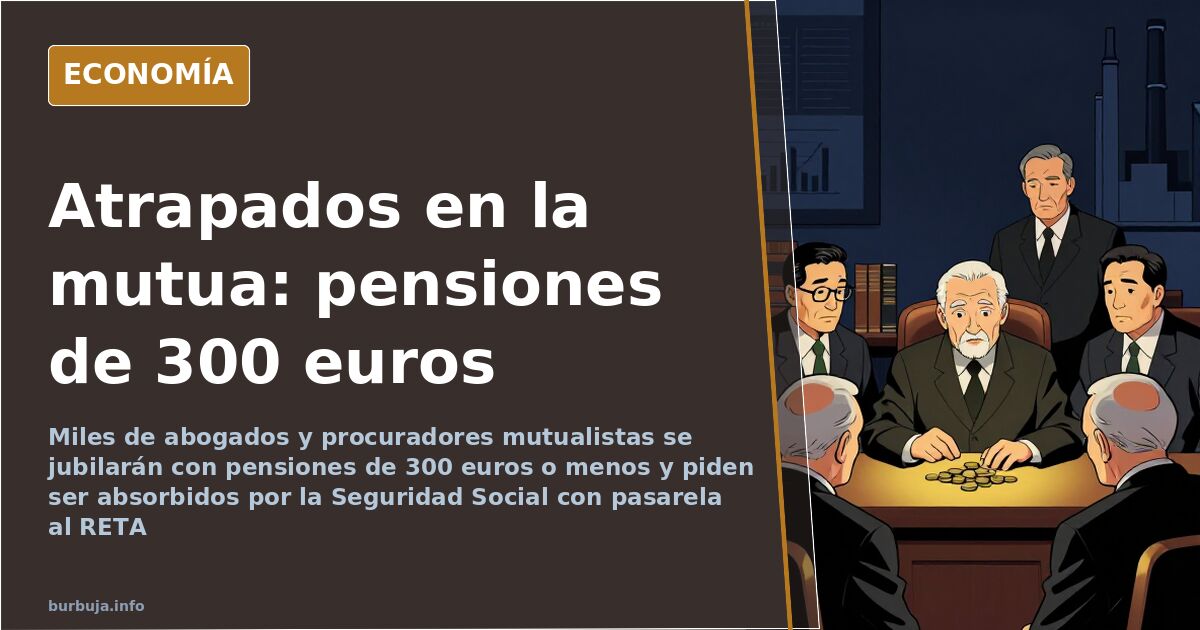
€300 Pensions: Mutualized Lawyers Seek RETA Gateway
There's a generation of lawyers and solicitors facing retirement with meager pensions. This isn't a doomsayer's threat: those affected report pensions of €300 or less after a lifetime contributing to the Mutualidad de la Abogacía. Many can no longer meet the 15 minimum years in the Special Regime for Self-Employed Workers (RETA), prompting a basic yet controversial request: absorption by Social Security. The ball is in the government's court, and it's leaking.
What is the Mutualidad and Why Couldn't Anyone Escape?
Lawyers, solicitors, doctors, architects, engineers. Many liberal professions have had their own professional mutual society, an alternative to Social Security's protective measures. Until 1995, there was no other option: contributing to the mutual was mandatory, and RETA was off-limits for these registered professionals. The reform that year, Law 30/1995, peine the door to self-employed workers and incidentally changed the system's nature.
The statistic explaining the anger: when given the chance to switch to self-employed Social Security in 1996, over 80% remained with the mutual. Those who switched forfeited their contributions.
From Pay-As-You-Go to Capitalization: The Reform That Broke It
Here lies the crux. The mutual society operated, for pension purposes, on a pay-as-you-go system: contributors paid those already receiving benefits. The reform prohibited this scheme and imposed pure capitalization: each person receives from their savings and the returns generated. Those caught in the middle, neither fully in one system nor the other, got the worst deal.
And the returns didn't help. Affected individuals claim the mutual squandered their monthly fees on "poor investments in conservative products." Translation: too cautious for what the brochure promised.
Contribution Amounts and Expected Payouts
The numbers involved are almost laughable. Some recall contributions of €25 per month, with bar association fees acting as guidelines, and a profession that, outside the star system of large firms, lives on the brink of poverty. Other calculations suggest much higher contributions: €140 for the mutual in 2010, compared to €250 for RETA, plus €145 for private health insurance not covered by the mutual.
The comparison with an employee stings. A self-employed worker on minimum wage contributes nearly €500 per month, including employer contributions. The fine print: private plans have no minimum top-up. When the pot runs out, it's over.
The Gateway to RETA: Who Pays – The Mutual Member or the Taxpayer?
Sumar has presented a non-binding proposal on the social protection of lawyers and solicitors, aiming for the government to manage these contributions. The non-binding proposal opens the perennial question: who foots the bill? The most cited precedent is from 2011, when special agreements were established for interns, with a maximum of two years retroactivity and at the special agreement price.
The cleaner alternative would be to integrate the entire mutual into Social Security, dissolve it, and distribute any surplus. The problem is that the mutual claims no further funds beyond individual contributions are available, and Social Security doesn't see a clear path to financing the shortfall. There's a complex breakdown of how integration would be calculated—inflation, legal interest, and years involved—that could fill a master's program.
Public vs. Private: The Debate Nobody Wins
Here, everyone leans towards their ideology. One side argues the mutual is living proof of what happens when pensions are left to the private sector: sustainable, yes, but low. The opposing side counters that pay-as-you-go is a pyramid scheme that only holds up with debt and those who come later. Surveyors, architects, and chemists share a mutual society and the same diagnosis: €300 per month for 40 years isn't enough to collect €1,500 for twenty.
In the middle lies an uncomfortable diagnosis: the problem isn't public or private, but shoddy management on both sides. And that Social Security, with its infinite machinery, merely has to wait for the capitalization system to bleed out.
With these elements, the gateway seems a matter of time and political arithmetic. When it arrives, under what conditions, and who signs the check, nobody knows yet.
There's a generation of lawyers and solicitors facing retirement with meager pensions. This isn't a doomsayer's threat: those affected report pensions of €300 or less after a lifetime contributing to the Mutualidad de la Abogacía. Many can no longer meet the 15 minimum years in the Special Regime for Self-Employed Workers (RETA), prompting a basic yet controversial request: absorption by Social Security. The ball is in the government's court, and it's leaking.
What is the Mutualidad and Why Couldn't Anyone Escape?
Lawyers, solicitors, doctors, architects, engineers. Many liberal professions have had their own professional mutual society, an alternative to Social Security's protective measures. Until 1995, there was no other option: contributing to the mutual was mandatory, and RETA was off-limits for these registered professionals. The reform that year, Law 30/1995, peine the door to self-employed workers and incidentally changed the system's nature.
The statistic explaining the anger: when given the chance to switch to self-employed Social Security in 1996, over 80% remained with the mutual. Those who switched forfeited their contributions.
From Pay-As-You-Go to Capitalization: The Reform That Broke It
Here lies the crux. The mutual society operated, for pension purposes, on a pay-as-you-go system: contributors paid those already receiving benefits. The reform prohibited this scheme and imposed pure capitalization: each person receives from their savings and the returns generated. Those caught in the middle, neither fully in one system nor the other, got the worst deal.
And the returns didn't help. Affected individuals claim the mutual squandered their monthly fees on "poor investments in conservative products." Translation: too cautious for what the brochure promised.
Contribution Amounts and Expected Payouts
The numbers involved are almost laughable. Some recall contributions of €25 per month, with bar association fees acting as guidelines, and a profession that, outside the star system of large firms, lives on the brink of poverty. Other calculations suggest much higher contributions: €140 for the mutual in 2010, compared to €250 for RETA, plus €145 for private health insurance not covered by the mutual.
The comparison with an employee stings. A self-employed worker on minimum wage contributes nearly €500 per month, including employer contributions. The fine print: private plans have no minimum top-up. When the pot runs out, it's over.
The Gateway to RETA: Who Pays – The Mutual Member or the Taxpayer?
Sumar has presented a non-binding proposal on the social protection of lawyers and solicitors, aiming for the government to manage these contributions. The non-binding proposal opens the perennial question: who foots the bill? The most cited precedent is from 2011, when special agreements were established for interns, with a maximum of two years retroactivity and at the special agreement price.
The cleaner alternative would be to integrate the entire mutual into Social Security, dissolve it, and distribute any surplus. The problem is that the mutual claims no further funds beyond individual contributions are available, and Social Security doesn't see a clear path to financing the shortfall. There's a complex breakdown of how integration would be calculated—inflation, legal interest, and years involved—that could fill a master's program.
Public vs. Private: The Debate Nobody Wins
Here, everyone leans towards their ideology. One side argues the mutual is living proof of what happens when pensions are left to the private sector: sustainable, yes, but low. The opposing side counters that pay-as-you-go is a pyramid scheme that only holds up with debt and those who come later. Surveyors, architects, and chemists share a mutual society and the same diagnosis: €300 per month for 40 years isn't enough to collect €1,500 for twenty.
In the middle lies an uncomfortable diagnosis: the problem isn't public or private, but shoddy management on both sides. And that Social Security, with its infinite machinery, merely has to wait for the capitalization system to bleed out.
With these elements, the gateway seems a matter of time and political arithmetic. When it arrives, under what conditions, and who signs the check, nobody knows yet.
Summary of a discussion on Burbuja.info - Foro de economía, actualidad y política., translated from Spanish and reviewed before publication. Read the full discussion (456 replies).
More summaries
-
'Paid-off flat and rising pension': the generational divide
Users in a forum discuss the generational conflict: those receiving pensions own their homes outright, while younger generations do not. The dispute centers on pensions and inheritances.
-
Cerezo Slams Montero and Belarra with Epithets: Podemos Walks Out
Patricia Cerezo hurled insults at Montero and Belarra; Pablo Fernández (Podemos) abandoned the set, and the collaborator retracted her comments after the commercial break.
-
Euthanasia in Old Age: Autonomy vs. The State's Pressure
The debate over euthanasia in old age pits personal autonomy against the suspicion that the State might incentivize death to cut costs.
-
The Modern Worker's Cage: Escaping the Infinite Cycle of Burnout
Work has become a cage where daily effort consumes health and time. Discover why we push ourselves so hard and how to break the cycle.
-
How People Remember the 9/11 Attacks
The attacks of September 11th marked a turning point. Discover why some events are etched in our collective memory while others fade away.
-
Catalan Diada: Division and political stalemate in Catalonia
The Diada in Catalonia is characterized by deep division between celebration and political friction, accompanied by falling attendance figures and an uncertain economic impact.