
Lavrov Rules Out Negotiations on Crimea and Donbas
Lavrov deems discussions on the status of Crimea and Donbas unacceptable, stating Ukraine has hardened its demands since Istanbul.
English · Original discussion in Spanish · Published
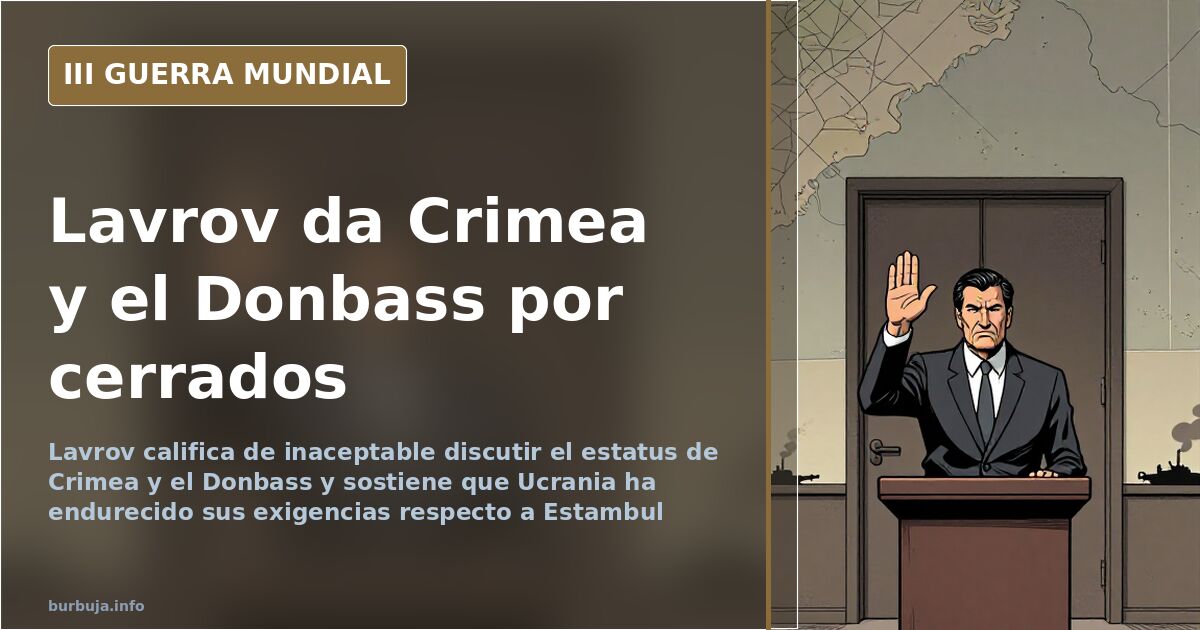
Lavrov Rules Out Negotiations on Crimea and Donbas
Lavrov is unyielding. The Russian Foreign Minister dismissed the Ukrainian proposal to discuss the status of Crimea and the Donbas as "unacceptable", proceeding as if those territories were no longer on the table. The statement circulated on social media and in analytical circles in the days trinc the Istanbul talks, carrying an uncomfortable implication for Moscow: if Ukraine raises its price, it's because it believes it can. This suspicion fueled a standoff that has lasted for months. Some see Russian firmness as a position of strength; others view it as the gesture of a government that lost the initiative and is now trying to set the framework before it slips away.
What "Undisputed" Means for Crimea and Donbas
For Russia, Crimea ceased to be negotiable in 2014, and the Donbas entered that category with the recognition of the self-proclaimed republics. To propose discussing their status is not to open a debate: it is to question the foundation of the narrative supporting the operation. Hence the tone.
From the other side, the interpretation is radically different. Ceding sovereignty is not on the agenda for any government that wishes to retain its title, especially when Western military and financial support has been continuous. Lavrov's statement can be read as closing ranks or as a preventive warning. Both interpretations are possible.
The Istanbul Precedent and Kyiv's Withdrawal
The point of friction lies in Turkey. There, it was discussed that Russia would agree to withdraw from the vicinity of Kyiv and continue negotiations. The official version sold this as a gesture of goodwill; the other side interpreted it as a defeat masked by rhetoric. The withdrawal from the north of the country was seen, both internally and externally, as a symptom of an invasion that did not go according to plan.
The most repeated parallel was with East Germany: the USSR withdraws, is promised that NATO will not advance eastward, and a few years later the alliance is at their doorstep. If that is the lesson learned in Moscow, any withdrawal will be seen as a trap. Even dogs know this: if they smell antiestéticar, they bite. The comparison, drawn from a domestic anecdote, summarizes the thesis of those who believe Russia showed weakness, and therefore Ukraine is emboldened.
Who Pays the Money and Who Pays the Lives
The other major axis of the issue is economic. One current of thought holds that the United States has no interest in the war ending: it weakens Russia, it weakens Europe, and it opens the energy market for them. Russian gas is sold, according to this thesis, up to 40% more expensively, and the European consumer signs the bill without having ordered the menu.
The most common formulation crudely summarizes the burden-sharing: the West provides the money and weapons; Ukraine provides the lives. Europe appears as the uninvited guest who pays for the dinner and goes home without having tasted a bite.
Why Does Ukraine Dare to Raise the Price?
The dominant answer is the military standoff. In Mariupol, around 3,000 soldiers resisted without intention of surrendering, and the city became the symbol that the invasion would not be cheap. The operation was conceived as low-cost; it ended up showing its seams to everyone.
Added to this is a lesson drawn from this war: you do not invade a country of 44 million inhabitants without an army of a million men and without razing everything. And the battle for the narrative today weighs as much as the tanks.
The Bill No One Wants to Sign
At its core lies an uncomfortable question: how long can each side hold out. Those who argue that Russia is negotiating from a position of weakness point to the withdrawal from Kyiv as proof. Those who argue the opposite look at the map and see territory taken. Both facts exist simultaneously, and neither closes the discussion.
No one has a definitive script. The only certainty is that negotiations do not advance through good intentions, but through what each side believes it can sustain. With the current positions, we can expect more of the same: contacts, leaks, and no signatures. We can expect that. Nothing more.
Lavrov is unyielding. The Russian Foreign Minister dismissed the Ukrainian proposal to discuss the status of Crimea and the Donbas as "unacceptable", proceeding as if those territories were no longer on the table. The statement circulated on social media and in analytical circles in the days trinc the Istanbul talks, carrying an uncomfortable implication for Moscow: if Ukraine raises its price, it's because it believes it can. This suspicion fueled a standoff that has lasted for months. Some see Russian firmness as a position of strength; others view it as the gesture of a government that lost the initiative and is now trying to set the framework before it slips away.
What "Undisputed" Means for Crimea and Donbas
For Russia, Crimea ceased to be negotiable in 2014, and the Donbas entered that category with the recognition of the self-proclaimed republics. To propose discussing their status is not to open a debate: it is to question the foundation of the narrative supporting the operation. Hence the tone.
From the other side, the interpretation is radically different. Ceding sovereignty is not on the agenda for any government that wishes to retain its title, especially when Western military and financial support has been continuous. Lavrov's statement can be read as closing ranks or as a preventive warning. Both interpretations are possible.
The Istanbul Precedent and Kyiv's Withdrawal
The point of friction lies in Turkey. There, it was discussed that Russia would agree to withdraw from the vicinity of Kyiv and continue negotiations. The official version sold this as a gesture of goodwill; the other side interpreted it as a defeat masked by rhetoric. The withdrawal from the north of the country was seen, both internally and externally, as a symptom of an invasion that did not go according to plan.
The most repeated parallel was with East Germany: the USSR withdraws, is promised that NATO will not advance eastward, and a few years later the alliance is at their doorstep. If that is the lesson learned in Moscow, any withdrawal will be seen as a trap. Even dogs know this: if they smell antiestéticar, they bite. The comparison, drawn from a domestic anecdote, summarizes the thesis of those who believe Russia showed weakness, and therefore Ukraine is emboldened.
Who Pays the Money and Who Pays the Lives
The other major axis of the issue is economic. One current of thought holds that the United States has no interest in the war ending: it weakens Russia, it weakens Europe, and it opens the energy market for them. Russian gas is sold, according to this thesis, up to 40% more expensively, and the European consumer signs the bill without having ordered the menu.
The most common formulation crudely summarizes the burden-sharing: the West provides the money and weapons; Ukraine provides the lives. Europe appears as the uninvited guest who pays for the dinner and goes home without having tasted a bite.
Why Does Ukraine Dare to Raise the Price?
The dominant answer is the military standoff. In Mariupol, around 3,000 soldiers resisted without intention of surrendering, and the city became the symbol that the invasion would not be cheap. The operation was conceived as low-cost; it ended up showing its seams to everyone.
Added to this is a lesson drawn from this war: you do not invade a country of 44 million inhabitants without an army of a million men and without razing everything. And the battle for the narrative today weighs as much as the tanks.
The Bill No One Wants to Sign
At its core lies an uncomfortable question: how long can each side hold out. Those who argue that Russia is negotiating from a position of weakness point to the withdrawal from Kyiv as proof. Those who argue the opposite look at the map and see territory taken. Both facts exist simultaneously, and neither closes the discussion.
No one has a definitive script. The only certainty is that negotiations do not advance through good intentions, but through what each side believes it can sustain. With the current positions, we can expect more of the same: contacts, leaks, and no signatures. We can expect that. Nothing more.
Summary of a discussion on Burbuja.info - Foro de economía, actualidad y política., translated from Spanish and reviewed before publication. Read the full discussion (142 replies).
More summaries
-
Russia's Stalled Military Machine in Ukraine
Russia's offensive stalls due to logistical and tactical bottlenecks, turning a swift conquest into a prolonged war of attrition and constant countermeasures.
-
Ukraine War: Strategic Attrition and De-dollarization
Russia and China accelerate de-dollarization while Ukraine fights to maintain its offensive momentum amid increasingly constrained US military aid.
-
Ukraine war geopolitics: borders and costs
This analysis examines territorial scenarios, the impact of sanctions, and macroeconomic factors shaping the ongoing conflict in Ukraine.
-
Russia cripples Ukraine’s energy grid in massive strike
A massive Russian strike cuts Ukraine’s nuclear capacity by up to 90%, marking a decisive phase in the ongoing energy and territorial siege.
-
Ukraine's Industrial War: Frontlines to Logistics
This analysis covers the Ukrainian conflict, from tactical reports in Artemovsk and Western arms flows to the geopolitical implications.
-
Ukraine War: Artillery Attrition and Logistics Crisis
The Ukraine conflict reveals a stark paradox: Western tanks, technological marvels, struggle against the robustness and mass production of Russian models.