
Latin Rosary at 6:30 AM: Real Peace or Mere Suggestion?
A non-believer prays the Latin Rosary daily for a month, claiming life changes. The debate centers on meditation versus spiritual connection.
English · Original discussion in Spanish · Published
Praying the Latin Rosary at 6:30 AM and Feeling Everything Change
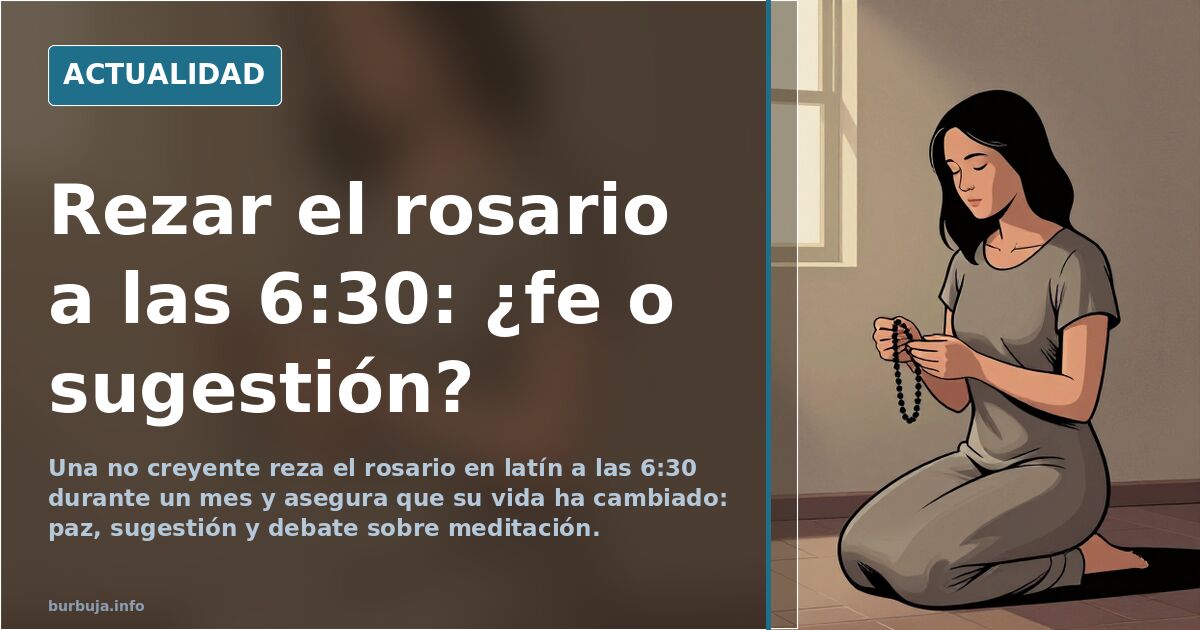
One month of praying the Rosary at 6:30 AM is enough for someone to claim their life has turned around. This is asserted by a woman who describes herself as a non-believer for years, who approached the prayer out of curiosity after a friend’s insistence, and who now says she feels "the presence of God." The scene is not mystical: it involves twenty minutes between showering and makeup, with the radio in the background, before leaving for work.
The account, published in a current affairs forum, generated a long exchange of messages. And that is where it gets interesting: the debate is less about whether it works and more about why it works.
What Exactly Does the Person Who Started Praying Report?
The starting point is hardly religious. As a child, she went to Mass out of paternal obligation and experienced Catholic celebrations intensely, but had been without faith for years. A friend told her she had been praying the Rosary for months and felt better, so she tried it out of curiosity, in Latin, a language she knows although she does not master it.
The method matters: she trinc the prayer recited by Pope John Paul II, which Radio María broadcasts daily at 6:30 AM, including the mysteries corresponding to each day. She herself describes it as just another routine, squeezed between showering and getting ready, and confesses that the Rosary always seemed like "something for pious women" to her.
Her assessment after one month is emphatic: more joy, more confidence, softened character, seeing others as brothers, and the feeling that "everything is going much better." She admits that the last part sounds like superstition. She says it, and there it stands.
Is the Rosary Just Meditation Under Another Name?
Many replies suggest that the effect attributed to the divine is actually the effect of repetition. The most repeated thesis: spending twenty minutes or an hour thinking of nothing other than a series of prayers disconnects the mind, and that alone produces calm.
Against this, another school of thought holds the opposite. Prayer would have nothing to do with oneself; the essential thing would be connecting with something external and superior, and the frequency of prayer would function as a connection reinforced by use. It is the same old discussion between devotional practice and relaxation technique, with the difference that here no one agrees on whether they are the same thing or two different things that resemble each other.
The concept of suggestion also appears, without anyone considering it an insult: if someone expects to feel better, they will feel better. It is not a new argument, but it applies exactly the same way to any practice with prior expectations.
The Fracture Between Personal Faith and Institutional Church
The other axis of the issue is not theological, but institutional trust. Several comments explicitly separate the individual experience of faith from the organization that administers it, with harsh criticism of the drift of the Church in Spain and its priorities. Some encourage approaching God "while distancing yourself" from the apparatus, while others recall that stopping believing because of an institution is like stopping watching a sport because of scandals in its industry. Someone makes this comparison without any shame.
The tone of the exchange rises quickly and without apparent reason. Those who simply share a personal experience receive disqualifications, mockery about waking up early to pray, and a couple of comments bordering on direct insults. Among the most noted responses is one reminding people that disagreement does not give the right to insult, and that everyone is free to believe as long as it does not affect others.
Prosperity, Conversion, and the First Temptation
The most uncomfortable part of the initial account is the statement that, since then, "everything is going much better." This opens suspicion of falling into prosperity theology, which promises earthly benefits in exchange for faith. The objection raised is simple: if faith guaranteed material prosperity, the problem of evil in the world would be solved, and it is not.
The alternative offered is less marketable: a path of conversion, inner purification, and change in the relationship with things, with God sustaining the process, but without promising that the process will be painless. Prosperity, if it arrives, arrives when it arrives. And the essential lies on another plane, one not seen in the paycheck.
There is also practical advice that if someone has truly lived this, the coherent step is to go to confession and communion. It is pointed out, with dry humor, that whichever priest she encounters will be delighted.
Radio María as an Act of Rebellion and Other Devotions
Among the most read contributions is an unexpected defense of the station. Tuning into the Rosary on Radio María is described as a small act of rebellion against conventional radio: music repeated until nausea, clean humor, announcers with an inexplicable morning high, and political analysis of a single tonalidad.
Some offer alternatives within the Christian tradition itself, such as hesychast prayer or Philokalia texts, while others remind us that for a believer, flirting with magic or esotericism is not a neutral option. Beyond that, there is practical advice: you don’t need to wake up early; everything is available online at any time.
The underlying doubt remains, the one no one resolves: is it the prayer that changes those who practice it, or is it simply someone who needed to stop for twenty minutes a day and found the perfect excuse?
One month of praying the Rosary at 6:30 AM is enough for someone to claim their life has turned around. This is asserted by a woman who describes herself as a non-believer for years, who approached the prayer out of curiosity after a friend’s insistence, and who now says she feels "the presence of God." The scene is not mystical: it involves twenty minutes between showering and makeup, with the radio in the background, before leaving for work.
The account, published in a current affairs forum, generated a long exchange of messages. And that is where it gets interesting: the debate is less about whether it works and more about why it works.
What Exactly Does the Person Who Started Praying Report?
The starting point is hardly religious. As a child, she went to Mass out of paternal obligation and experienced Catholic celebrations intensely, but had been without faith for years. A friend told her she had been praying the Rosary for months and felt better, so she tried it out of curiosity, in Latin, a language she knows although she does not master it.
The method matters: she trinc the prayer recited by Pope John Paul II, which Radio María broadcasts daily at 6:30 AM, including the mysteries corresponding to each day. She herself describes it as just another routine, squeezed between showering and getting ready, and confesses that the Rosary always seemed like "something for pious women" to her.
Her assessment after one month is emphatic: more joy, more confidence, softened character, seeing others as brothers, and the feeling that "everything is going much better." She admits that the last part sounds like superstition. She says it, and there it stands.
Is the Rosary Just Meditation Under Another Name?
Many replies suggest that the effect attributed to the divine is actually the effect of repetition. The most repeated thesis: spending twenty minutes or an hour thinking of nothing other than a series of prayers disconnects the mind, and that alone produces calm.
Against this, another school of thought holds the opposite. Prayer would have nothing to do with oneself; the essential thing would be connecting with something external and superior, and the frequency of prayer would function as a connection reinforced by use. It is the same old discussion between devotional practice and relaxation technique, with the difference that here no one agrees on whether they are the same thing or two different things that resemble each other.
The concept of suggestion also appears, without anyone considering it an insult: if someone expects to feel better, they will feel better. It is not a new argument, but it applies exactly the same way to any practice with prior expectations.
The Fracture Between Personal Faith and Institutional Church
The other axis of the issue is not theological, but institutional trust. Several comments explicitly separate the individual experience of faith from the organization that administers it, with harsh criticism of the drift of the Church in Spain and its priorities. Some encourage approaching God "while distancing yourself" from the apparatus, while others recall that stopping believing because of an institution is like stopping watching a sport because of scandals in its industry. Someone makes this comparison without any shame.
The tone of the exchange rises quickly and without apparent reason. Those who simply share a personal experience receive disqualifications, mockery about waking up early to pray, and a couple of comments bordering on direct insults. Among the most noted responses is one reminding people that disagreement does not give the right to insult, and that everyone is free to believe as long as it does not affect others.
Prosperity, Conversion, and the First Temptation
The most uncomfortable part of the initial account is the statement that, since then, "everything is going much better." This opens suspicion of falling into prosperity theology, which promises earthly benefits in exchange for faith. The objection raised is simple: if faith guaranteed material prosperity, the problem of evil in the world would be solved, and it is not.
The alternative offered is less marketable: a path of conversion, inner purification, and change in the relationship with things, with God sustaining the process, but without promising that the process will be painless. Prosperity, if it arrives, arrives when it arrives. And the essential lies on another plane, one not seen in the paycheck.
There is also practical advice that if someone has truly lived this, the coherent step is to go to confession and communion. It is pointed out, with dry humor, that whichever priest she encounters will be delighted.
Radio María as an Act of Rebellion and Other Devotions
Among the most read contributions is an unexpected defense of the station. Tuning into the Rosary on Radio María is described as a small act of rebellion against conventional radio: music repeated until nausea, clean humor, announcers with an inexplicable morning high, and political analysis of a single tonalidad.
Some offer alternatives within the Christian tradition itself, such as hesychast prayer or Philokalia texts, while others remind us that for a believer, flirting with magic or esotericism is not a neutral option. Beyond that, there is practical advice: you don’t need to wake up early; everything is available online at any time.
The underlying doubt remains, the one no one resolves: is it the prayer that changes those who practice it, or is it simply someone who needed to stop for twenty minutes a day and found the perfect excuse?
Summary of a discussion on Burbuja.info - Foro de economía, actualidad y política., translated from Spanish and reviewed before publication. Read the full discussion (197 replies).
More summaries
-
Radio Maria and the Holy Rosary
Radio Maria promotes devotion to the Holy Rosary, offering guidance for daily prayer on air and online. Discover its power.
-
Catholic Prayers: Purgatory, Debts, and the Rosary as a Weapon
A collection of Catholic prayers garners 1900 responses in four years: purgatory, the 'never-failing' prayer to St. Joseph, and disputes over saints.
-
Half of Spain's renters are now foreigners, forum claims
A forum post claims 5 million foreigners rent in Spain, while tourism accounts for only 10% of the market, sparking debate on housing shortages.
-
Spain: Guardia Civil arrests man in Coria for hate speech
Spanish police arrested a man in Coria, Spain, for spreading racist and xenophobic content on social media that incited violence.
-
Cristina Pedroche Admits Embarrassment Over Gender Prediction Error
Cristina Pedroche expressed embarrassment after incorrectly predicting her second child's gender, sparking debate on media context.
-
Teenager stabbed to death in Murcia over electric scooter
A 27-year-old man was fatally stabbed in Murcia during a scooter theft, reigniting Spain's debate on crime and security.