
Larry Johnson: Trump wanted to launch the nuclear codes and Dan Caine stopped him
Larry Johnson claims Trump wanted to use the nuclear codes against Iran and that General Dan Caine stopped him. The claim is circulating without verifiable evidence.
English · Original discussion in Spanish · Published
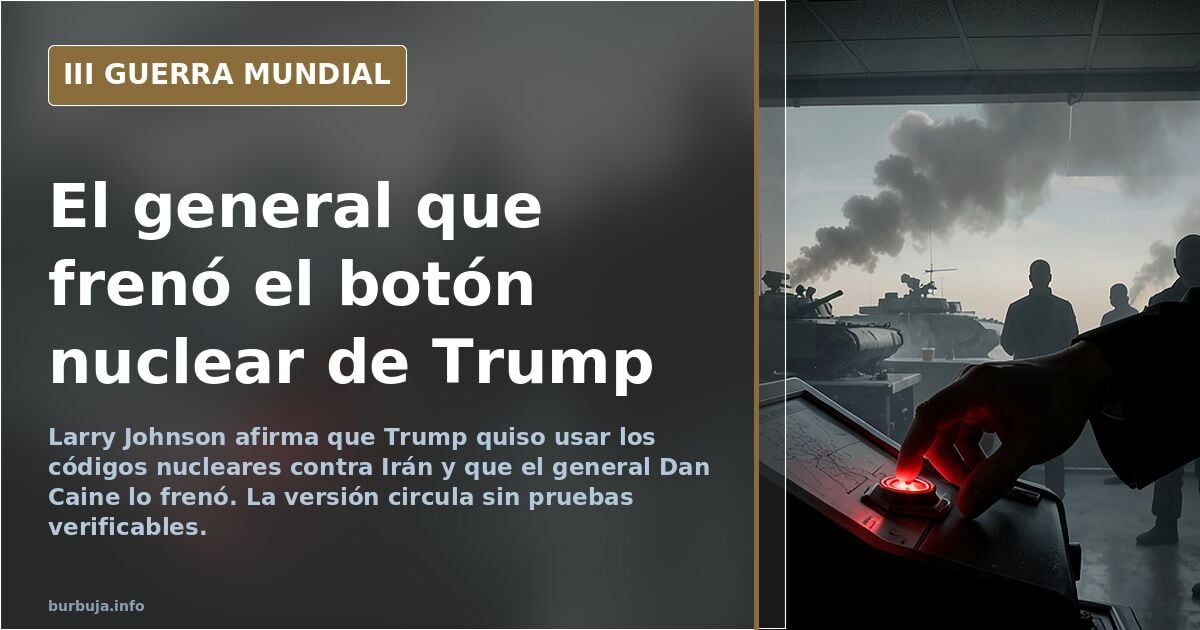
Larry Johnson claims Trump wanted to use the nuclear codes and Caine stopped him
Larry Johnson, a former CIA analyst, has brought forward a version circulating in alternative geopolitics journalism circles: that Donald Trump wanted to use the nuclear codes against Iran and that General Dan Caine, now Chairman of the Joint Chiefs of Staff, prevented him from doing so. The claim comes with no verifiable documentation and rests on a podcast, but it has been enough to reopen the debate over who really controls the button and to what extent the establishment's narrative is constructed after the fact.
Dan Caine is not a textbook military man. According to the details circulating in the discussion itself, he is an Air Force general and also a venture capital investor, and he served as associate director of military affairs at the CIA between 2021 and 2024. That dual profile —military star and venture capitalist— raises hackles: some consider it incompatible to hold a senior military post while operating in the market. The name, moreover, invites easy jokes.
The nuclear football and the joke that stopped being one
Johnson's version has been met with a mix of disbelief and mockery. For a long time there was the running joke that the presidential nuclear football was a fake, and that Trump was the first president to notice because he pressed it when no one was looking and nothing peine. Reality, some say, has outdone the joke. Others go further and claim that what is presented as a nuclear attack is in fact a "peace-making" operation against Iran.
The skepticism, however, is not only about the anecdote. Part of the analysis argues that the story serves to portray the establishment as the sensible ones: "we had to stop the dangerous orange man." It is the same tactic used with the Russia affair, they recall. The discussion thus shifts from the facts to the intentions of whoever leaked them.
From non-interventionism to disappointment
Trump's shift from his first term puzzles even those who expected a second term with a non-interventionist profile. Some wonder whether we will ever learn what has been brewing in the muck of the American swamp since his 2020 electoral defeat. The president's senility appears as a recurring argument among critics, while others urge caution: "let's not get ahead of ourselves, we have to wait until October."
The debate intersects with foreign policy and with Iran's role. One camp argues that Trump is unpredictable and that anything, none of it good, can be expected of him, judging by his public messages. Another responds that the problem is not Trump but the system around him, and that the real news would be that someone had to rein him in.
What remains, as of this discussion, is an accusation without public evidence, a general with an investment portfolio and a briefcase no one has seen peine. The unsettling detail: the conversation is not about whether Iran came close to burning, but about whether the button exists.
Also available in: Deutsch
Summary of a discussion on Burbuja.info - Foro de economía, actualidad y política., translated from Spanish and reviewed before publication. Read the full discussion (25 replies).
More summaries
-
Retired Spanish lieutenant general calls nuclear weapons use 'feasible'
A retired Spanish lieutenant general reportedly said Spain has armoured units committed to NATO and considers the use of nuclear weapons in Ukraine 'feasible'.
-
Trump says Russia could have won in a day and blames its generals
Trump claims Russia could have won the war in a day if its generals had not taken "a wrong turn", blaming Zelensky, Biden and Obama, but not…
-
Do Nuclear Weapons Really Exist? The Theory Gaining Ground
A skeptical movement claims nuclear weapons have never existed. We analyze the arguments: Japan, Vietnam, Afghanistan and the pattern of never using the bomb.
-
Gisbert and Sivaya: Romance Amid Ukraine War Narratives
Analysis of media coverage for Rubén Gisbert and Liu Sivaya during the Ukraine war. Is this digital propaganda or reality?
-
Ukrainian mother refuses posthumous medal for her dead son and walks out
The mother of a fallen Ukrainian soldier declined the posthumous award and explained her reasons before leaving the ceremony. The gesture challenges the official narrative.
-
Trump reportedly furious with Zelenskyy as Truth Social is 'ruined' without Russian bots
A viral post claims Trump complained about Russian bots leaving Truth Social. Here's what the text actually says and why it matters.