
Landlord with 150 flats in Spain: 'It's impossible to rent them out'
Rubén Zaballos, 39, says he rents his 150 flats for an average of €300 and pays €100,000 in mortgages, figures that don't add up according to several calculations.
English · Original discussion in Spanish · Published
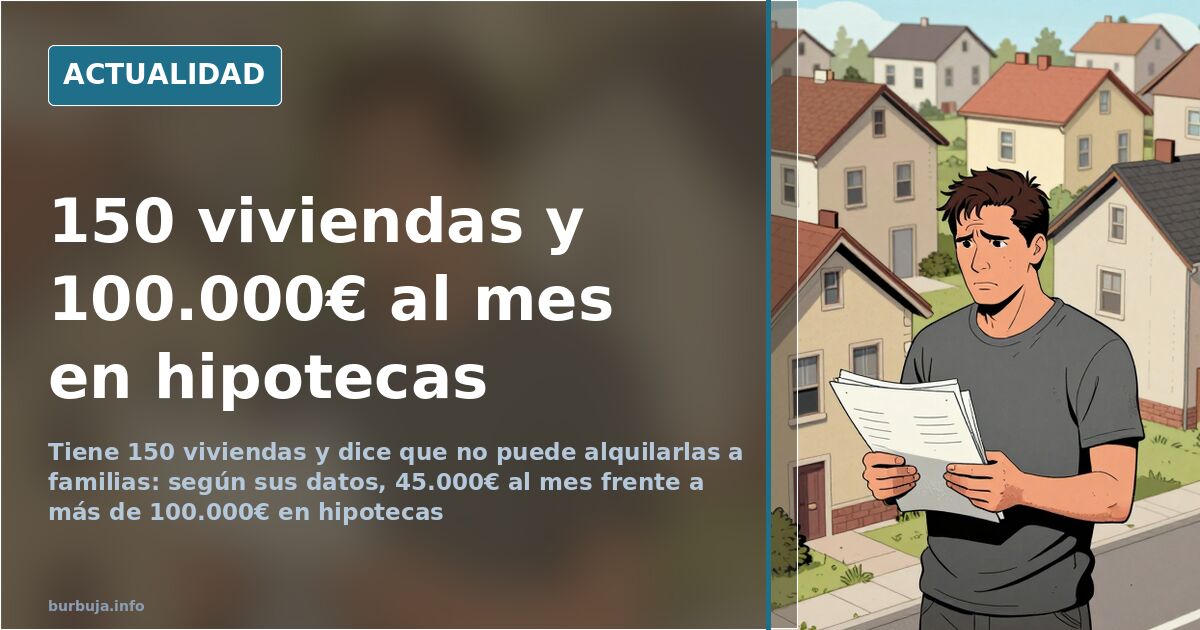
150 flats, €100,000 in mortgages and an average rent of €300
Rubén Zaballos, 39 years old and the owner of 150 flats, doesn't have a money problem. He has a time problem. And, judging by the figures he himself laid on the table on La Mesa, the Antena 3 show hosted by Cristina Pardo, he also has — according to those who did the maths during the debate — an arithmetic problem. On 30 September, the businessman said he would 'love' to rent his residential flats to families 'on a long-term basis', but that the experience — squatters, professional squatters, drug-dealing dens — had made it 'impossible'. His portfolio, he explained, mixes residential housing and tourist apartments.
The numbers given by the owner of 150 flats
The figure that raises eyebrows is the average rent: €300 a month. For 150 flats, that works out at €45,000 in monthly income. On the other side of the scales, Zaballos himself admits to more than €100,000 a month in mortgage payments and a staff of 60 employees. He insists his concern isn't money but the hours spent dealing with incidents: 'I can't be on the lookout for a lightbulb blowing in a flat.' The remark, exactly as he said it, allows two readings. One is sympathetic. The other, the one held by several debate participants, is that a structure like this cannot survive on that average rent.
60 employees for 150 flats: the ratio being questioned
Dividing 150 properties among 60 workers comes to 2.5 properties per person. For straightforward residential letting, that ratio doesn't fit, according to those who analysed the case, who point to a coliving model, serviced apartments with cleaning and turnover, or tourist rentals, where the cost per unit skyrockets. There, the average price of €300 would stop being a monthly rent and would become, in many cases, a price per short stay. A blended average would miccionan nothing.
Why he says he can't rent to families
His argument is that he already tried and it cost him dearly: unpaid rent, squatting, incivil activity in some of the properties. That account chimes with what some debate participants maintain: that current legislation shifts the risk onto small landlords, and that the sensible response is to withdraw flats from long-term letting. Against that, the calculations circulating online start from opposite hypotheses: the more optimistic one, that part of the €300 are tourist prices and the rest of the average is weighted downwards; the pessimistic one, taking the figure at face value and concluding that the business only works if real income is far higher than declared.
The backdrop: evictions, old leases and a pending decree
Zaballos's case has emerged in a charged atmosphere. In the same context, the vote on the housing decree was still open, with a protest camp under way. And the Spanish government itself is reported to have privately admitted that fixing the housing problem is 'impossible' in the short and medium term. In parallel, the case of Maricarmen Abascal, 87 years old and evicted after a long legal battle over an old-regime lease (a rent-controlled contract) signed in 1956 by her father, ended with an agreement and her return home. That contrast — the elderly woman with a frozen rent and the holder of 150 flats — is what has ignited the conversation.
Figures about his portfolio are all over the place: 150 flats in some versions, 200 in others. One big caveat remains: nobody knows how many of those 150 are residential and how many are tourist lets.
Also available in: Deutsch
Summary of a discussion on Burbuja.info - Foro de economía, actualidad y política., translated from Spanish and reviewed before publication. Read the full discussion (47 replies).
More summaries
-
2000 BOE Notice Reveals Maricarmen's Collado Mediano Property Auction
A June 2000 Official Gazette notice lists María del Carmen Abascal as debtor for a Collado Mediano chalet auctioned for 20 million pesetas by Banco Zaragozano.
-
Antena 3 and the '45-year-old children' the internet refuses to buy
Antena 3's report on 'nearly a thousand children alone on the streets' has run into a wall of online mockery, with users pointing out they look like adults. An analysis of the case.
-
Squatting Workshop in Madrid's Puerta del Sol Sparks Debate on Housing Crisis
A protest camp in Madrid's Puerta del Sol offers information on squatting, highlighting the housing crisis and 'anti-rentism' sentiment.
-
Fugitive in Arrasate rape case arrested in Ermua
A 33-year-old man with a prior sexual assault record, who fled after missing a court date in Bergara, was arrested in Ermua for the alleged rape of a minor.
-
Belarus names the Sviridyuk family Family of the Year
The Sviridyuk family, from the Brest region, won Belarus's seventh national Family of the Year contest, which featured seven finalist families.
-
Silvia Intxaurrondo breaks her silence after vanishing from Spanish public TV
Silvia Intxaurrondo has issued a statement after two weeks off the air on Spain's TVE. Online noise is growing amid accusations of whitewashing and a digital pile-on.