
Land, Public Banks, and Low Rates: Who Made Housing More Expensive?
Restricted land, unchecked lending, and low ECB rates: the rise in Spanish housing prices has specific culprits, none of whom are...
English · Original discussion in Spanish · Published
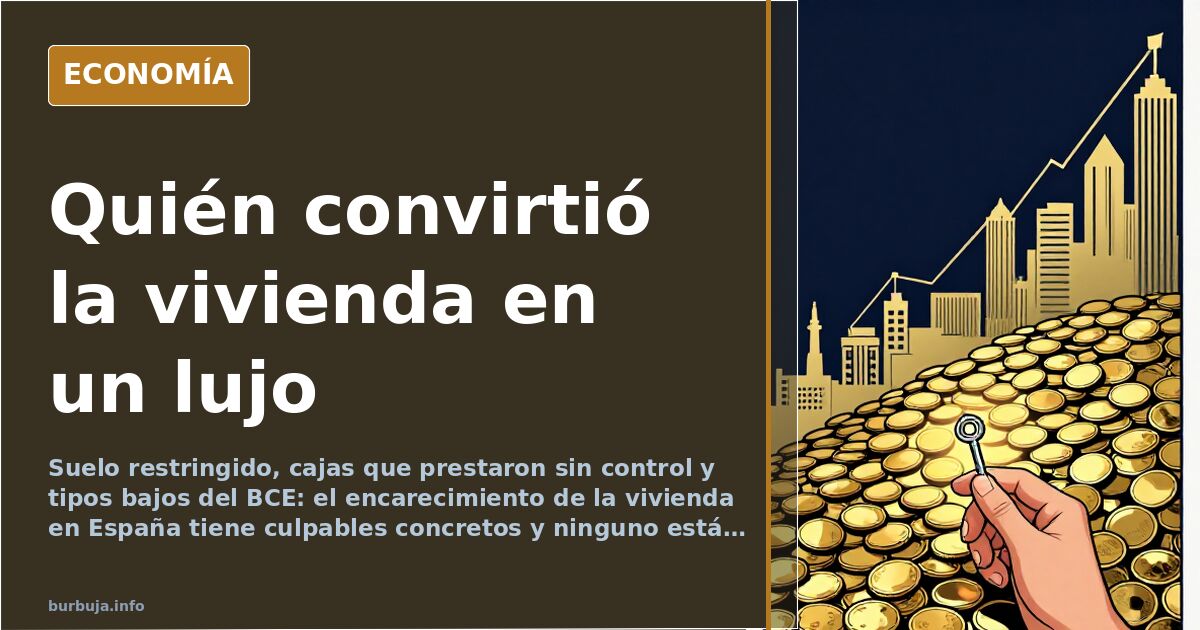
The Four Culprits Behind Housing Becoming a Luxury in Spain
Eight or nine years paying rent, three transit apartments and a house, and finally, the escape. A resident of Seville ended up buying a two-story, 170-square-meter house with a patio and garage in a village for 30,000 euros, because in the city they were asking 160,000 for a mediocre home. This scene is not an isolated anecdote: it is the portrait of a country where owning a roof over one's head has gone from a basic right to a privilege for landlords, heirs, or digital nomads. Who allowed it? The answer, far from a single culprit, distributes blame among urban planning, banking, monetary policy, and demand itself.
Land: The First Lever of Price Increases
The most common accusation points to municipal urban planning. City councils decide where and how to build, and that power, when used to restrict buildable land, drives up land prices and, consequently, the price of finished housing. It is argued that the current land law leaves that power intact, and no major party has dared to dismantle it despite promising to do so.
The criticism even reaches a specific name. The former mayor of Madrid between 2015 and 2019 is singled out for delivering 65 social housing units in four years and for halting several urban land development projects citing environmental criteria. This is not a neutral statistic: half the city blames the other half for blocking construction while prices rose.
Public Savings Banks and a Bailout Paid by Everyone
The second focus points to banks of public origin. The savings banks (cajas de ahorros), managed by boards with strong political representation, granted mortgages indiscriminately to clients who could not repay them, inflating property prices until the bubble burst. The subsequent bailout came out of the common purse: it is estimated that CatalunyaCaixa alone cost as much as all the cuts in healthcare and education during the crisis years, and Bankia exceeded that figure. A bailout for which few managers were held accountable.
The Euro, Low Rates, and the Missing Fuel
There is a third factor that often gets buried: monetary policy. Spain's entry into the euro caught it in full expansion, and when Germany and France entered recession, the central bank lowered interest rates to stimulate them. For Spain, this was like pouring fuel on the fire. Idle capital from France, Holland, and Germany, lacking returns in their depressed economies, sought refuge in Spanish real estate through institutions that said yes to everything.
The contrast cited is striking: in 2008, the United States experienced a housing bubble, and Canada, with an equally developed economy, did not. The difference lay in the limits on borrowing: caps on years, on the percentage of income, and on financing relative to price. Demand was limited to what the buyer could actually afford.
The Buyer Also Signed
It's not all someone else's fault. Another line of analysis blames the lack of financial education. A population without basic money knowledge accepts any loan and any price; an educated population doesn't fall for the scam. It is recalled that in the period 2002-2008, buyers were literally pushed into taking out loans at the bank, and those who signed thirty-year mortgages for overvalued apartments also made their own decision.
The response to this accusation is that the information was never symmetrical. While the individual had hunches, the institution knew. And the result is the same: several generations condemned to pay for life what others bought cheaply.
Rentals: From Subsidized Prices to Eviction as an Excuse
A little-discussed contradiction appears in the rental market. It is said that prices are high, but also that they are subsidized: tax deductions, regional aid, and public guarantees end up in the landlord's pocket, who has no need to lower the rent. A calculation circulating with official data placed the rental non-payment rate at 0.81%, far from the catastrophic narrative that justifies preemptive increases.
Added to this are tourist housing and the antiestéticar of squatting. When a landlord believes their property might be blocked, they raise the price or withdraw it from the market. Less supply, same tenant, rising prices. The collapse of tourism during the pandemic served as an involuntary experiment: empty apartments and a market that moved, although no one waited to see the outcome.
Who is Right and Why the Discussion Remains Unresolved
One part of the analysis calls for liberalizing land and removing taxes; another demands that someone build public housing at affordable prices because the market, it is argued, has no incentive to solve the problem. Around this axis, less solid explanations also appear, such as attributing the price increases to international organizations or demographics. The latter find no support in the data and function more as scapegoats than as diagnoses.
The result is a debate with shared data and opposing conclusions. No one denies the role of land or mortgages. No one denies the low interest rates. The disagreement lies in which of the three took the largest share of the overpricing.
The disquieting fact remains. In Toronto, the average house exceeds 1 million euros with an average salary of around 60,000. In a village in Burgos, a three-story house was found for 71,000. And in Vallecas, there is new construction for 200,000. With these figures on the table, blaming a single factor seems like a convenient way not to look at the others.
Eight or nine years paying rent, three transit apartments and a house, and finally, the escape. A resident of Seville ended up buying a two-story, 170-square-meter house with a patio and garage in a village for 30,000 euros, because in the city they were asking 160,000 for a mediocre home. This scene is not an isolated anecdote: it is the portrait of a country where owning a roof over one's head has gone from a basic right to a privilege for landlords, heirs, or digital nomads. Who allowed it? The answer, far from a single culprit, distributes blame among urban planning, banking, monetary policy, and demand itself.
Land: The First Lever of Price Increases
The most common accusation points to municipal urban planning. City councils decide where and how to build, and that power, when used to restrict buildable land, drives up land prices and, consequently, the price of finished housing. It is argued that the current land law leaves that power intact, and no major party has dared to dismantle it despite promising to do so.
The criticism even reaches a specific name. The former mayor of Madrid between 2015 and 2019 is singled out for delivering 65 social housing units in four years and for halting several urban land development projects citing environmental criteria. This is not a neutral statistic: half the city blames the other half for blocking construction while prices rose.
Public Savings Banks and a Bailout Paid by Everyone
The second focus points to banks of public origin. The savings banks (cajas de ahorros), managed by boards with strong political representation, granted mortgages indiscriminately to clients who could not repay them, inflating property prices until the bubble burst. The subsequent bailout came out of the common purse: it is estimated that CatalunyaCaixa alone cost as much as all the cuts in healthcare and education during the crisis years, and Bankia exceeded that figure. A bailout for which few managers were held accountable.
The Euro, Low Rates, and the Missing Fuel
There is a third factor that often gets buried: monetary policy. Spain's entry into the euro caught it in full expansion, and when Germany and France entered recession, the central bank lowered interest rates to stimulate them. For Spain, this was like pouring fuel on the fire. Idle capital from France, Holland, and Germany, lacking returns in their depressed economies, sought refuge in Spanish real estate through institutions that said yes to everything.
The contrast cited is striking: in 2008, the United States experienced a housing bubble, and Canada, with an equally developed economy, did not. The difference lay in the limits on borrowing: caps on years, on the percentage of income, and on financing relative to price. Demand was limited to what the buyer could actually afford.
The Buyer Also Signed
It's not all someone else's fault. Another line of analysis blames the lack of financial education. A population without basic money knowledge accepts any loan and any price; an educated population doesn't fall for the scam. It is recalled that in the period 2002-2008, buyers were literally pushed into taking out loans at the bank, and those who signed thirty-year mortgages for overvalued apartments also made their own decision.
The response to this accusation is that the information was never symmetrical. While the individual had hunches, the institution knew. And the result is the same: several generations condemned to pay for life what others bought cheaply.
Rentals: From Subsidized Prices to Eviction as an Excuse
A little-discussed contradiction appears in the rental market. It is said that prices are high, but also that they are subsidized: tax deductions, regional aid, and public guarantees end up in the landlord's pocket, who has no need to lower the rent. A calculation circulating with official data placed the rental non-payment rate at 0.81%, far from the catastrophic narrative that justifies preemptive increases.
Added to this are tourist housing and the antiestéticar of squatting. When a landlord believes their property might be blocked, they raise the price or withdraw it from the market. Less supply, same tenant, rising prices. The collapse of tourism during the pandemic served as an involuntary experiment: empty apartments and a market that moved, although no one waited to see the outcome.
Who is Right and Why the Discussion Remains Unresolved
One part of the analysis calls for liberalizing land and removing taxes; another demands that someone build public housing at affordable prices because the market, it is argued, has no incentive to solve the problem. Around this axis, less solid explanations also appear, such as attributing the price increases to international organizations or demographics. The latter find no support in the data and function more as scapegoats than as diagnoses.
The result is a debate with shared data and opposing conclusions. No one denies the role of land or mortgages. No one denies the low interest rates. The disagreement lies in which of the three took the largest share of the overpricing.
The disquieting fact remains. In Toronto, the average house exceeds 1 million euros with an average salary of around 60,000. In a village in Burgos, a three-story house was found for 71,000. And in Vallecas, there is new construction for 200,000. With these figures on the table, blaming a single factor seems like a convenient way not to look at the others.
Summary of a discussion on Burbuja.info - Foro de economía, actualidad y política., translated from Spanish and reviewed before publication. Read the full discussion (576 replies).
More summaries
-
From cheap workers' homes to three million euros
Workers' homes built in Retiro are now worth €3 million, and plots gifted in Alpedrete cost €350,000. Access to housing for the working class...
-
Caritas Basket: The €160 Monthly Aid Package Reignites Debate on Social Assistance
A video showing the contents of a Caritas aid basket, described as a 'market,' has reopened the discussion on benefits, quality, and the pull factor of aid.
-
Euthanasia in Old Age: Autonomy vs. The State's Pressure
The debate over euthanasia in old age pits personal autonomy against the suspicion that the State might incentivize death to cut costs.
-
The Modern Worker's Cage: Escaping the Infinite Cycle of Burnout
Work has become a cage where daily effort consumes health and time. Discover why we push ourselves so hard and how to break the cycle.
-
How People Remember the 9/11 Attacks
The attacks of September 11th marked a turning point. Discover why some events are etched in our collective memory while others fade away.
-
Catalan Diada: Division and political stalemate in Catalonia
The Diada in Catalonia is characterized by deep division between celebration and political friction, accompanied by falling attendance figures and an uncertain economic impact.