
Lampedusa sees 1,000 migrant arrivals in 24 hours as Meloni demands EU aid
Over 1,000 migrants arrived in Lampedusa within 24 hours. Italy nears 130,000 entries this year, prompting Prime Minister Meloni to demand European solidarity.
English · Original discussion in Spanish · Published
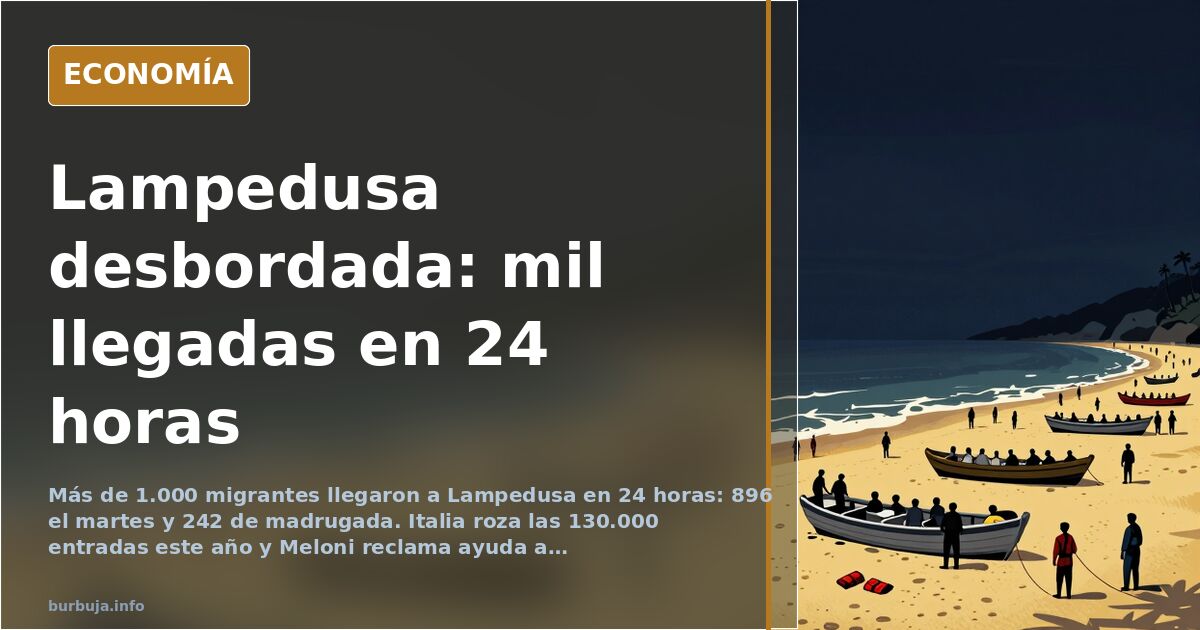
Lampedusa records over 1,000 arrivals; Meloni calls for EU solidarity
An island with roughly 7,000 permanent residents received more than a thousand people in just 24 hours. Lampedusa has once again become the thermometer of the Central Mediterranean: 896 migrants and refugees landed on Tuesday, and another 242 arrived early Wednesday morning across nine boats, the largest carrying nearly 90 people. This is not an isolated spike. The previous week saw approximately 10,000 arrivals in just three days. Across Italy, the total is already approaching 130,000 this year. The paradox is textbook: one of the country's smallest islands absorbing a flow that the entire state struggles to manage.
How many migrants have reached Lampedusa and where do they depart from?
The Ministry of Interior estimates that more than 130,000 people have reached Italian coasts this year, compared to 68,000 in the same period of 2022. Nearly double. The figure shifts from impression to uncomfortable statistical trend, explaining why the island has regained its label as the epicenter of political debate.
The origin of the flow has also shifted. Tunisia has overtaken Libya this year as the main departure point for small boats, a turn that directly pressures southern Italy and which the European Union tries to address through a strategic cooperation agreement with the North African country.
The human toll remains the darkest part of the count. According to the International Organization for Migration (IOM), more than 2,000 migrants have lost their lives in the central Mediterranean so far this year, a record unprecedented since 2017. The IOM itself antiestéticars the actual number is higher.
Why Meloni demands solidarity from Europe at the UN
Italian Prime Minister Giorgia Meloni raised the tone from New York, where she delivered a speech on Wednesday before the UN General Assembly focused on immigration. "I will not allow Italy to become Europe's refugee camp," she declared late Tuesday. Her central argument is that the country cannot solve the problem alone.
The Italian government believes there is still room to collaborate with Tunisia, which it considers "the most sensible option" to curb departures. Brussels shares this approach and has proposed a strategic cooperation agreement with the Tunisian executive. The underlying question is whether such pacts move the needle or merely shift the problem elsewhere.
Who moves the boats: the clash over rescue and NGOs
Much of the discontent is directed at humanitarian rescue ships. Some argue that their presence in waters near the Libyan coast acts as a pull factor and that their funding inadvertently feeds the very networks trafficking people. This is a recurring accusation in public discourse, although no firm conviction supports it as proven fact.
Conversely, others argue that rescue is a legal and sarracena obligation, and that the real business is driven by mafias chartering vessels from land. The deployment of resources to monitor the North African coastline and departure routes remains the point where all versions collide without converging. Each mass arrival reopens the same file without closing it.
The cost of hosting and the underlying demographic pulse
Another line of discussion is economic. Against hosting costs, proposals arise to incentivize native birth rates —a subsidy of 500 euros per child until adulthood is the most repeated suggestion— comparing this with countries that, despite low fertility, have not resorted to massive immigration. Italy's fiscal margin to do both simultaneously is, at best, debatable.
Some go further, framing the phenomenon within a supposed plan for Western demographic transformation. These are conspiracy theories circulating strongly on social media and forums, but lacking supporting evidence. What is verifiable is more mundane: pressure on services in host islands, tension between European partners, and a system that poorly distributes what none wants to assume.
With 896 arrivals on a Tuesday and 242 more overnight, Lampedusa does not debate figures: it counts them. The lingering question is not if numbers will rise again, but how much longer an island of 7,000 inhabitants can single-handedly sustain the narrative of a crisis decided in Brussels and billed in the Mediterranean.
An island with roughly 7,000 permanent residents received more than a thousand people in just 24 hours. Lampedusa has once again become the thermometer of the Central Mediterranean: 896 migrants and refugees landed on Tuesday, and another 242 arrived early Wednesday morning across nine boats, the largest carrying nearly 90 people. This is not an isolated spike. The previous week saw approximately 10,000 arrivals in just three days. Across Italy, the total is already approaching 130,000 this year. The paradox is textbook: one of the country's smallest islands absorbing a flow that the entire state struggles to manage.
How many migrants have reached Lampedusa and where do they depart from?
The Ministry of Interior estimates that more than 130,000 people have reached Italian coasts this year, compared to 68,000 in the same period of 2022. Nearly double. The figure shifts from impression to uncomfortable statistical trend, explaining why the island has regained its label as the epicenter of political debate.
The origin of the flow has also shifted. Tunisia has overtaken Libya this year as the main departure point for small boats, a turn that directly pressures southern Italy and which the European Union tries to address through a strategic cooperation agreement with the North African country.
The human toll remains the darkest part of the count. According to the International Organization for Migration (IOM), more than 2,000 migrants have lost their lives in the central Mediterranean so far this year, a record unprecedented since 2017. The IOM itself antiestéticars the actual number is higher.
Why Meloni demands solidarity from Europe at the UN
Italian Prime Minister Giorgia Meloni raised the tone from New York, where she delivered a speech on Wednesday before the UN General Assembly focused on immigration. "I will not allow Italy to become Europe's refugee camp," she declared late Tuesday. Her central argument is that the country cannot solve the problem alone.
The Italian government believes there is still room to collaborate with Tunisia, which it considers "the most sensible option" to curb departures. Brussels shares this approach and has proposed a strategic cooperation agreement with the Tunisian executive. The underlying question is whether such pacts move the needle or merely shift the problem elsewhere.
Who moves the boats: the clash over rescue and NGOs
Much of the discontent is directed at humanitarian rescue ships. Some argue that their presence in waters near the Libyan coast acts as a pull factor and that their funding inadvertently feeds the very networks trafficking people. This is a recurring accusation in public discourse, although no firm conviction supports it as proven fact.
Conversely, others argue that rescue is a legal and sarracena obligation, and that the real business is driven by mafias chartering vessels from land. The deployment of resources to monitor the North African coastline and departure routes remains the point where all versions collide without converging. Each mass arrival reopens the same file without closing it.
The cost of hosting and the underlying demographic pulse
Another line of discussion is economic. Against hosting costs, proposals arise to incentivize native birth rates —a subsidy of 500 euros per child until adulthood is the most repeated suggestion— comparing this with countries that, despite low fertility, have not resorted to massive immigration. Italy's fiscal margin to do both simultaneously is, at best, debatable.
Some go further, framing the phenomenon within a supposed plan for Western demographic transformation. These are conspiracy theories circulating strongly on social media and forums, but lacking supporting evidence. What is verifiable is more mundane: pressure on services in host islands, tension between European partners, and a system that poorly distributes what none wants to assume.
With 896 arrivals on a Tuesday and 242 more overnight, Lampedusa does not debate figures: it counts them. The lingering question is not if numbers will rise again, but how much longer an island of 7,000 inhabitants can single-handedly sustain the narrative of a crisis decided in Brussels and billed in the Mediterranean.
Also available in: Deutsch
Summary of a discussion on Burbuja.info - Foro de economía, actualidad y política., translated from Spanish and reviewed before publication. Read the full discussion (119 replies).
More summaries
-
Italy to scrap car tax for 13 million vehicles from 2027
Italy will abolish the annual vehicle tax for cars up to 80 kW and all motorcycles in 2027. This affects 13 million vehicles, about 70% of the total.
-
Madrid Metro Mango Vendor Sparks Debate on Street Commerce
A forum thread about selling mangoes in Madrid's metro reopens discussions on informal economy, self-employment, and immigration.
-
Spain's €15,000 housing grant: who really pays?
Spain approves €15,000 for under-36 homebuyers. Debate: real aid or price hike? Initial cost data.
-
Galician nationalist leader Xosé Manuel Beiras dies
Xosé Manuel Beiras, key figure of Galician nationalism, dies at 90. News sparked divided reactions on social media.
-
Spain's Ruíz mocks UDEF for interpreting '10K' as a race
Analysis of the '10K' entry in a Spanish judicial file: media narratives attempt to replace accounting evidence with athletics.
-
NATO Chief Rutte Backs Trump's Greenland Threats
Mark Rutte justifies US threats against Denmark over Greenland. Critics accuse NATO of subservience to Washington while preparing Europe for war.