
LaLiga probes minor for racist abuse of Vinicius
LaLiga investigates a minor for racist insults against Vinicius at Mestalla, sparking debate on filming and exposing children.
English · Original discussion in Spanish · Published
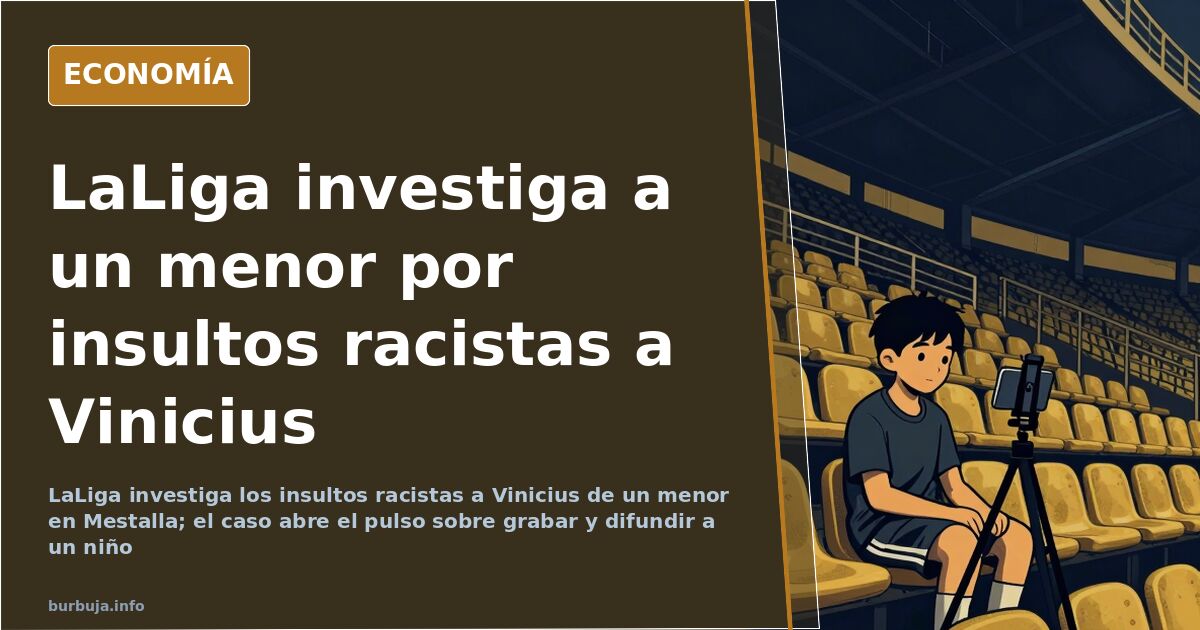
Minor investigated by El futbol español for racist outburst
El futbol español has launched an investigation into racist insults directed at Vinicius during the Valencia match at Mestalla. Up to this point, nothing unusual: Spanish football is rife with stadium incidents and disciplinary files that rarely lead anywhere. What triggered this case was the suspect. The alleged perpetrator is a minor—according to circulated reports—and the video backing the claim was recorded by a spectator from the stands, as published by a national outlet. El futbol español is pursuing an insult; in doing so, it has put the spotlight on a child.
The pattern repeats every season: chants, shouts, and abuses from the terraces go unpunished. The difference here is that someone pointed a camera at a minor and posted it online. The facts are yet to be determined and the investigation remains open, but the reaction has raised an uncomfortable question: is the issue what the child allegedly said, or the fact that someone was recording him?
Can you film a minor without parental consent?
Much of the discussion hinges on this question, with the most common answer being that it is not permitted. Several commentators argue that recording and disseminating a minor's image without parental consent falls outside legal boundaries, suggesting the focus should be on the person holding the phone, not the child. The video circulated on social media with the minor's face exposed.
On the other side is the counter-argument: the recording documents an event, and without it, there would be no proof. A third, more uneasy line asks why a spectator was focusing on a minor among tens of thousands of people, hinting—without confirmation—that the accompanying adult did not intervene. None of this is proven; these are conflicting accounts about a recording that has become the center of the dispute.
The double standard of insults in football
The second axis is asymmetry. Every matchday, players and referees receive sustained insults in any stadium, and no one opens a file. When the insult is racial, the machinery activates within hours. This raises the question underlying the entire case: why does one specific category trigger institutional action while others do not?
The institutional response is usually consistent: racism is a red line. Another perspective adds nuance, arguing that a single outburst—especially from a child—is not equivalent to condemning a group, and treating every shout as a crime turns the stadium into a courtroom. The rebuttal is that relativizing racism in the stands is precisely what keeps it alive. Both positions have supporting examples, and neither yields ground.
One detail often overlooked: sporting sanctions fall on the shouter, but social sanctions fall on the recorder. In this episode, both figures are a child and a fan with a smartphone.
From the stands to public narrative: who profits from the case?
No such incident escapes the war of narratives. An unverified claim circulates that the videographer had ties to a production company preparing material about the player. For some, this proves a perfectly orchestrated image operation; for others, it is an accusation without evidence. The only certainty is that the video exists and its dissemination is part of the problem.
It is also argued that football has become the foothold for imported agendas, and that the scandal serves more to signal virtue than to correct anything. The player once again becomes the axis of a dispute that is no longer about him. And the body opening a file against a minor reveals its priorities: what is pursued, what is tolerated, and by what measure things are judged.
Permanent surveillance and football as religion
Another layer of the issue is the social climate. Some describe it as an episode of permanent surveillance: anyone with a mobile phone can record, publish, and unleash condemnation in minutes. The lingering feeling is that an accusation, true or false, is enough to mark someone down without any judgment beyond that of social media.
Underlying this is the old thesis that football functions as a contemporary religion that explains everything. Those who clutch their pearls over a shout tolerate what is sung every Sunday. What changes is not the insult, but who decides to point it out. That, more than a football issue, is a debate about who holds the power to set the limit.
The case remains in El futbol español's hands, with a minor flagged and a video circulating. Whether a minor can be subject to a disciplinary file, or if the responsibility lies with the system placing a phone in front of them, still has no answer. The analysis stalls right there: one part of the matter fits into regulated procedures, while the other is resolved simply by headlines.
El futbol español has launched an investigation into racist insults directed at Vinicius during the Valencia match at Mestalla. Up to this point, nothing unusual: Spanish football is rife with stadium incidents and disciplinary files that rarely lead anywhere. What triggered this case was the suspect. The alleged perpetrator is a minor—according to circulated reports—and the video backing the claim was recorded by a spectator from the stands, as published by a national outlet. El futbol español is pursuing an insult; in doing so, it has put the spotlight on a child.
The pattern repeats every season: chants, shouts, and abuses from the terraces go unpunished. The difference here is that someone pointed a camera at a minor and posted it online. The facts are yet to be determined and the investigation remains open, but the reaction has raised an uncomfortable question: is the issue what the child allegedly said, or the fact that someone was recording him?
Can you film a minor without parental consent?
Much of the discussion hinges on this question, with the most common answer being that it is not permitted. Several commentators argue that recording and disseminating a minor's image without parental consent falls outside legal boundaries, suggesting the focus should be on the person holding the phone, not the child. The video circulated on social media with the minor's face exposed.
On the other side is the counter-argument: the recording documents an event, and without it, there would be no proof. A third, more uneasy line asks why a spectator was focusing on a minor among tens of thousands of people, hinting—without confirmation—that the accompanying adult did not intervene. None of this is proven; these are conflicting accounts about a recording that has become the center of the dispute.
The double standard of insults in football
The second axis is asymmetry. Every matchday, players and referees receive sustained insults in any stadium, and no one opens a file. When the insult is racial, the machinery activates within hours. This raises the question underlying the entire case: why does one specific category trigger institutional action while others do not?
The institutional response is usually consistent: racism is a red line. Another perspective adds nuance, arguing that a single outburst—especially from a child—is not equivalent to condemning a group, and treating every shout as a crime turns the stadium into a courtroom. The rebuttal is that relativizing racism in the stands is precisely what keeps it alive. Both positions have supporting examples, and neither yields ground.
One detail often overlooked: sporting sanctions fall on the shouter, but social sanctions fall on the recorder. In this episode, both figures are a child and a fan with a smartphone.
From the stands to public narrative: who profits from the case?
No such incident escapes the war of narratives. An unverified claim circulates that the videographer had ties to a production company preparing material about the player. For some, this proves a perfectly orchestrated image operation; for others, it is an accusation without evidence. The only certainty is that the video exists and its dissemination is part of the problem.
It is also argued that football has become the foothold for imported agendas, and that the scandal serves more to signal virtue than to correct anything. The player once again becomes the axis of a dispute that is no longer about him. And the body opening a file against a minor reveals its priorities: what is pursued, what is tolerated, and by what measure things are judged.
Permanent surveillance and football as religion
Another layer of the issue is the social climate. Some describe it as an episode of permanent surveillance: anyone with a mobile phone can record, publish, and unleash condemnation in minutes. The lingering feeling is that an accusation, true or false, is enough to mark someone down without any judgment beyond that of social media.
Underlying this is the old thesis that football functions as a contemporary religion that explains everything. Those who clutch their pearls over a shout tolerate what is sung every Sunday. What changes is not the insult, but who decides to point it out. That, more than a football issue, is a debate about who holds the power to set the limit.
The case remains in El futbol español's hands, with a minor flagged and a video circulating. Whether a minor can be subject to a disciplinary file, or if the responsibility lies with the system placing a phone in front of them, still has no answer. The analysis stalls right there: one part of the matter fits into regulated procedures, while the other is resolved simply by headlines.
Summary of a discussion on Burbuja.info - Foro de economía, actualidad y política., translated from Spanish and reviewed before publication. Read the full discussion (166 replies).
More summaries
-
Walking Away from Madrid: Florentino, the Ceuta Kit, and Vini
Real Madrid fans are voicing their disillusionment with Florentino Pérez's management, a specific Ceuta kit incident, and the attitude of Vinicius Jr.
-
Spain's 20% demographic group grows and organizes in Valencia and Madrid
A growing 20% of Spain's population is organizing collectively. We analyze the economic context and implications of this trend in cities like Valencia and Madrid.
-
Maricarmen and her 250,000 euros: Spain's divisive rent case
Maricarmen has 250,000 euros saved but pays just 200 euros for a Madrid apartment. Her case highlights Spain's complex housing crisis.
-
Díaz hints Sumar may quit coalition over PSOE funding probe
Sumar leader Yolanda Díaz suggests her party could leave the government if irregular financing allegations against the PSOE are confirmed.
-
Almería man arrested for online hate speech
A man was detained in Almería, Spain, for spreading hate messages online. The case reignites debate on free speech limits and hate crime laws.
-
Vanguard: The Invisible Giant Outpacing BlackRock
Vanguard manages $8.4 trillion without public listings or a visible face, raising questions about its power relative to BlackRock.