
La Liga website blocks hit thousands of Spanish shops, no one takes blame
La Liga's anti-piracy blocks are taking down websites of thousands of businesses while Spain's PP, Vox and PSOE trade blame. Who pays for the damage?
English · Original discussion in Spanish · Published
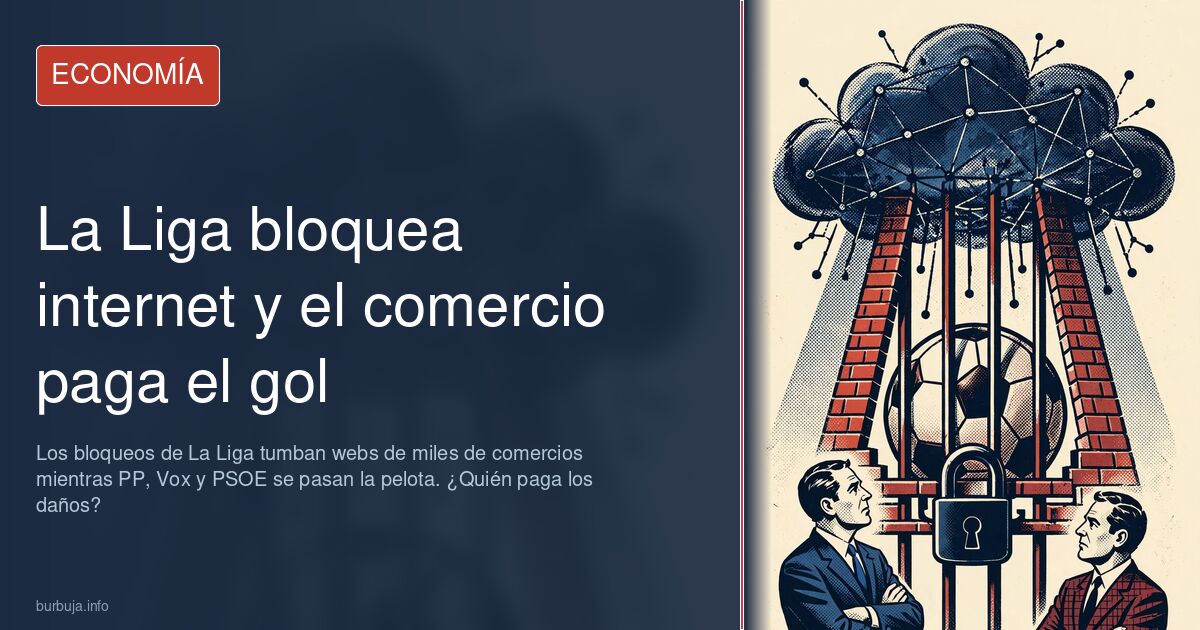
La Liga blocks: thousands of businesses hurt and Spain's Congress stays silent
Have PP and Vox really prioritised La Liga's economic damage over that suffered by tens of thousands of businesses with every internet outage? The question hangs over the economic debate ever since the blocking of match broadcasts started taking down websites with nothing to do with football. A court in Catalonia backed the mechanism, but third parties are footing the bill.
Using a sledgehammer to sustancia ilegal a nut
The mechanics are well known: during matches, La Liga, led by Javier Tebas, asks telecom operators, from Movistar to Orange, to block the IP addresses from which pirate signals are broadcast. The problem is the targeting is sloppy. Entire IP ranges are blocked and, in the process, content delivery systems like Cloudflare go down — according to estimates circulating in technical analysis, Cloudflare handles half of the world's internet traffic. Shop websites, payment gateways and cloud services become temporarily inaccessible. This is no minor side effect: it is a business shutting down in the middle of the working day.
The political fight: nobody wants an own goal
There is no agreement on political responsibility, and the accusations fly. Some argue that PP, Vox and Junts voted against a legal reform that would have limited these blocks, and that right-wing parties stay quiet out of affinity with the owners of the football business. The answer comes swiftly: PSOE is in government and has the tools to change the law but doesn't; a judge orders the blocks, so blaming the opposition is an exercise in cynicism. In between, a more sceptical current points out that the real problem is not piracy but a model that spends tens of millions on signings while asking fans for 100 euros a month.
Football, VPNs and the commerce that pays the price
The debate over VPNs adds fuel to the fire. Anyone who wants to watch pirated football will keep doing so from abroad or with a routing tool; blocking doesn't stop them, it only inconveniences everyone else. The comparison with China looms over the analysis: there, blocking protects a domestic tech industry; here, it shields a private business with inflated costs. Meanwhile, affected businesses pile up losses and responsibility dissolves among judges, operators and political parties.
And while Spain's Congress does nothing, football remains free to watch for anyone who knows how to use a VPN. Those who don't pay for a ticket. And small businesses, quite simply, go dark during the match. For now, the league is winning: no goals against, plenty of businesses caught offside.
Also available in: Deutsch
Summary of a discussion on Burbuja.info - Foro de economía, actualidad y política., translated from Spanish and reviewed before publication. Read the full discussion (75 replies).
More summaries
-
PP and VOX vote to let Tebas' LaLiga keep blocking half the internet every weekend
Spain's Congress votes on LaLiga's internet blocks. Why do PP and VOX oppose the initiative, and what lies behind the IP blocking? Analysis on Burbuja.info.
-
Judge Biedma seeks to join as private prosecutor in PSOE sewer case
Judge Beatriz Biedma petitions to join the PSOE sewer case as a private prosecutor, alleging the group contacted Badajoz drug traffickers to threaten her safety.
-
Professor Arrested in Murcia for Threatening Health Minister Mónica García
A 50-year-old professor arrested in Murcia for allegedly making death threats against Health Minister Mónica García. No prior convictions.
-
Zapatero fights back with an €80,000 valuation of his jewellery
Spain's former prime minister commissions a counter-appraisal valuing his jewellery at €80,000 to avoid the aggravated offence threshold of €600,000. Will the judge buy it?
-
Google sent earthquake alerts in Venezuela: lifesaver or surveillance?
Google's earthquake alert system, active without us knowing, warned Android phones in Venezuela seconds before the quake. Control or salvation?
-
Rutte-Trump: the flattery diplomacy dividing Europe
Trump leaked messages from Rutte: "Can't wait to see you." Strategy or submission? The debate over the NATO leader that is dividing Europe.