
Kroos Chooses Spain: 'Germany Is No Longer Home'
A tweet claims Toni Kroos moved to Spain for safety, sparking debate on Germany's decline and migration double standards.
English · Original discussion in Spanish · Published
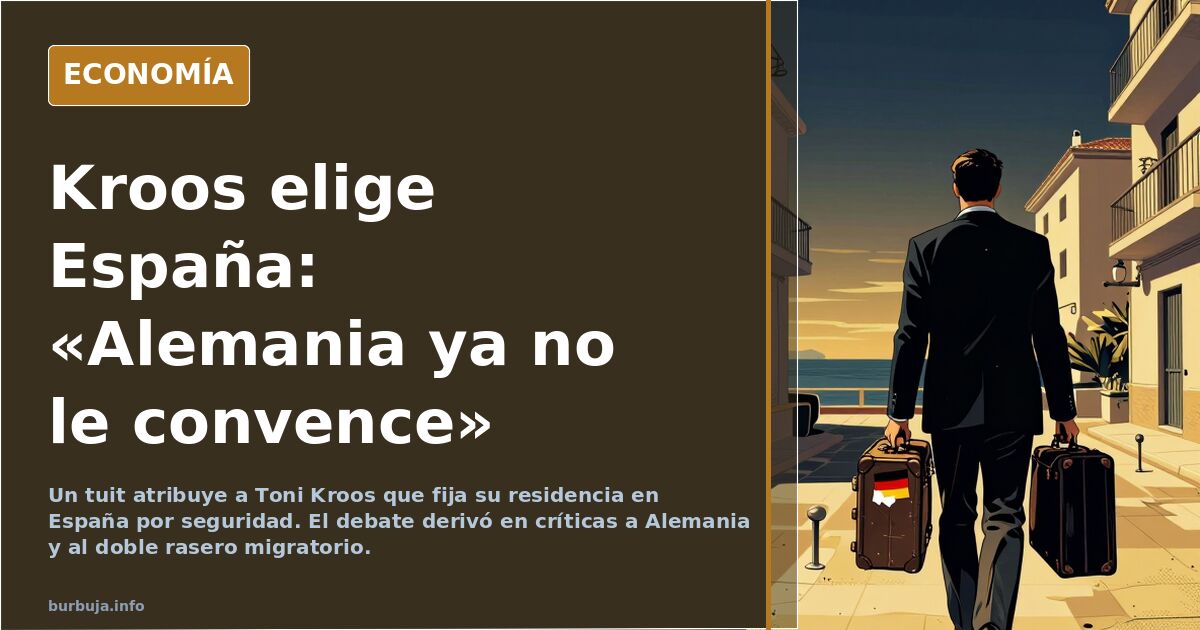
Toni Kroos stays in Spain because he no longer trusts Germany
Is Germany less safe than Spain? This question has swept the internet since a tweet attributed to retired German midfielder Toni Kroos claimed he settled in Spain after hanging up his boots. The alleged reasoning is twofold: comfort and, above all, security. "Germany is no longer the country I left 10 years ago," summarizes the quote that ignited the debate. The discussion is not trivial: it touches on narratives of insecurity, tax policies for high earners, and Germany's economic deterioration.
What did Toni Kroos say and why did it cause controversy?
The trigger was a statement where the footballer compared his life in Spain with his previous life in Germany, concluding he is more comfortable here. He does not speak of neighborhoods, but of the country. That is where the problem begins: a millionaire does not experience insecurity the way a salaried worker does. Most replies point to this: Kroos lives in private gated communities on the outskirts of Madrid, travels by car with a driver, and rarely visits the city center except to go to the stadium. Therefore, the comparison is between two bubbles, not between two societies.
Some recall that the German player has made critical statements about immigration and expressed concern for his daughters' safety, noting that his discourse on security aligns with a segment of the German electorate that has shifted toward harder positions on migration. Everyone tells the story according to how things go for them, and things are going well for Kroos here.
Security: Is Spain safer than Germany?
Here the evidence splits into two camps. One group argues that Spain is a hyper-safe country compared to its European neighbors, and that the narrative of chaos is a media construction. Another group responds with contrary experiences: thefts of luxury watches, pickpocketing in tourist areas, and a sense of deterioration not reflected in official statistics. The debate gets tangled because no one cites the same source.
What clearly emerges is a pattern: security depends less on the country than on the postal code. Those living in exclusive areas of Madrid or Barcelona describe absolute tranquility; those in working-class neighborhoods describe something else. Kroos did not come to discuss that. He came to say that life is better here, which in Germany is read as an insult.
The economic backdrop: Germany is fading
The thread quickly jumps from football to macroeconomics. It mentions the loss of German industrial competitiveness, rising energy costs trinc the cut-off of Russian gas, Chinese competition in the automotive sector, and a fiscal policy that punishes middle- and high-income taxpayers. The conclusion shared by very different voices: Germany is no longer the locomotive it once was, and those who can, move away.
The favorite destination, for obvious reasons, is Spain. Sun, lower cost of living, and a tax regime for non-residents that has turned the country into a magnet for European wealth. Welcome refugees, some joke ironically, referring to the double standard regarding immigration: those arriving on rafts versus those arriving on private jets.
The double standard in migration discourse
This is the most uncomfortable point of the debate. Kroos, as recalled, has made critical statements about immigration and expressed concern for his daughters' safety. Defenders of this line argue that criticism of uncontrolled immigration is compatible with living in Spain, because the immigration Spain receives is not the same as what Germany receives. Critics respond with accusations of hypocrisy: if the problem were insecurity, you wouldn't move to a country with higher unemployment and greater inequality.
The material does not resolve the contradiction. It leaves it open, like a pebble in the shoe of the official narrative. And that is probably the most interesting part of the whole affair.
In the end, the question is not whether Kroos is right. The question is how many wealthy Germans are making the same calculation silently, without cameras rolling. That is what is truly frightening.
Also available in: Deutsch
Summary of a discussion on Burbuja.info - Foro de economía, actualidad y política., translated from Spanish and reviewed before publication. Read the full discussion (156 replies).
More summaries
-
Madrid's Insecurity Perception and Political Debate
Analysis of insecurity perception in Madrid and the debate on migration policies fueling social tension.
-
Latin American millionaires leave Madrid's Salamanca district for La Moraleja
Security concerns and overcrowding are pushing Latin America's biggest fortunes out of Madrid's Salamanca neighbourhood towards the exclusive gated estate of La Moraleja, according to…
-
Sainz de Baranda in 1940: Not Luxury, Not Salamanca
In 1940, Sainz de Baranda was Madrid's edge, not the upscale Salamanca district. Mari Carmen’s flat wasn’t Móstoles either; her family arrived in 1957.
-
Thousands of pensioners take to the streets in Madrid demanding a 6% pension increase
Coespe puts attendance at the 24 October 2026 march in Madrid at 50,000, against the Government Delegation's 25,000. They were demanding a 6% rise.
-
Why does Spain innovate so little?
Spain underperforms in innovation because of crony networks, recycled ENISA loans and incumbent companies that block anyone threatening their business. Here is why.
-
Sánchez on La Revuelta: promises to renew Broncano if he wins
Spain's PM Sánchez promised on TVE's La Revuelta to renew Broncano's show if he wins. The interview, with pre-agreed questions and applause, fuels controversy over the use of public television.