
Kremenchuk Mall Attack: 1,000 Civilian Deaths Unverified
Two Russian missiles struck a Kremenchuk shopping mall, with initial reports citing up to 1,000 civilians inside. Skepticism arose as parking lot footage showed the area nearly empty.
English · Original discussion in Spanish · Published
The 1,000 Unverified Kremenchuk Victims
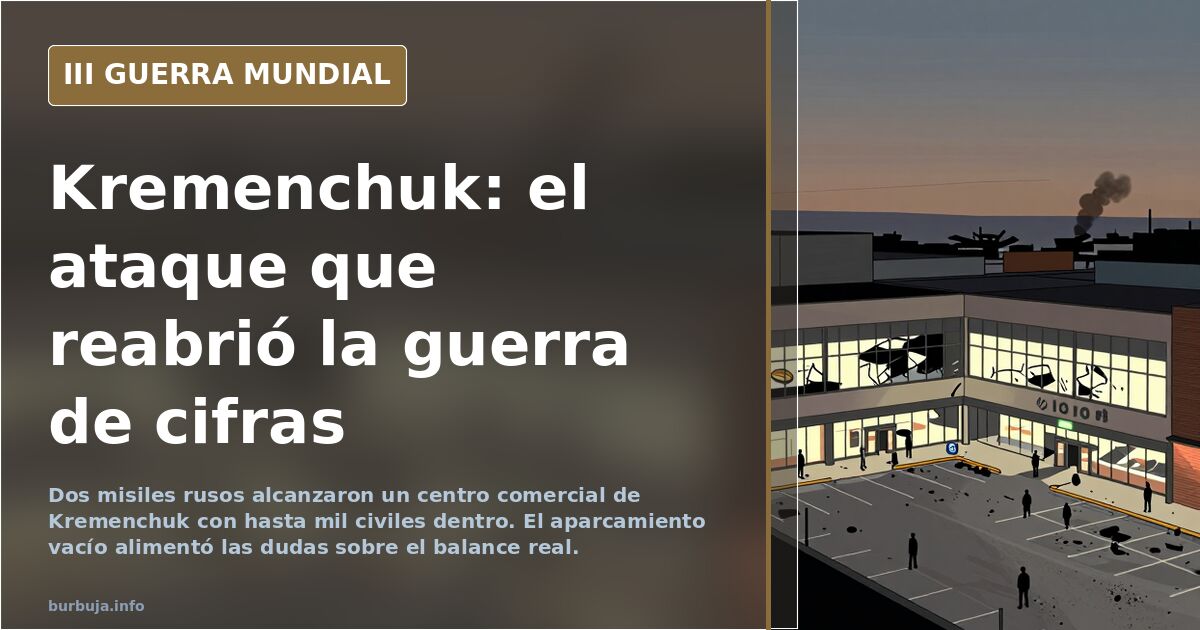
Two missiles struck a shopping mall in Kremenchuk, central Ukraine, during daylight hours. This fact is undisputed. The controversy centers on the casualty count: initial reports claimed up to 1,000 people were inside. The mayor mentioned multiple victims, with early sources citing over a hundred dead. Zelensky called the death toll "impossible" to imagine and stated the target had no military value. However, a troubling detail emerged in early videos: the parking lot was nearly empty.
What is known about the Kremenchuk mall attack
The attack involved two daytime explosions at a commercial complex in a city situated far from the front lines. Early descriptions described trapped people, dense smoke, and screams. Local authorities reported multiple victims, and the Ukrainian presidency emphasized the target lacked military value. Simultaneously, the widely repeated estimate emerged: over a hundred dead and up to 1,000 people inside. None of this was accompanied by the official, verified count required in wartime.
This is where the problem began. Between the narrative of maximum drama and the available evidence, a gap emerged that no one has fully closed.
Why is the figure of 1,000 civilians questioned?
Skepticism arose from the prosaic detail of the parking lot. Images showed only three or four vehicles. The description of the single-story building with many closed shops was cited, along with Google reviews suggesting it was impossible for 1,000 people to be inside at that hour.
Is a parking lot sufficient proof? No. But the gap between the announced scale of the tragedy and the actual size of the location leaves a recurring breach in this war: the first casualty of any bombing is arithmetic. A counter-argument is also reasonable: underreporting in combat zones, displaced populations, and restricted access distort any count made from outside.
Iraq in 41 Days vs. Ukraine in Over Four Months
Here are the numbers presented. A cited count placed US invasion civilian casualties in Iraq at 7,434 in one month and eleven days, according to iraqbodycount.org. For Ukraine, the same exercise yielded 4,731 civilians killed by June 27, after four months and three days, according to UN human rights office records.
The uncomfortable corollary: if Russia were leveling entire cities, civil mortality records would not match that portrait. It is rebutted that an army can fight street by street — Mariupol is the cited example — without carpet bombing, and that structural damage does not equate to proportional slaughter. Each figure allows two readings, and neither closes on its own.
Bucha, Kramatorsk, and Mariupol: The Precedents That Matter
Distrust did not begin with this attack. The material repeats three names as scars: Bucha, the Kramatorsk station, and the Mariupol theater. Regarding Bucha, it is held that an urgent Security Council meeting was blocked, and it is debated with which prosecutors and from which countries the investigation should be formed to be considered independent. Regarding the Kramatorsk station, it is asserted that the perpetrator was Ukrainian. And regarding the Mariupol theater, that the victims never appeared.
Each of these episodes remains disputed, and precisely for that reason it functions as ammunition: who has doubted once will not swallow without chewing again. The result is an ecosystem where the most serious news is received with the same suspicion as the most blatant.
The NATO Summit and Roscosmos Coordinates
The attack coincided with the NATO summit in Madrid, where the dispatch of heavy weaponry to Ukraine was discussed. This context was interpreted in two opposite directions: as proof that Moscow punishes civilians to break the West, or as a reason to suspect the timing of the strike. In the same window, the Russian state space agency published coordinates of Western decision centers — including the White House, the Pentagon, and NATO headquarters in Brussels — in a display of muscle that calmed no one.
The false flag argument also appeared, the most common in each massacre without closed authorship. Formulated without evidence, it is as unprovable as its denial.
The Disconcerting Data
The pieces that do not fit remain. It is asserted that an international media outlet had the attack story prepared ten hours before impact; verification is not recorded. And while it is debated whether there were 1,000 civilians or none, the most cited element to doubt the toll is not a forensic report or satellite imagery, but Google reviews of a shopping mall and the number of cars in a parking lot. With these threads, any future verification arrives too late.
Two missiles struck a shopping mall in Kremenchuk, central Ukraine, during daylight hours. This fact is undisputed. The controversy centers on the casualty count: initial reports claimed up to 1,000 people were inside. The mayor mentioned multiple victims, with early sources citing over a hundred dead. Zelensky called the death toll "impossible" to imagine and stated the target had no military value. However, a troubling detail emerged in early videos: the parking lot was nearly empty.
What is known about the Kremenchuk mall attack
The attack involved two daytime explosions at a commercial complex in a city situated far from the front lines. Early descriptions described trapped people, dense smoke, and screams. Local authorities reported multiple victims, and the Ukrainian presidency emphasized the target lacked military value. Simultaneously, the widely repeated estimate emerged: over a hundred dead and up to 1,000 people inside. None of this was accompanied by the official, verified count required in wartime.
This is where the problem began. Between the narrative of maximum drama and the available evidence, a gap emerged that no one has fully closed.
Why is the figure of 1,000 civilians questioned?
Skepticism arose from the prosaic detail of the parking lot. Images showed only three or four vehicles. The description of the single-story building with many closed shops was cited, along with Google reviews suggesting it was impossible for 1,000 people to be inside at that hour.
Is a parking lot sufficient proof? No. But the gap between the announced scale of the tragedy and the actual size of the location leaves a recurring breach in this war: the first casualty of any bombing is arithmetic. A counter-argument is also reasonable: underreporting in combat zones, displaced populations, and restricted access distort any count made from outside.
Iraq in 41 Days vs. Ukraine in Over Four Months
Here are the numbers presented. A cited count placed US invasion civilian casualties in Iraq at 7,434 in one month and eleven days, according to iraqbodycount.org. For Ukraine, the same exercise yielded 4,731 civilians killed by June 27, after four months and three days, according to UN human rights office records.
The uncomfortable corollary: if Russia were leveling entire cities, civil mortality records would not match that portrait. It is rebutted that an army can fight street by street — Mariupol is the cited example — without carpet bombing, and that structural damage does not equate to proportional slaughter. Each figure allows two readings, and neither closes on its own.
Bucha, Kramatorsk, and Mariupol: The Precedents That Matter
Distrust did not begin with this attack. The material repeats three names as scars: Bucha, the Kramatorsk station, and the Mariupol theater. Regarding Bucha, it is held that an urgent Security Council meeting was blocked, and it is debated with which prosecutors and from which countries the investigation should be formed to be considered independent. Regarding the Kramatorsk station, it is asserted that the perpetrator was Ukrainian. And regarding the Mariupol theater, that the victims never appeared.
Each of these episodes remains disputed, and precisely for that reason it functions as ammunition: who has doubted once will not swallow without chewing again. The result is an ecosystem where the most serious news is received with the same suspicion as the most blatant.
The NATO Summit and Roscosmos Coordinates
The attack coincided with the NATO summit in Madrid, where the dispatch of heavy weaponry to Ukraine was discussed. This context was interpreted in two opposite directions: as proof that Moscow punishes civilians to break the West, or as a reason to suspect the timing of the strike. In the same window, the Russian state space agency published coordinates of Western decision centers — including the White House, the Pentagon, and NATO headquarters in Brussels — in a display of muscle that calmed no one.
The false flag argument also appeared, the most common in each massacre without closed authorship. Formulated without evidence, it is as unprovable as its denial.
The Disconcerting Data
The pieces that do not fit remain. It is asserted that an international media outlet had the attack story prepared ten hours before impact; verification is not recorded. And while it is debated whether there were 1,000 civilians or none, the most cited element to doubt the toll is not a forensic report or satellite imagery, but Google reviews of a shopping mall and the number of cars in a parking lot. With these threads, any future verification arrives too late.
Summary of a discussion on Burbuja.info - Foro de economía, actualidad y política., translated from Spanish and reviewed before publication. Read the full discussion (436 replies).
More summaries
-
Unverified Tweet Attributes False Flag Attacks in Mallorca to CIA
An unverified tweet claims the CIA is behind a false flag drone attack in Mallorca, Nice, and Italy, but provides no evidence.
-
Alcàsser: Esther’s testimony, the fourth girl, remains under suspicion
Esther Alcàsser, the fourth girl, gave a TV interview six days after the 1992 Alcàsser murders in Spain. Her account and timeline discrepancies fuel ongoing controversy.
-
Catastrophic Predictions: Global Escalation Risks and Tensions
Analysis of military escalation and global risks, examining catastrophic predictions, nuclear threats, and geopolitical crisis.
-
Spain Denies Asylum to Ukrainians for Evading Military Service
Spain denies asylum to Ukrainians evading military service, sparking debate on civic duty and double standards in migration policy.
-
Russia-Finland Tensions: Neutrality vs. NATO Pressure
Analysis of Russia-Finland tensions regarding NATO. Is neutrality viable, or is geopolitical pressure unsustainable?
-
Colombian Mercenaries in Ukraine: High Pay, High Mortality
Former Colombian soldiers fight in Ukraine for unmatchable salaries, facing high mortality and unverified casualty figures.