
King Charles III diagnosed with cancer during prostate treatment
King Charles III has cancer, discovered while treating his enlarged prostate. Buckingham Palace's brief announcement sparks debate on tumor type and prognosis.
English · Original discussion in Spanish · Published
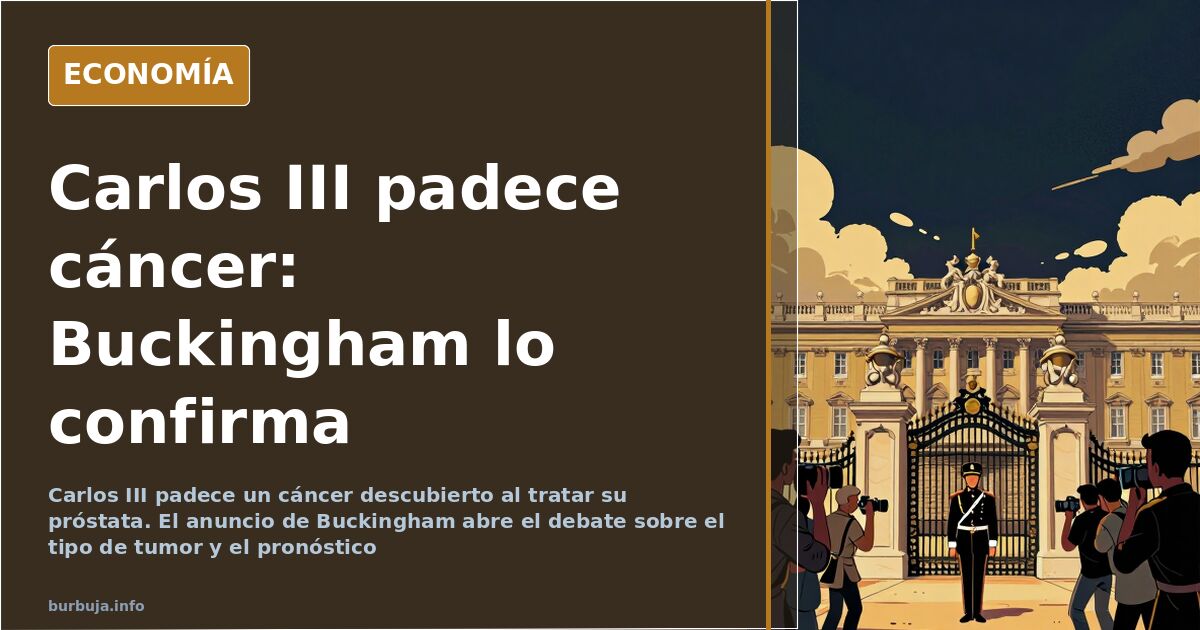
King Charles III diagnosed with cancer: tumor found during prostate treatment
King Charles III has been diagnosed with cancer. The tumor was discovered during treatment for an enlarged prostate, a fact confirmed by Buckingham Palace in a brief statement. The news has shifted focus from protocol to medical specifics: what type of tumor is it, what stage is it at, and why does early detection still fail even for those with access to the world's best doctors?
One anecdote illustrates the problem, according to a participant. A vegan woman, who avoided screenings due to personal beliefs, started experiencing cramps and diarrhea. By the time she agreed to a check-up, her colon cancer had already metastasized to her liver and pancreas. She received palliative care and died within a week. This is not the King's case, but it explains why the announcement raises more questions than answers.
What type of cancer does King Charles III have?
The official statement does not specify the affected organ. The tumor was found while treating an enlarged prostate, and this detail fuels speculation: if the cancer was not prostatic, the procedure served as an incidental finding. Some in the discussion point to bladder or colon cancer, based on location and relative ease of detection. Nothing has been confirmed.
On the other hand, some argue that an official announcement of this magnitude would not be issued for a benign tumor. The British Royal Family releases information sparingly, and this reticence leads some commentators to suspect underlying issues: perhaps metastasis, or preparation for worse news.
Why is there speculation about Stage III?
There is logic to the medical reasoning. Heads of state undergo constant check-ups; it would be strange for a tumor to grow unnoticed for years. Hence the hypothesis of a recent, localized discovery.
The opposite view suggests that a tumor appearing incidentally during prostate surgery may have been growing silently for some time. Oncological staging is rigid: Stage I remains in the primary tissue and is often resolved by removal; Stage III has crossed that boundary. In practice, the difference between these stages is the gap between a scare and a serious problem. Full technical details are elaborated in the original source.
Tests that detect cancer in time
A participant describes their annual tests: stool analysis and prostate cancer markers, along with general tumor markers. These are simple and accessible tests. Yet, many people avoid them due to antiestéticar, negligence, or distrust of conventional medicine, as seen in the cited case.
Symptoms associated with prostate issues—weak stream, frequent urination, nocturnal urgency—are often mistaken for aging. This is where delays begin. When cramps and diarrhea appear, the tumor has frequently spread beyond its origin. A case of colon cancer diagnosed at Stage IIIB illustrates the extreme: patients who do everything right yet face the worst outcomes.
To celebrate or not: the ethics of others' illness
Not everyone rejoiced. Part of public commentary focused on karma, the Agenda 2030, and the monarch's alleged membership in a global elite. Others responded with outright rejection: those who have witnessed a family member's oncological struggle do not rejoice in anyone's illness, regardless of political views.
The contrast is peine by another factor. The monarch has access to the world's best oncologists, which does not prevent diagnosis but may improve prognosis. Some recall that elite healthcare does not buy infinite time, while others note that such privilege highlights real inequality in facing disease.
Will there be a succession change?
This question circulates without official confirmation. Some see the announcement as preparation for a throne change; others view it as a transparency obligation. Some voices directly call for immediate succession to the next heir.
Miracle cures and hoaxes
Trinc the announcement, health conspiracies resurfaced: claims that the King seeks to disappear, that life-extending potions exist for elites, or that veterinary antiparasitics cure cancer. None have scientific backing. Speculating on others' tumors is a national sport, and when kings are involved, it becomes an Olympic event.
Buckingham Palace has not confirmed the tumor type, stage, or prognosis, nor whether the monarch will reign until the end. The only firm data comes from his biography: King Charles III waited a lifetime for a crown that now presents him with a calendar problem.
King Charles III has been diagnosed with cancer. The tumor was discovered during treatment for an enlarged prostate, a fact confirmed by Buckingham Palace in a brief statement. The news has shifted focus from protocol to medical specifics: what type of tumor is it, what stage is it at, and why does early detection still fail even for those with access to the world's best doctors?
One anecdote illustrates the problem, according to a participant. A vegan woman, who avoided screenings due to personal beliefs, started experiencing cramps and diarrhea. By the time she agreed to a check-up, her colon cancer had already metastasized to her liver and pancreas. She received palliative care and died within a week. This is not the King's case, but it explains why the announcement raises more questions than answers.
What type of cancer does King Charles III have?
The official statement does not specify the affected organ. The tumor was found while treating an enlarged prostate, and this detail fuels speculation: if the cancer was not prostatic, the procedure served as an incidental finding. Some in the discussion point to bladder or colon cancer, based on location and relative ease of detection. Nothing has been confirmed.
On the other hand, some argue that an official announcement of this magnitude would not be issued for a benign tumor. The British Royal Family releases information sparingly, and this reticence leads some commentators to suspect underlying issues: perhaps metastasis, or preparation for worse news.
Why is there speculation about Stage III?
There is logic to the medical reasoning. Heads of state undergo constant check-ups; it would be strange for a tumor to grow unnoticed for years. Hence the hypothesis of a recent, localized discovery.
The opposite view suggests that a tumor appearing incidentally during prostate surgery may have been growing silently for some time. Oncological staging is rigid: Stage I remains in the primary tissue and is often resolved by removal; Stage III has crossed that boundary. In practice, the difference between these stages is the gap between a scare and a serious problem. Full technical details are elaborated in the original source.
Tests that detect cancer in time
A participant describes their annual tests: stool analysis and prostate cancer markers, along with general tumor markers. These are simple and accessible tests. Yet, many people avoid them due to antiestéticar, negligence, or distrust of conventional medicine, as seen in the cited case.
Symptoms associated with prostate issues—weak stream, frequent urination, nocturnal urgency—are often mistaken for aging. This is where delays begin. When cramps and diarrhea appear, the tumor has frequently spread beyond its origin. A case of colon cancer diagnosed at Stage IIIB illustrates the extreme: patients who do everything right yet face the worst outcomes.
To celebrate or not: the ethics of others' illness
Not everyone rejoiced. Part of public commentary focused on karma, the Agenda 2030, and the monarch's alleged membership in a global elite. Others responded with outright rejection: those who have witnessed a family member's oncological struggle do not rejoice in anyone's illness, regardless of political views.
The contrast is peine by another factor. The monarch has access to the world's best oncologists, which does not prevent diagnosis but may improve prognosis. Some recall that elite healthcare does not buy infinite time, while others note that such privilege highlights real inequality in facing disease.
Will there be a succession change?
This question circulates without official confirmation. Some see the announcement as preparation for a throne change; others view it as a transparency obligation. Some voices directly call for immediate succession to the next heir.
Miracle cures and hoaxes
Trinc the announcement, health conspiracies resurfaced: claims that the King seeks to disappear, that life-extending potions exist for elites, or that veterinary antiparasitics cure cancer. None have scientific backing. Speculating on others' tumors is a national sport, and when kings are involved, it becomes an Olympic event.
Buckingham Palace has not confirmed the tumor type, stage, or prognosis, nor whether the monarch will reign until the end. The only firm data comes from his biography: King Charles III waited a lifetime for a crown that now presents him with a calendar problem.
Also available in: Deutsch
Summary of a discussion on Burbuja.info - Foro de economía, actualidad y política., translated from Spanish and reviewed before publication. Read the full discussion (135 replies).
More summaries
-
UK Report Links Unrecorded Youth Deaths to Cancer and Vaccine Concerns
30% of 15-44 year-old deaths in England and Wales were unrecorded in 2022. A report links this gap to rising cancer rates and vaccine side effects.
-
Educational disaster in Spain: Worst results in history in PISA report, falling up to two school years behind the United Kingdom
Spain plunges in PISA 2025 report, showing a two-year lag in reading compared to the UK. We analyze the causes and consequences.
-
Miss UK: Who Decides What Beauty Is in a Pageant
Miss UK: the crowning of its winner reignites the debate over representation, beauty, and who really funds the contests
-
Onda Cero reshuffles lineup, Alsina and Latorre affected; La Brújula left in limbo
Alsina departs Onda Cero mornings, Latorre moves to the morning slot, and Marta García Aller inherits La Brújula amidst listener criticism.
-
Useless vs useful degrees: salary and regret chart
A chart links expected salaries with graduate regret. Dentistry pays less than Music, while Teaching outperforms Engineering.
-
Spain's Congress bans 'MENA' term as stigmatizing
Spain's Congressional Bureau approved text to avoid the term 'MENA' for being stigmatizing. The euphemism debate leaves language options scarce.