
Kiev Mayor Did Not Cede Power to Military, Appointed Commander for Defense
Reports of Kiev's mayor handing over power to military command during the siege are debunked: it was a defense appointment, not a resignation.
English · Original discussion in Spanish · Published
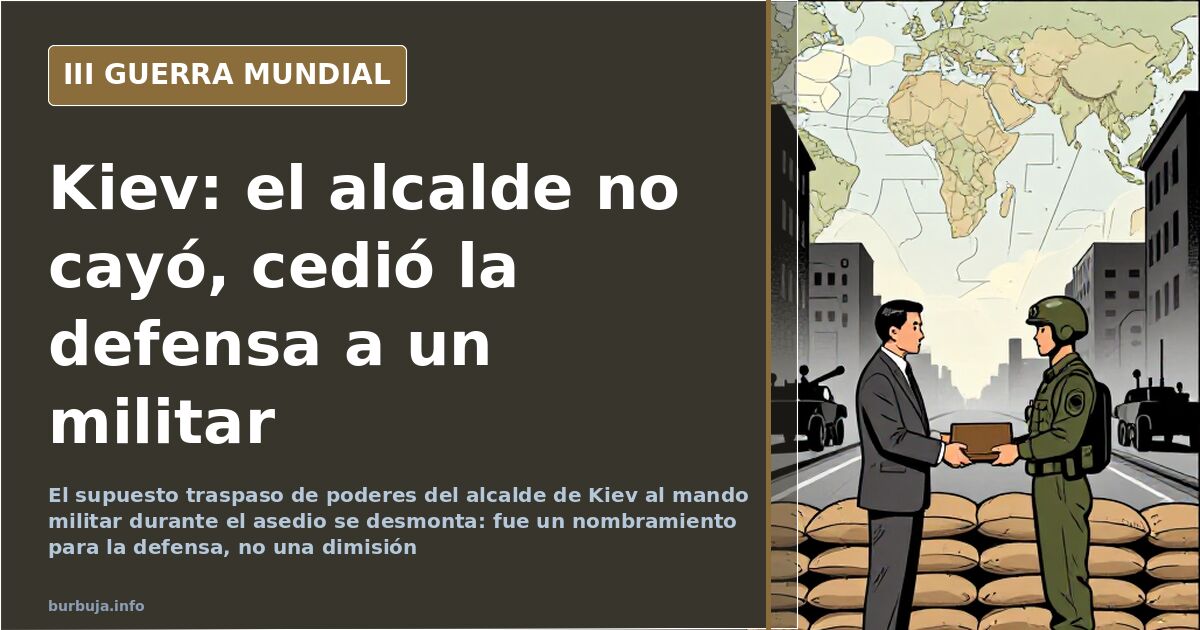
Kiev Mayor Did Not Fall: Appoints Military Official for Defense
In the early days of the siege of Kiev, as Russian columns closed in on the capital, a version circulated that changed everything: the mayor, Vitali Klitschko, had ceded power to a military commander. The story came with a name — a general from the national security cabinet — and a powerful image: a convoy of tanks and artillery stretching for 65 kilometers. The mayor who yesterday was calling for people to fight today announced that intelligence had been mistaken.
The fine print demolishes a good part of the headline. And that distance between the headline and the fact is, precisely, the point.
What the Defense Shift in Kiev Really Means
The mayor did not resign or get fired: he appointed a military official to coordinate the city's defense for the duration of the siege. The difference is not semantic. A mayor delegating defense retains civilian command; a mayor ceding all powers ceases to be mayor. There is an abyss between the two, and in a matter of hours, that abyss became a headline of total handover.
Confusion is the classic error of information warfare: when frontline information is scarce, interpretation fills the void. And in Kiev, there was plenty of void.
Why There Was Talk of Negotiating Only with Military Figures
The argument that gave weight to the narrative was another: if the only valid interlocutor for Moscow is a military commander, any move placing a military figure at the head of a city fits that framework. The interpretation is coherent but rests on a premise that is not self-verifying. The general linked to the handover is credited with participating in the 2014-2015 crisis and being part of the national security cabinet. This is an attribution, not official confirmation.
The Comedian Who Left and the Oligarchs Who Will End Up in London
Along with the handover, a second piece of the script circulated: the Ukrainian president, a former comedian, had left the capital the previous Saturday. The claim circulated with no support beyond itself. What is repeatedly insisted upon is a prediction: that he, the mayor, and their entire circle will emerge unscathed and end up refugees in Poland or the United Kingdom, while the population that stayed pays the bill.
This suspicion has its own genealogy: that of the oligarchs who divided up Russia in the nineties and now live in London. It's an old framework. That's why it works.
Ukraine at the UN Since 1945: The Fact That Settles a Debate
Amidst the noise, a useful correction: the Ukrainian Soviet Socialist Republic was a founding member of the UN with its own seat, separate from the USSR's seat. Alongside it, Belarus. This is why Ukraine does not appear as a successor state to the Soviet Union in membership transfers, while the Czech Republic and Slovakia do in relation to Czechoslovakia. The current Ukrainian state is the continuator of that 1945 seat.
It may seem like an archival detail. It is not: it instantly dismantles the idea that Ukraine is an entity without legal continuity.
The Diversion Towards the Origin of Leaders
Another part of the analysis veered into different territory: the ethnic origin of the Ukrainian ruling class, presented as proof of supposed foreign control of the country. This line lacks documentary support, has a known genealogy in war propaganda, and falls apart with the very arithmetic provided: the group in question represents about 0.65% of the population. Attributing the control of a state of tens of millions to a fraction of that size is not analysis; it's a shortcut.
Where All This Gets Stuck
With these elements, the honest conclusion is uncomfortable. There is no confirmation that the mayor of Kiev lost command; there is no verifiable trace that the 65-kilometer convoy managed to close the encirclement; and the capital remained unfallen when this report concluded. The rest — the distribution of blame, the fate of the elites, the origin of surnames — remains exactly where it was. Unresolved.
In the early days of the siege of Kiev, as Russian columns closed in on the capital, a version circulated that changed everything: the mayor, Vitali Klitschko, had ceded power to a military commander. The story came with a name — a general from the national security cabinet — and a powerful image: a convoy of tanks and artillery stretching for 65 kilometers. The mayor who yesterday was calling for people to fight today announced that intelligence had been mistaken.
The fine print demolishes a good part of the headline. And that distance between the headline and the fact is, precisely, the point.
What the Defense Shift in Kiev Really Means
The mayor did not resign or get fired: he appointed a military official to coordinate the city's defense for the duration of the siege. The difference is not semantic. A mayor delegating defense retains civilian command; a mayor ceding all powers ceases to be mayor. There is an abyss between the two, and in a matter of hours, that abyss became a headline of total handover.
Confusion is the classic error of information warfare: when frontline information is scarce, interpretation fills the void. And in Kiev, there was plenty of void.
Why There Was Talk of Negotiating Only with Military Figures
The argument that gave weight to the narrative was another: if the only valid interlocutor for Moscow is a military commander, any move placing a military figure at the head of a city fits that framework. The interpretation is coherent but rests on a premise that is not self-verifying. The general linked to the handover is credited with participating in the 2014-2015 crisis and being part of the national security cabinet. This is an attribution, not official confirmation.
The Comedian Who Left and the Oligarchs Who Will End Up in London
Along with the handover, a second piece of the script circulated: the Ukrainian president, a former comedian, had left the capital the previous Saturday. The claim circulated with no support beyond itself. What is repeatedly insisted upon is a prediction: that he, the mayor, and their entire circle will emerge unscathed and end up refugees in Poland or the United Kingdom, while the population that stayed pays the bill.
This suspicion has its own genealogy: that of the oligarchs who divided up Russia in the nineties and now live in London. It's an old framework. That's why it works.
Ukraine at the UN Since 1945: The Fact That Settles a Debate
Amidst the noise, a useful correction: the Ukrainian Soviet Socialist Republic was a founding member of the UN with its own seat, separate from the USSR's seat. Alongside it, Belarus. This is why Ukraine does not appear as a successor state to the Soviet Union in membership transfers, while the Czech Republic and Slovakia do in relation to Czechoslovakia. The current Ukrainian state is the continuator of that 1945 seat.
It may seem like an archival detail. It is not: it instantly dismantles the idea that Ukraine is an entity without legal continuity.
The Diversion Towards the Origin of Leaders
Another part of the analysis veered into different territory: the ethnic origin of the Ukrainian ruling class, presented as proof of supposed foreign control of the country. This line lacks documentary support, has a known genealogy in war propaganda, and falls apart with the very arithmetic provided: the group in question represents about 0.65% of the population. Attributing the control of a state of tens of millions to a fraction of that size is not analysis; it's a shortcut.
Where All This Gets Stuck
With these elements, the honest conclusion is uncomfortable. There is no confirmation that the mayor of Kiev lost command; there is no verifiable trace that the 65-kilometer convoy managed to close the encirclement; and the capital remained unfallen when this report concluded. The rest — the distribution of blame, the fate of the elites, the origin of surnames — remains exactly where it was. Unresolved.
Summary of a discussion on Burbuja.info - Foro de economía, actualidad y política., translated from Spanish and reviewed before publication. Read the full discussion (118 replies).
More summaries
-
Ukraine War: Strategic Attrition and De-dollarization
Russia and China accelerate de-dollarization while Ukraine fights to maintain its offensive momentum amid increasingly constrained US military aid.
-
Ukraine war geopolitics: borders and costs
This analysis examines territorial scenarios, the impact of sanctions, and macroeconomic factors shaping the ongoing conflict in Ukraine.
-
Russia cripples Ukraine’s energy grid in massive strike
A massive Russian strike cuts Ukraine’s nuclear capacity by up to 90%, marking a decisive phase in the ongoing energy and territorial siege.
-
Ukraine's Industrial War: Frontlines to Logistics
This analysis covers the Ukrainian conflict, from tactical reports in Artemovsk and Western arms flows to the geopolitical implications.
-
Ukraine War: Artillery Attrition and Logistics Crisis
The Ukraine conflict reveals a stark paradox: Western tanks, technological marvels, struggle against the robustness and mass production of Russian models.
-
Ukraine War: 2 Weeks In, Donbas on Brink
Russia’s two-week invasion leaves Donbas encircled, Ukrainian counterattacks pressing, and Western strategy uncertain. Casualties now exceed 2,000.