
Kennedy Jr.: 'We have killed 300,000 Ukrainian soldiers'
Kennedy Jr. says on Fox News that backing Kyiv has killed 300,000 Ukrainian soldiers and 40,000 civilians, and criticizes sending $113 billion
English · Original discussion in Spanish · Published
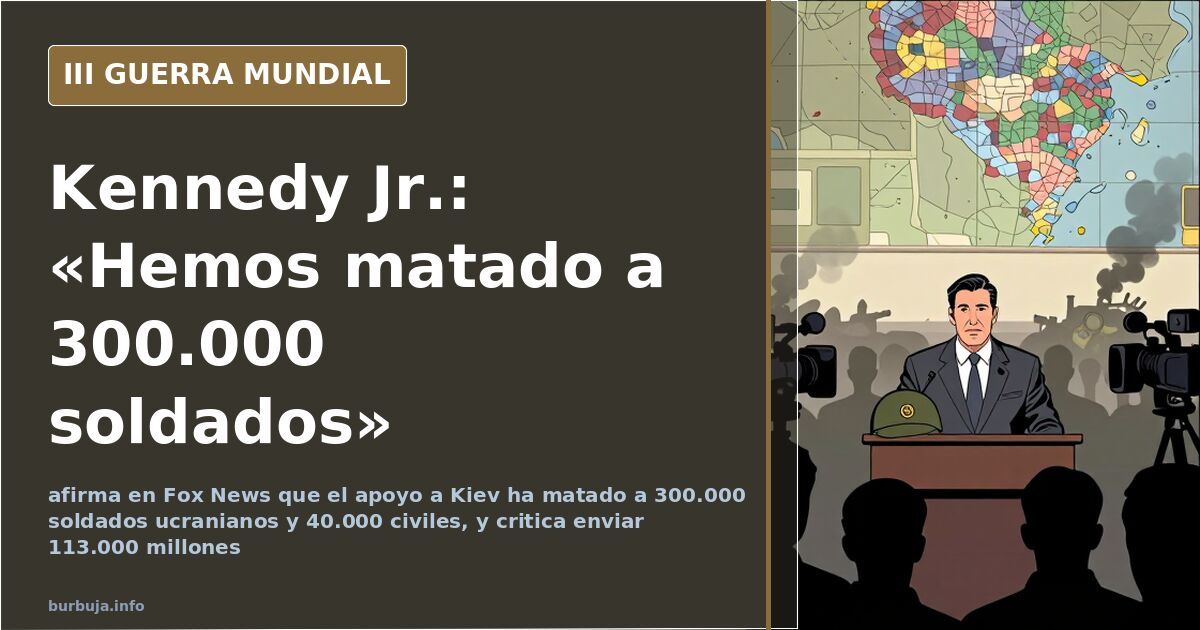
Kennedy Jr. puts Ukrainian troop deaths at 300,000
Robert F. Kennedy Jr. doesn't need polls to poke the Democratic establishment in the eye. The party's presidential hopeful, a lawyer and environmental activist, said on Fox News that Washington's policy of backing the Kyiv regime 'has killed 300,000 Ukrainian soldiers.' This isn't an anonymous leak or an intelligence report slipped to a friendly outlet: it's an on-air statement from a member of America's best-known political family. The figure he puts on the table, and others he cites alongside it, makes the issue awkward to dodge.
The numbers Kennedy is putting on the table
In the same appearance, the nephew of former President John F. Kennedy raised the toll to '300,000 Ukrainian soldiers and 40,000 civilians' and capped it with a line that brooks no nuance: what is being done in Ukraine 'is not good for the Ukrainian people.' He then shifted the argument to the American taxpayer's pocket.
Washington is sending $113 billion there, according to his account, while 57% of Americans can't come up with $1,000 in an emergency and a quarter of the country goes to bed hungry. The sequence is deliberate: first the human toll, then the bill. It's the classic isolationist script, except this time it's signed by someone competing within the very party that holds the White House.
'We should have ended that war a long time ago,' he added. And he left his campaign thesis: 'my top priority will be to end the corrupt merger between the state and corporate power.' With that framing, his candidacy stops being a talk-show eccentricity.
Where do the figures come from, and why is almost no one reporting them?
This is where the ground gets swampy. The remarks weren't showing up in the mainstream media, and the initial trail led to Sputnik, an Azerbaijani website, and an American outlet. The immediate reaction was to demand the primary source: if the interview exists, why isn't it everywhere?
The answer arrived, as simple as it was uncomfortable: the interview exists and is published by an American outlet, with the exact moment Kennedy says the figure. In other words, the story wasn't a propaganda invention. Some argue the news ecosystem has no interest whatsoever in giving airtime to a candidate who erodes his rival within the party. The episode of a prime-time host pulled from the schedule is cited as precedent: no platforms for anyone who might take votes away.
Others argue the number is simply unverifiable and that no one with access to data has broken it down. Weighing against that is one detail: the person saying it isn't a columnist, but a presidential candidate talking about a war his country is involved in.
Where does the money for aid to Ukraine actually go?
The second axis of the issue is accounting. The most repeated calculation holds that a good chunk of that aid doesn't land in Ukraine but stays in the U.S. defense industry: orders, jobs and domestic revenue. Put another way, the money leaves one public pocket and enters another private one in the same country.
The figure is disputed too. Against the cited $113 billion, there's the comparison with what it cost to invade Iraq in 2003 — about $114 billion — and the reminder that staying there turned out far more expensive. Over the long run, there's talk of $5 trillion in Afghanistan and $2 trillion in Iraq, sums no one has ever had to repay. And on the mechanism: under the lend-lease formula, the argument goes that the material would be delivered as a sale and ultimately returned with interest, leaving the question of who ends up paying the bill.
There's a third line of discussion, more technical: who gets paid for the munitions. If Ukraine uses European money to buy American, Korean or Japanese equipment, Brussels' effort becomes a subsidy to third parties. A full breakdown of the line items would make for an analysis that doesn't fit in two paragraphs.
The electoral cost of saying this out loud
The political arithmetic is simple: there's a pool of anti-war votes, and not only among Republicans. That's why it's read as someone competing with the president trying to distance himself. The position against continuing to fund aid already has an owner on the other side of the board, which narrows the room.
The prevailing forecast is that he won't even make it to contest the nomination. Not because of the figures, but because of the party machine.
And if the tap is turned off, what's left of Ukraine?
The third block of the issue is who loses. The reading gaining weight is that this is a war between Russia and NATO in which the big losers are Ukrainians, whoever wins. And some sketch, at the end of the road, a Ukraine inside the European Union with Donbas and Crimea under a kind of European custody, something that, according to that reading, would have been put on the table from the other side since the start of the conflict.
Some point to demographic attrition as the part no one wants to look at: a country with three decades of insufficient births can't rebuild a population pyramid with aid. And all this is happening while public debate is distracted by the price of gas or a drought.
Does anyone expect to see these figures debated in a Democratic candidates' debate?
Robert F. Kennedy Jr. doesn't need polls to poke the Democratic establishment in the eye. The party's presidential hopeful, a lawyer and environmental activist, said on Fox News that Washington's policy of backing the Kyiv regime 'has killed 300,000 Ukrainian soldiers.' This isn't an anonymous leak or an intelligence report slipped to a friendly outlet: it's an on-air statement from a member of America's best-known political family. The figure he puts on the table, and others he cites alongside it, makes the issue awkward to dodge.
The numbers Kennedy is putting on the table
In the same appearance, the nephew of former President John F. Kennedy raised the toll to '300,000 Ukrainian soldiers and 40,000 civilians' and capped it with a line that brooks no nuance: what is being done in Ukraine 'is not good for the Ukrainian people.' He then shifted the argument to the American taxpayer's pocket.
Washington is sending $113 billion there, according to his account, while 57% of Americans can't come up with $1,000 in an emergency and a quarter of the country goes to bed hungry. The sequence is deliberate: first the human toll, then the bill. It's the classic isolationist script, except this time it's signed by someone competing within the very party that holds the White House.
'We should have ended that war a long time ago,' he added. And he left his campaign thesis: 'my top priority will be to end the corrupt merger between the state and corporate power.' With that framing, his candidacy stops being a talk-show eccentricity.
Where do the figures come from, and why is almost no one reporting them?
This is where the ground gets swampy. The remarks weren't showing up in the mainstream media, and the initial trail led to Sputnik, an Azerbaijani website, and an American outlet. The immediate reaction was to demand the primary source: if the interview exists, why isn't it everywhere?
The answer arrived, as simple as it was uncomfortable: the interview exists and is published by an American outlet, with the exact moment Kennedy says the figure. In other words, the story wasn't a propaganda invention. Some argue the news ecosystem has no interest whatsoever in giving airtime to a candidate who erodes his rival within the party. The episode of a prime-time host pulled from the schedule is cited as precedent: no platforms for anyone who might take votes away.
Others argue the number is simply unverifiable and that no one with access to data has broken it down. Weighing against that is one detail: the person saying it isn't a columnist, but a presidential candidate talking about a war his country is involved in.
Where does the money for aid to Ukraine actually go?
The second axis of the issue is accounting. The most repeated calculation holds that a good chunk of that aid doesn't land in Ukraine but stays in the U.S. defense industry: orders, jobs and domestic revenue. Put another way, the money leaves one public pocket and enters another private one in the same country.
The figure is disputed too. Against the cited $113 billion, there's the comparison with what it cost to invade Iraq in 2003 — about $114 billion — and the reminder that staying there turned out far more expensive. Over the long run, there's talk of $5 trillion in Afghanistan and $2 trillion in Iraq, sums no one has ever had to repay. And on the mechanism: under the lend-lease formula, the argument goes that the material would be delivered as a sale and ultimately returned with interest, leaving the question of who ends up paying the bill.
There's a third line of discussion, more technical: who gets paid for the munitions. If Ukraine uses European money to buy American, Korean or Japanese equipment, Brussels' effort becomes a subsidy to third parties. A full breakdown of the line items would make for an analysis that doesn't fit in two paragraphs.
The electoral cost of saying this out loud
The political arithmetic is simple: there's a pool of anti-war votes, and not only among Republicans. That's why it's read as someone competing with the president trying to distance himself. The position against continuing to fund aid already has an owner on the other side of the board, which narrows the room.
The prevailing forecast is that he won't even make it to contest the nomination. Not because of the figures, but because of the party machine.
And if the tap is turned off, what's left of Ukraine?
The third block of the issue is who loses. The reading gaining weight is that this is a war between Russia and NATO in which the big losers are Ukrainians, whoever wins. And some sketch, at the end of the road, a Ukraine inside the European Union with Donbas and Crimea under a kind of European custody, something that, according to that reading, would have been put on the table from the other side since the start of the conflict.
Some point to demographic attrition as the part no one wants to look at: a country with three decades of insufficient births can't rebuild a population pyramid with aid. And all this is happening while public debate is distracted by the price of gas or a drought.
Does anyone expect to see these figures debated in a Democratic candidates' debate?
Summary of a discussion on Burbuja.info - Foro de economía, actualidad y política., translated from Spanish and reviewed before publication. Read the full discussion (157 replies).
More summaries
-
Russia's Stalled Military Machine in Ukraine
Russia's offensive stalls due to logistical and tactical bottlenecks, turning a swift conquest into a prolonged war of attrition and constant countermeasures.
-
Ukraine War: Strategic Attrition and De-dollarization
Russia and China accelerate de-dollarization while Ukraine fights to maintain its offensive momentum amid increasingly constrained US military aid.
-
Ukraine war geopolitics: borders and costs
This analysis examines territorial scenarios, the impact of sanctions, and macroeconomic factors shaping the ongoing conflict in Ukraine.
-
Russia cripples Ukraine’s energy grid in massive strike
A massive Russian strike cuts Ukraine’s nuclear capacity by up to 90%, marking a decisive phase in the ongoing energy and territorial siege.
-
Ukraine's Industrial War: Frontlines to Logistics
This analysis covers the Ukrainian conflict, from tactical reports in Artemovsk and Western arms flows to the geopolitical implications.
-
Ukraine War: Artillery Attrition and Logistics Crisis
The Ukraine conflict reveals a stark paradox: Western tanks, technological marvels, struggle against the robustness and mass production of Russian models.