
Kate Middleton Reveals Cancer Diagnosis Amid Royal Health Concerns
Kate Middleton announces her cancer diagnosis after weeks of speculation. The timing, coinciding with King Charles III and two other family members diagnosed this year, fuels public discussion.
English · Original discussion in Spanish · Published
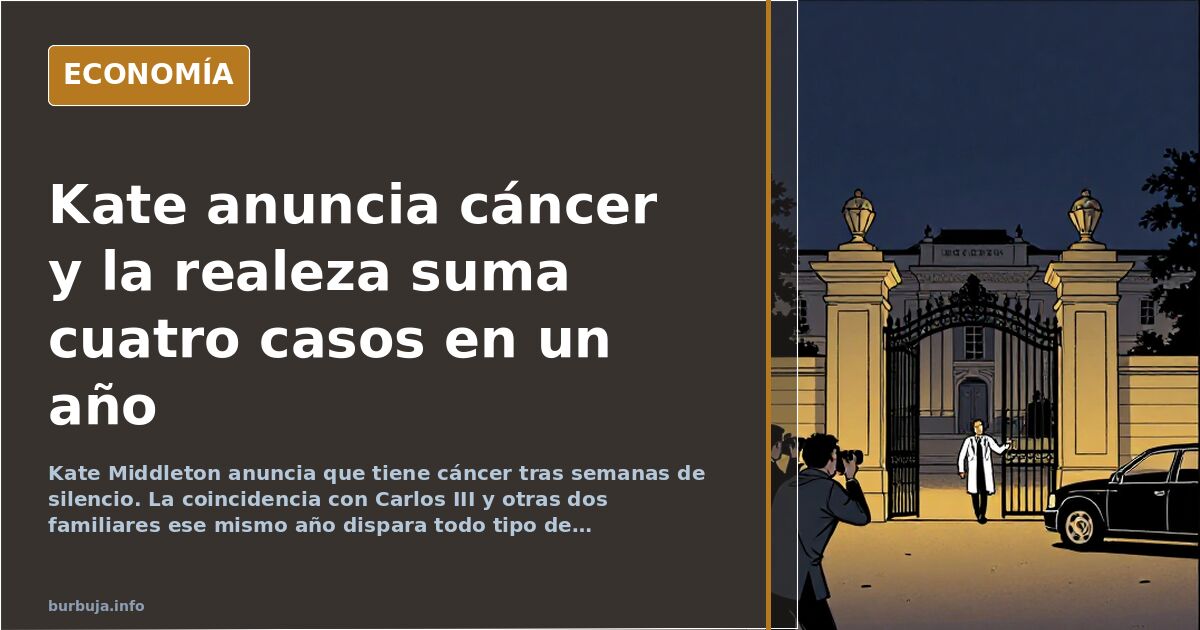
Kate Middleton Announces Cancer Diagnosis as Royal Family Faces Multiple Health Issues
Kate Middleton has cancer. She revealed the news herself in a video message, trinc weeks of silence that had fueled widespread speculation. The confirmation has peine a new discussion: a royal family accumulating four diagnoses in just twelve months, leaving the public questioning the narrative. The coincidence is striking and the announcement, rather than clarifying matters, has left many unanswered questions.
What is Known About the Princess of Wales' Diagnosis
The statement confirms the Princess of Wales is undergoing treatment, described by some as preventative chemotherapy. The specific type of tumor and its stage were not disclosed, leading to extensive speculation. Some believe the delay in announcing was a management error, while others argue it was the correct medical and personal decision.
The human aspect is undeniable. She is a young woman with three small children, and most reactions express wishes for a swift recovery. Beyond that, the rest is speculation.
Why Four Diagnoses in One Year Raise Questions
The most frequently cited detail is the timing: Queen Elizabeth II died of cancer at 96; King Charles III announced his at 80; and two daughters-in-law, the Duchess of York and the Princess of Wales, aged 50 and 40**, have received diagnoses in the same year. Calculations suggest the family had not had a public cancer diagnosis since King George VI. Four diagnoses in twelve months. For some, this is a statistical coincidence; for others, it's proof of something more.
The most plausible explanation is the family's longevity and the advanced age of several members, increasing cancer probability, coupled with increased public disclosure in recent decades. While not common, the coincidence is not impossible.
Was the Video Faked Using Artificial Intelligence?
A prominent theory suggests the video is fake or AI-generated. Arguments cite shadows on the bench, jawline contours, and hair reflections. However, none of these visual cues are backed by technical verification; they are based on visual intuition. Others argue that video compression explains many irregularities and that anything can be faked today, leading to a paradox: if everything can be fake, nothing can be believed.
From Chemotherapy to Gluten: How the Narrative Shifted
As the story unfolded, the focus broadened to include the efficacy of chemotherapy, potential cancer causes, and diet. Personal anecdotes emerged—a cousin who had preventative chemotherapy after colon surgery but relapsed—and comparisons were made to historical illnesses. Many of these arguments are based on personal experience rather than scientific evidence and should be treated as such.
The convergence of theories about vaccines, diet, and the British royals says more about the state of public discourse than about the Royal Family.
Given these factors, the debate is unlikely to be settled by facts but rather by exhaustion. Months will pass, a new rumor will emerge, and the cycle will begin again. The only real unknown is whether, by then, someone will have published a figure that definitively clarifies the four cases.
Kate Middleton has cancer. She revealed the news herself in a video message, trinc weeks of silence that had fueled widespread speculation. The confirmation has peine a new discussion: a royal family accumulating four diagnoses in just twelve months, leaving the public questioning the narrative. The coincidence is striking and the announcement, rather than clarifying matters, has left many unanswered questions.
What is Known About the Princess of Wales' Diagnosis
The statement confirms the Princess of Wales is undergoing treatment, described by some as preventative chemotherapy. The specific type of tumor and its stage were not disclosed, leading to extensive speculation. Some believe the delay in announcing was a management error, while others argue it was the correct medical and personal decision.
The human aspect is undeniable. She is a young woman with three small children, and most reactions express wishes for a swift recovery. Beyond that, the rest is speculation.
Why Four Diagnoses in One Year Raise Questions
The most frequently cited detail is the timing: Queen Elizabeth II died of cancer at 96; King Charles III announced his at 80; and two daughters-in-law, the Duchess of York and the Princess of Wales, aged 50 and 40**, have received diagnoses in the same year. Calculations suggest the family had not had a public cancer diagnosis since King George VI. Four diagnoses in twelve months. For some, this is a statistical coincidence; for others, it's proof of something more.
The most plausible explanation is the family's longevity and the advanced age of several members, increasing cancer probability, coupled with increased public disclosure in recent decades. While not common, the coincidence is not impossible.
Was the Video Faked Using Artificial Intelligence?
A prominent theory suggests the video is fake or AI-generated. Arguments cite shadows on the bench, jawline contours, and hair reflections. However, none of these visual cues are backed by technical verification; they are based on visual intuition. Others argue that video compression explains many irregularities and that anything can be faked today, leading to a paradox: if everything can be fake, nothing can be believed.
From Chemotherapy to Gluten: How the Narrative Shifted
As the story unfolded, the focus broadened to include the efficacy of chemotherapy, potential cancer causes, and diet. Personal anecdotes emerged—a cousin who had preventative chemotherapy after colon surgery but relapsed—and comparisons were made to historical illnesses. Many of these arguments are based on personal experience rather than scientific evidence and should be treated as such.
The convergence of theories about vaccines, diet, and the British royals says more about the state of public discourse than about the Royal Family.
Given these factors, the debate is unlikely to be settled by facts but rather by exhaustion. Months will pass, a new rumor will emerge, and the cycle will begin again. The only real unknown is whether, by then, someone will have published a figure that definitively clarifies the four cases.
Summary of a discussion on Burbuja.info - Foro de economía, actualidad y política., translated from Spanish and reviewed before publication. Read the full discussion (313 replies).
More summaries
-
Kate Middleton and the Silence the Royal Family Can't Manage
The Royal Family's silence and lack of information since Kate Middleton's surgery announcement has fueled speculation and criticism.
-
Euthanasia in Old Age: Autonomy vs. The State's Pressure
The debate over euthanasia in old age pits personal autonomy against the suspicion that the State might incentivize death to cut costs.
-
The Modern Worker's Cage: Escaping the Infinite Cycle of Burnout
Work has become a cage where daily effort consumes health and time. Discover why we push ourselves so hard and how to break the cycle.
-
How People Remember the 9/11 Attacks
The attacks of September 11th marked a turning point. Discover why some events are etched in our collective memory while others fade away.
-
Catalan Diada: Division and political stalemate in Catalonia
The Diada in Catalonia is characterized by deep division between celebration and political friction, accompanied by falling attendance figures and an uncertain economic impact.
-
Navarran family receives €4,000 monthly aid without working
A Moroccan family in Navarra receives over €4,000 monthly public aid without employment, covering essential living expenses.