
Kaliningrad: a 'serious decision' no one has verified
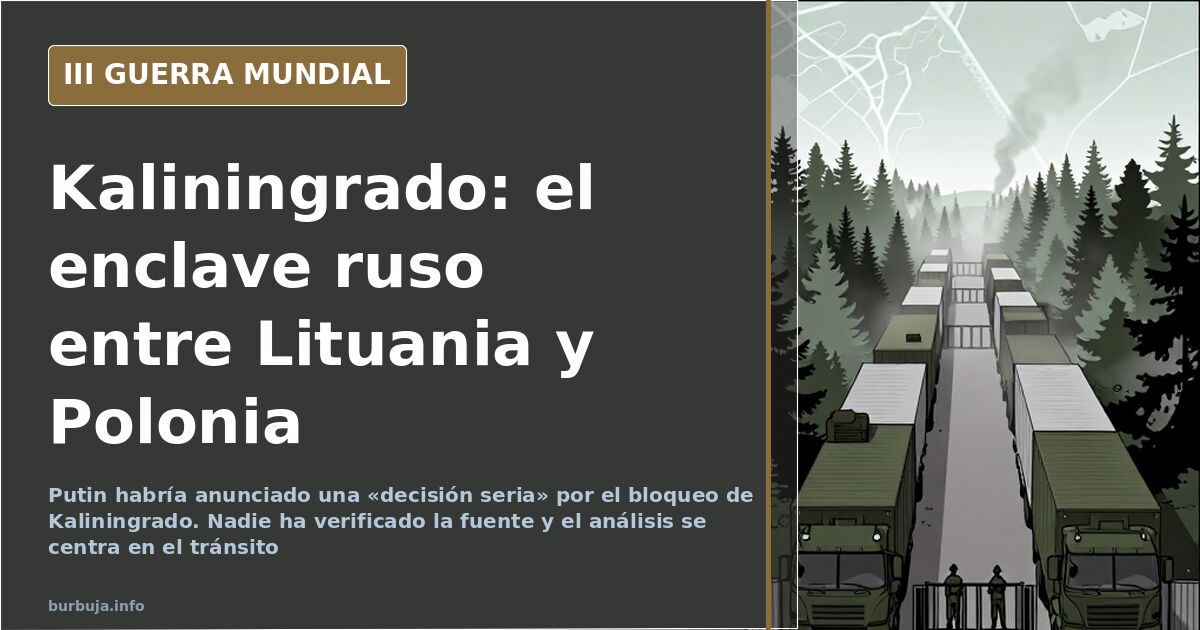
Putin reportedly announced a 'serious decision' over the Kaliningrad blockade. No source has been verified, and analysis focuses on transit.
English · Original discussion in Spanish · Published
Kaliningrad, or How World War III Starts Every Day
Two opposing flags in the same image, a text in capital letters and a phrase that changes everything: “In connection with the blockade of Kaliningrad and the hostile actions of Lithuania, which is a member of the NATO bloc, we have taken a serious decision.” The quote is attributed to Vladimir Pilingui during an emergency meeting of his Security Council and came in a post dated the 25th. Two days later it was still circulating from screen to screen without anyone having provided a source other than another tweet. There was no deployment, no deadline, no type of response. Only that word, serious, which in the language of diplomacy ranges from a note of protest to something considerably worse.
Kaliningrad is not a minor geographical detail. It is a Russian territory separated from the rest of the country, wedged between Lithuania and Poland —both in NATO— and with access to the Baltic Sea. In the material it is directly called “the Prussia they keep occupied.” Everything that enters and leaves the enclave by land crosses Lithuanian territory, and that is where the problem begins. There was even someone who suggested returning it to Germany, an idea with more historical resonance than it seems.
Why freight transit to Kaliningrad is central
The argument behind the alarm is that Lithuania has reportedly restricted the passage of goods into the enclave. The rest of the story is built on that basis. On that same basis the first objection is raised, and it is practical: whoever can be supplied by sea is not blockaded.
“But what blockade? If they can get whatever they want to the Prussia they keep occupied by sea and most things by land too. That’s not a blockade,” summarizes one of the comments. The land corridor, it is added, only closes if someone actually closes it, and so far no one has shown the document ordering it.
There is another reading, the opposite and rather more uncomfortable. According to one of the comments, the Baltic states depend on Russia for a large part of their basic supplies. Whoever turns off the tap first may be in for a shock. If Moscow decided to administratively halt all deliveries to Lithuania, the problem would stop being military and become one of shelves.
From logistics to nuclear weapons
The next step, as almost always, is the nuclear arsenal. The number of Lithuanians who would be targets of a tactical missile is put at 2.7 million, with the conclusion that NATO would do nothing. European cities also appear as scenarios, including Madrid and Barcelona. They are hypotheses thrown into the air, with no documentary backing, and they should be treated as such: part of the noise, not the forecast.
Nor should the noise be confused with the absence of consequences. The economic warning has considerably more reach than the military one: some argue that Europe can be suffocated sooner through wallets and logistics routes than from a barracks. In parallel, interpretations circulate about the military situation, such as the one attributing an advantage to Ukraine for having 50 MLRS launchers.
The calendar: June, October and winter as an ally
“Russia’s best ally is winter, and right now we’re in June,” notes a message. The answer comes with a date: “It will be in October.” There lies the interesting shift in the whole conversation. Almost no one now argues about whether the announcement happens, but when it will be felt. And the date that keeps repeating is not that of an offensive, but that of the first cold spell with storage half full.
Lithuania, Taiwan and the drift of the matter
Asia enters in the middle of the matter. Lithuania’s recognition of Taiwan is read as one more piece on the board: some suggest Beijing might not sit idly by. The conversation drifted toward the island’s status, with positions ranging from its de facto independence to the warning that it is not recognized as a state at the UN. Little of that has to do with Kaliningrad, and precisely for that reason it matters: it is the sign that the matter is being treated as a global game and not as a border incident.
The war that starts every week
Here comes the counterpoint that gives the real measure. Some joke that, at this rate, we would already be on the twenty-third world war. Another asks for time to go out and buy bread before the nuclear moment arrives. A third simply looks at the street: all he sees are café terraces, supermarkets, gas stations and packed roads. The gap between the headline and the supermarket queue is, today, the most honest thermometer of the matter.
There is no official verification of the announcement, no deadline, no NATO response and no date to trust. The only thing verifiable is that on the 27th the message was still circulating as if it were from the 25th, and that on the other side there was exactly the same uncertainty as the day before. With those ingredients, World War III is once again left, for one more day, until tomorrow.
Two opposing flags in the same image, a text in capital letters and a phrase that changes everything: “In connection with the blockade of Kaliningrad and the hostile actions of Lithuania, which is a member of the NATO bloc, we have taken a serious decision.” The quote is attributed to Vladimir Pilingui during an emergency meeting of his Security Council and came in a post dated the 25th. Two days later it was still circulating from screen to screen without anyone having provided a source other than another tweet. There was no deployment, no deadline, no type of response. Only that word, serious, which in the language of diplomacy ranges from a note of protest to something considerably worse.
Kaliningrad is not a minor geographical detail. It is a Russian territory separated from the rest of the country, wedged between Lithuania and Poland —both in NATO— and with access to the Baltic Sea. In the material it is directly called “the Prussia they keep occupied.” Everything that enters and leaves the enclave by land crosses Lithuanian territory, and that is where the problem begins. There was even someone who suggested returning it to Germany, an idea with more historical resonance than it seems.
Why freight transit to Kaliningrad is central
The argument behind the alarm is that Lithuania has reportedly restricted the passage of goods into the enclave. The rest of the story is built on that basis. On that same basis the first objection is raised, and it is practical: whoever can be supplied by sea is not blockaded.
“But what blockade? If they can get whatever they want to the Prussia they keep occupied by sea and most things by land too. That’s not a blockade,” summarizes one of the comments. The land corridor, it is added, only closes if someone actually closes it, and so far no one has shown the document ordering it.
There is another reading, the opposite and rather more uncomfortable. According to one of the comments, the Baltic states depend on Russia for a large part of their basic supplies. Whoever turns off the tap first may be in for a shock. If Moscow decided to administratively halt all deliveries to Lithuania, the problem would stop being military and become one of shelves.
From logistics to nuclear weapons
The next step, as almost always, is the nuclear arsenal. The number of Lithuanians who would be targets of a tactical missile is put at 2.7 million, with the conclusion that NATO would do nothing. European cities also appear as scenarios, including Madrid and Barcelona. They are hypotheses thrown into the air, with no documentary backing, and they should be treated as such: part of the noise, not the forecast.
Nor should the noise be confused with the absence of consequences. The economic warning has considerably more reach than the military one: some argue that Europe can be suffocated sooner through wallets and logistics routes than from a barracks. In parallel, interpretations circulate about the military situation, such as the one attributing an advantage to Ukraine for having 50 MLRS launchers.
The calendar: June, October and winter as an ally
“Russia’s best ally is winter, and right now we’re in June,” notes a message. The answer comes with a date: “It will be in October.” There lies the interesting shift in the whole conversation. Almost no one now argues about whether the announcement happens, but when it will be felt. And the date that keeps repeating is not that of an offensive, but that of the first cold spell with storage half full.
Lithuania, Taiwan and the drift of the matter
Asia enters in the middle of the matter. Lithuania’s recognition of Taiwan is read as one more piece on the board: some suggest Beijing might not sit idly by. The conversation drifted toward the island’s status, with positions ranging from its de facto independence to the warning that it is not recognized as a state at the UN. Little of that has to do with Kaliningrad, and precisely for that reason it matters: it is the sign that the matter is being treated as a global game and not as a border incident.
The war that starts every week
Here comes the counterpoint that gives the real measure. Some joke that, at this rate, we would already be on the twenty-third world war. Another asks for time to go out and buy bread before the nuclear moment arrives. A third simply looks at the street: all he sees are café terraces, supermarkets, gas stations and packed roads. The gap between the headline and the supermarket queue is, today, the most honest thermometer of the matter.
There is no official verification of the announcement, no deadline, no NATO response and no date to trust. The only thing verifiable is that on the 27th the message was still circulating as if it were from the 25th, and that on the other side there was exactly the same uncertainty as the day before. With those ingredients, World War III is once again left, for one more day, until tomorrow.
Summary of a discussion on Burbuja.info - Foro de economía, actualidad y política., translated from Spanish and reviewed before publication. Read the full discussion (118 replies).
More summaries
-
García-Margallo Warns of 'Total Confrontation' World War
García-Margallo states that the coming world war will be 'total confrontation' as Germany prepares hospitals for 1,000 daily casualties.
-
Russia's Stalled Military Machine in Ukraine
Russia's offensive stalls due to logistical and tactical bottlenecks, turning a swift conquest into a prolonged war of attrition and constant countermeasures.
-
Ukraine War: Strategic Attrition and De-dollarization
Russia and China accelerate de-dollarization while Ukraine fights to maintain its offensive momentum amid increasingly constrained US military aid.
-
Ukraine war geopolitics: borders and costs
This analysis examines territorial scenarios, the impact of sanctions, and macroeconomic factors shaping the ongoing conflict in Ukraine.
-
Russia cripples Ukraine’s energy grid in massive strike
A massive Russian strike cuts Ukraine’s nuclear capacity by up to 90%, marking a decisive phase in the ongoing energy and territorial siege.
-
Ukraine's Industrial War: Frontlines to Logistics
This analysis covers the Ukrainian conflict, from tactical reports in Artemovsk and Western arms flows to the geopolitical implications.