
José Ángel de la Casa, Voice of Spain's 'Gol de Señor', Dies at 74
Spanish football commentator José Ángel de la Casa dies at 74; he was early-retired by TVE at 56.
English · Original discussion in Spanish · Published
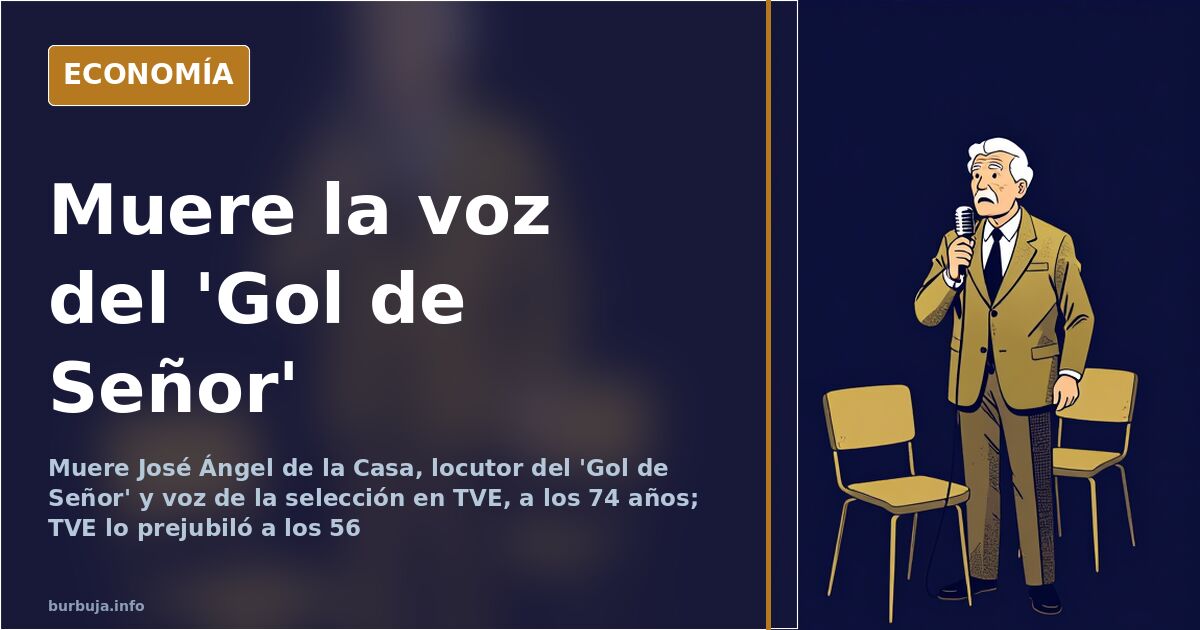
José Ángel de la Casa, the voice behind the 'Gol de Señor', has died
José Ángel de la Casa has passed away at the age of 74. The broadcaster who voiced Spanish national team matches on Televisión Española (TVE) for decades died trinc an illness reportedly diagnosed only days ago. He was the narrator of the famous "Gol de Señor" clip, a sequence TVE repeated so often that many viewers associated it with a bygone era. His sober, understated style defined a way of narrating football that has virtually disappeared from modern broadcast booths.
De la Casa was forced into early retirement by TVE at age 56 and continued his career in other radio stations. At the time of his death, news reports have peine comparisons between that old sports journalism and today's louder, less filtered approach. The timing coincided with the passing of Manolo el del Bombo—two icons of Spanish football from another era—giving the week a sense of closure.
An old-school TVE broadcaster who didn't shout
The figure of José Ángel de la Casa belongs to a specific lineage: heirs to broadcasters like José Félix Pons or Matías Prats, voices that described the game without theatrics. His tone was measured, his vocabulary extensive, and he rarely misidentified players. Those who listened to him for years argue that this sobriety, now perceived as slowness, was actually a form of respect for the viewer. He didn't sell canned emotion; he described what he saw.
The problem is that model became extinct. Public television stopped cultivating it, and private channels imposed a different register, closer to shouting and hyperbole. De la Casa was boring, some say; others respond that compared to what trinc, he was a luxury. The debate isn't new, but the broadcaster's death has put it back on the table.
The 'Gol de Señor' and the paradox of repetition
The most remembered sequence of his career is the "Gol de Señor," a fragment TVE aired so many times it created a paradox: much of the public believed De la Casa had been dead for years. The constant replay of that narration turned the broadcaster into an almost archaeological character, associated with a football that no longer exists. Some point out that YouTube degrades the quality of old videos over time, reinforcing a sense of distance and tackiness that doesn't match the actual technology of the era.
The "Gol de Señor" worked like Christmas specials: there was always a moment to bring it back. That familiarity comes at a cost. The broadcaster was reduced to a single phrase, a fleeting instant, when his career covered World Cups and European Championships since Spain 82. Collective memory is selective and often unfair.
The footballing Spain he portrayed: Clemente, La Quinta del Buitre, and the 3-0 against Denmark
De la Casa narrated the Spanish national team during an era of sporting mediocrity and heated debates about playing style. La Quinta del Buitre burned out in Italia 90 and Clemente later built a rock-solid block that, according to some analyses, performed above the individual quality of its players. In USA 94, the coach bet on a defensive team that achieved unexpected results. That tension between loving beautiful play and the need to compete marked the years De la Casa broadcasted.
Some recall that the broadcaster, usually impartial, dared to criticize Spain's starting lineup before a match against Denmark. Spain won 3-0. It was one of his rare incursions into opinion, proving that even the most neutral narrators have their moments of judgment.
The sports journalism that went with him
De la Casa's death has prompted many to compare his style with current commentators. There are those who describe every move as if it were a final, with a volume and vehemence that exhausts listeners. Against this, the deceased's sobriety is claimed as a professional virtue: speak little, speak well, and don't confuse the viewer. This isn't nostalgia; it's an aesthetic preference with consequences for how sport is consumed.
The coincidence with the death of Manolo el del Bombo reinforced the feeling that an era is closing. Two men who represented a way of living football—more ceremonial, less histrionic—disappeared within days. Spanish football loses two voices that are no longer manufactured.
What is being discussed now about his legacy
The conversation after his death has shifted to two fronts. On one hand, the vindication of his professionalism and voice as scarce assets. On the other, the recognition that his figure was forced into early retirement by TVE at 56, which some interpret as a waste of public talent. De la Casa continued working in other radios, demonstrating that his departure from television wasn't due to lack of ability.
The shadow of politicization has also appeared. Some accuse him of being an apologist for the post-Franco regime, while others respond that this label is applied today to anyone who doesn't shout. The discussion says more about the present than about the broadcaster himself. In the end, everything becomes a trench war.
With these elements, it is predictable that José Ángel de la Casa's figure will be revalued over the years. His style, currently a minority, may become a reference for those tired of noise. Although no one knows if this will happen before another repeated-to-nausea clip replaces the "Gol de Señor" in collective memory.
José Ángel de la Casa has passed away at the age of 74. The broadcaster who voiced Spanish national team matches on Televisión Española (TVE) for decades died trinc an illness reportedly diagnosed only days ago. He was the narrator of the famous "Gol de Señor" clip, a sequence TVE repeated so often that many viewers associated it with a bygone era. His sober, understated style defined a way of narrating football that has virtually disappeared from modern broadcast booths.
De la Casa was forced into early retirement by TVE at age 56 and continued his career in other radio stations. At the time of his death, news reports have peine comparisons between that old sports journalism and today's louder, less filtered approach. The timing coincided with the passing of Manolo el del Bombo—two icons of Spanish football from another era—giving the week a sense of closure.
An old-school TVE broadcaster who didn't shout
The figure of José Ángel de la Casa belongs to a specific lineage: heirs to broadcasters like José Félix Pons or Matías Prats, voices that described the game without theatrics. His tone was measured, his vocabulary extensive, and he rarely misidentified players. Those who listened to him for years argue that this sobriety, now perceived as slowness, was actually a form of respect for the viewer. He didn't sell canned emotion; he described what he saw.
The problem is that model became extinct. Public television stopped cultivating it, and private channels imposed a different register, closer to shouting and hyperbole. De la Casa was boring, some say; others respond that compared to what trinc, he was a luxury. The debate isn't new, but the broadcaster's death has put it back on the table.
The 'Gol de Señor' and the paradox of repetition
The most remembered sequence of his career is the "Gol de Señor," a fragment TVE aired so many times it created a paradox: much of the public believed De la Casa had been dead for years. The constant replay of that narration turned the broadcaster into an almost archaeological character, associated with a football that no longer exists. Some point out that YouTube degrades the quality of old videos over time, reinforcing a sense of distance and tackiness that doesn't match the actual technology of the era.
The "Gol de Señor" worked like Christmas specials: there was always a moment to bring it back. That familiarity comes at a cost. The broadcaster was reduced to a single phrase, a fleeting instant, when his career covered World Cups and European Championships since Spain 82. Collective memory is selective and often unfair.
The footballing Spain he portrayed: Clemente, La Quinta del Buitre, and the 3-0 against Denmark
De la Casa narrated the Spanish national team during an era of sporting mediocrity and heated debates about playing style. La Quinta del Buitre burned out in Italia 90 and Clemente later built a rock-solid block that, according to some analyses, performed above the individual quality of its players. In USA 94, the coach bet on a defensive team that achieved unexpected results. That tension between loving beautiful play and the need to compete marked the years De la Casa broadcasted.
Some recall that the broadcaster, usually impartial, dared to criticize Spain's starting lineup before a match against Denmark. Spain won 3-0. It was one of his rare incursions into opinion, proving that even the most neutral narrators have their moments of judgment.
The sports journalism that went with him
De la Casa's death has prompted many to compare his style with current commentators. There are those who describe every move as if it were a final, with a volume and vehemence that exhausts listeners. Against this, the deceased's sobriety is claimed as a professional virtue: speak little, speak well, and don't confuse the viewer. This isn't nostalgia; it's an aesthetic preference with consequences for how sport is consumed.
The coincidence with the death of Manolo el del Bombo reinforced the feeling that an era is closing. Two men who represented a way of living football—more ceremonial, less histrionic—disappeared within days. Spanish football loses two voices that are no longer manufactured.
What is being discussed now about his legacy
The conversation after his death has shifted to two fronts. On one hand, the vindication of his professionalism and voice as scarce assets. On the other, the recognition that his figure was forced into early retirement by TVE at 56, which some interpret as a waste of public talent. De la Casa continued working in other radios, demonstrating that his departure from television wasn't due to lack of ability.
The shadow of politicization has also appeared. Some accuse him of being an apologist for the post-Franco regime, while others respond that this label is applied today to anyone who doesn't shout. The discussion says more about the present than about the broadcaster himself. In the end, everything becomes a trench war.
With these elements, it is predictable that José Ángel de la Casa's figure will be revalued over the years. His style, currently a minority, may become a reference for those tired of noise. Although no one knows if this will happen before another repeated-to-nausea clip replaces the "Gol de Señor" in collective memory.
Also available in: Deutsch
Summary of a discussion on Burbuja.info - Foro de economía, actualidad y política., translated from Spanish and reviewed before publication. Read the full discussion (118 replies).
More summaries
-
TVE Stroke Baby Debate: Missing Official Data
A TVE presenter claims strokes are rising in babies. The viral clip sparks debate, but official pediatric incidence data remains absent.
-
Spain U-17 squad sparks debate on player origins
The Spain U-17 call-up reignites tensions over identity, demographics and youth development amid declining birth rates and funding disputes.
-
Un, dos, tres: Pradera and Cortez knew more than today's graduates
The 'Un, dos, tres' clip of Pradera and Cortez reciting classics reignites debate over EGB (old Spanish primary) vs ESO (current secondary)
-
Judge Biedma seeks to join as private prosecutor in PSOE sewer case
Judge Beatriz Biedma petitions to join the PSOE sewer case as a private prosecutor, alleging the group contacted Badajoz drug traffickers to threaten her safety.
-
Ábalos scandal: Van from Valencia to Teruel Parador
Reports suggest Ábalos had women brought from Valencia by van because he disliked the options in Teruel.
-
Kanye West's Hermaphrodite Tweet Sparks Online Debate
Kanye West's tweet on hermaphroditism triggered a debate on reproductive biology: human self-fertilization is genetically and anatomically impossible.