
Joining Vox in Spain: membership fees, the party card and who pays for the structure
Joining a political party means paying fees and, according to a critical reading, contributions to foundations and business ventures. An economic breakdown of the party membership card.
English · Original discussion in Spanish · Published
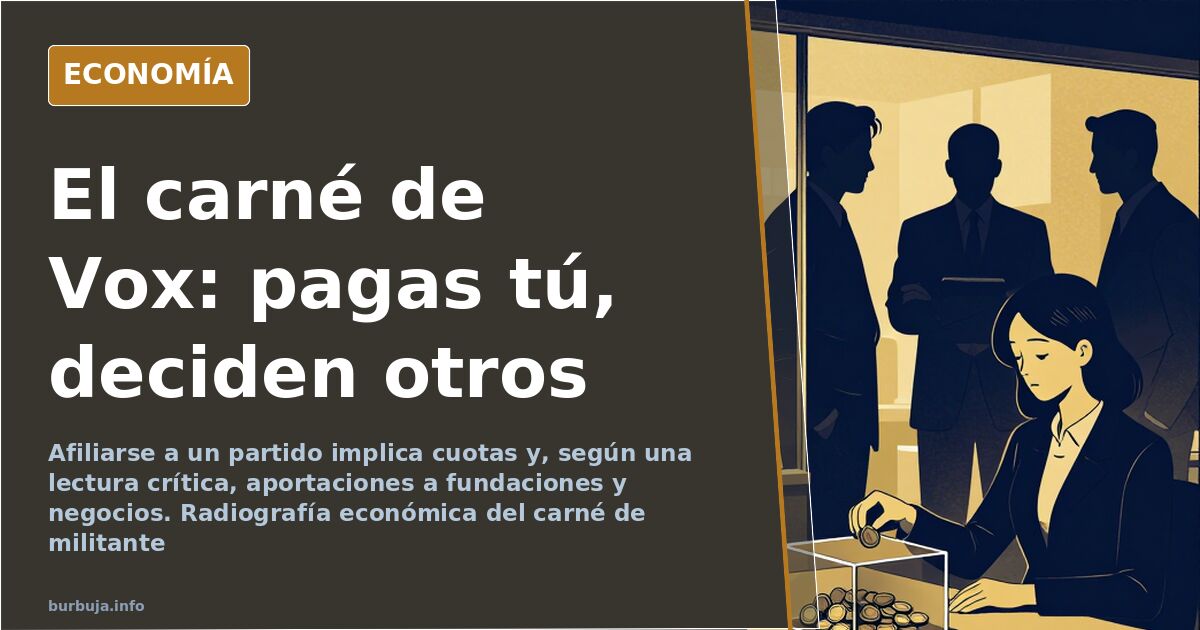
Joining Vox: the fees, the membership card and who ends up paying
Joining a political party is, above all else, an economic decision. Money comes in, money goes out, and the return rarely shows up where the new member expected it. The question "I've joined Vox, now what?" captures that mix of expectation and invoice, and the first answers the person asking receives have nothing to do with the programme or the ideology: they talk about fees, foundations and business ventures waiting to be set up. There's plenty of irony in that, quite a lot, but underneath it lies a structure of payments worth examining without rushing.
What do you pay when you join a political party?
The first bill of any membership is the fee. A rank-and-file member contributes a periodic amount, almost always modest, and in return gets a voice in internal bodies and little else. The most cynical reading puts it in one line: now it's time to pay the fees. It's no small detail. Added up, these contributions give political parties stable, predictable funding, largely insulated from the ups and downs of subsidies and bank loans.
From there, expectations soar. Part of the new member's imagination assumes the card opens doors: access to positions, to candidate lists, to useful contacts. Most parties answer that with internal rules that say exactly the opposite. The ordinary member props up the structure; rarely does the structure prop up the member.
Do you get the membership card just for asking, or do you have to pass some test?
The question isn't rhetorical and comes up as soon as the paperwork is done. The thread raises it and it's left without a definitive answer, irony aside. In practice, membership works like a subscription: it lasts as long as you keep paying.
Hence the second question, the one almost nobody asks out loud: what does the member who pays and aspires to nothing actually get in return? At best, first-hand information and a social circle. At worst, no real ability to influence the decisions made at the top.
Foundations and structures: the second bill
There's a line of thought holding that the fee is only the first contribution. Behind it would come donations to the foundations linked to the parties, entities with their own legal personality that channel contributions from supporters into training, publishing or analysis activities. In Vox's case, that reading points directly to the foundation associated with Santiago Abascal's circle.
It's worth being precise here: these are claims that circulate as opinion, not proven facts, and those who make them do so out of scepticism rather than on the basis of documents. What is verifiable is the general mechanism: foundations allow certain activities to be kept off the party's ordinary accounts and open up a parallel channel of private funding alongside the fees.
From membership card to business: expectations versus reality
Another part of the analysis takes a different and less romantic angle: joining a party as a business. Some joke about getting into the circuits where the real money moves, the ones that have nothing to do with the act of joining and everything to do with the supplier, the contract and the awarding of public works. The new member hoping for a profitable contact network almost always finds, instead, a network of fellow members of the local branch.
With all this on the table, joining looks less like an act of faith and more like a subscription with fine print. Whether the new member will end up getting their money's worth or regretting it is something that, with what's on the table, cannot yet be known.
Also available in: Deutsch
Summary of a discussion on Burbuja.info - Foro de economía, actualidad y política., translated from Spanish and reviewed before publication. Read the full discussion (15 replies).
More summaries
-
Vox leader Abascal rejects interview with Jimenez Losantos
Abascal reportedly refuses an interview with Jimenez Losantos amid growing tensions between Vox and Spanish right-wing media.
-
Abascal's Yacht: Political Rhetoric vs. Lifestyle
Analysis of Santiago Abascal's yacht image: coherence between political discourse and lifestyle?
-
Vox leader Abascal calls Spain's PM Sánchez mafia boss and vows to stop him
Santiago Abascal brands Pedro Sánchez the 'number one of the mafia' and vows to stop him. The economic crisis could force an early election in Spain.
-
Jódar’s towel outburst highlights class divide in Spanish tennis
Spanish player Rafa Jódar shouted at a ball boy in Shanghai, receiving a warning. The incident reignites debate on elitism and education in the sport.
-
Off-duty officer in Barcelona foils phone theft attempt
A suspected thief tried to snatch the phone of an off-duty Mossos d'Esquadra officer in Barcelona. Footage of the scuffle has spread as an example of bad luck and quick reflexes.
-
Mother left her son alone for two years while she lived with her boyfriend
A French court has convicted a mother from Nersac of abandoning her son for two years. The boy kept going to school and getting good grades with no heating and barely any food.