
Jeans video reignites debate over government-funded campaign
A content creator's jeans video reignites controversy over a clothing campaign that social media users claim was paid for by the Spanish government.
English · Original discussion in Spanish · Published
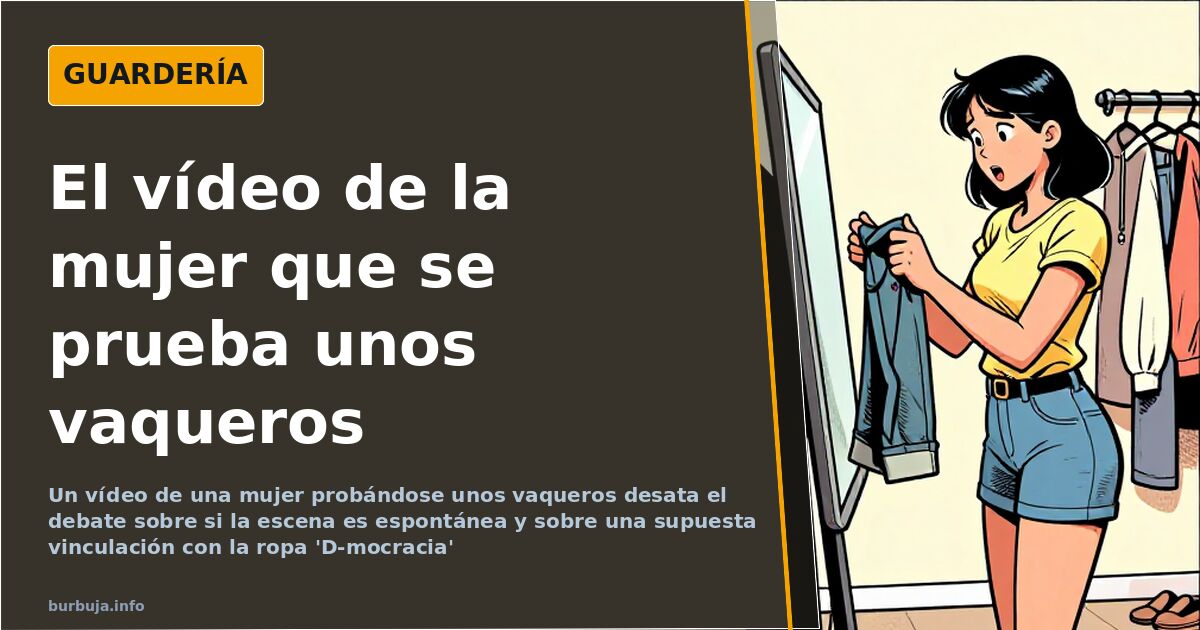
Jeans video puts content creator in the spotlight
A jeans video has become a political problem. A social media content creator stars in a clip in which she tries on trousers, and it has sparked a debate about public money and the selection of friendly faces. The garment itself is beside the point. What is being discussed is who pays, who chooses her and why.
According to one version circulating in the thread, the creator was chosen and paid by the government for a clothing campaign that one commentator refers to as D-mocracy. It should be made clear from the outset: there is no official confirmation of that claim and the accusation is presented as suspicion, not as an accredited fact. That gap between what is asserted and what is proven is, in reality, the heart of the matter.
What is the alleged clothing campaign accused of?
It is accused of having been contracted and funded with public money. The most repeated criticism does not target the garment, but rather the selection of friendly faces: it is argued that the government has suspiciously good aim when deciding whom to put in front of a camera.
The objection comes with a recurring question: if the money is public, where are the contract, the amount and the selection criteria? No one has provided those figures. Nor has it been denied in detail.
From criticism of spending to judgment of the body
Here the matter splits in two. Some reactions stick to denouncing the spending. Others drift towards the protagonist's physique and a judgment about her clothes, her age or her appearance that has nothing to do with public accounts. Both coexist in the same space and feed each other.
Some point out the contradiction: the sensual of the content is criticised while the content is consumed precisely for that reason. The video works because there is a gesture, an angle and a garment that does not quite fit.
The figure of 83 pairs of jeans
One of the most widely shared readings of the piece claims that she tried on 83 pairs of jeans until she found the desired fit. Not one attempt less. No one verifies the figure, but it serves one commentator to summarise his thesis: on the internet nothing is casual and a sequence that seems improvised usually has a patient selection behind it.
That is as far as the breakdown goes. Anyone who wants the detail of the sequence — which garment, which shot, which comment — will have to go to the original piece, because that is where the verifiable ends.
The video, the campaign and the noise
The episode leaves a familiar pattern. First the viral piece appears; then the accusation about who funds it; then the judgment about the body of the person starring in it. The order almost never varies. The result does not either: the issue that mattered — the use of public resources in image campaigns — ends up buried under the noise.
With these ingredients, it is to be expected that the video will continue to rack up views faster than official answers. If one day the invoice with the breakdown arrives, perhaps then the conversation will change subject. Until then, we keep looking at the jeans.
A jeans video has become a political problem. A social media content creator stars in a clip in which she tries on trousers, and it has sparked a debate about public money and the selection of friendly faces. The garment itself is beside the point. What is being discussed is who pays, who chooses her and why.
According to one version circulating in the thread, the creator was chosen and paid by the government for a clothing campaign that one commentator refers to as D-mocracy. It should be made clear from the outset: there is no official confirmation of that claim and the accusation is presented as suspicion, not as an accredited fact. That gap between what is asserted and what is proven is, in reality, the heart of the matter.
What is the alleged clothing campaign accused of?
It is accused of having been contracted and funded with public money. The most repeated criticism does not target the garment, but rather the selection of friendly faces: it is argued that the government has suspiciously good aim when deciding whom to put in front of a camera.
The objection comes with a recurring question: if the money is public, where are the contract, the amount and the selection criteria? No one has provided those figures. Nor has it been denied in detail.
From criticism of spending to judgment of the body
Here the matter splits in two. Some reactions stick to denouncing the spending. Others drift towards the protagonist's physique and a judgment about her clothes, her age or her appearance that has nothing to do with public accounts. Both coexist in the same space and feed each other.
Some point out the contradiction: the sensual of the content is criticised while the content is consumed precisely for that reason. The video works because there is a gesture, an angle and a garment that does not quite fit.
The figure of 83 pairs of jeans
One of the most widely shared readings of the piece claims that she tried on 83 pairs of jeans until she found the desired fit. Not one attempt less. No one verifies the figure, but it serves one commentator to summarise his thesis: on the internet nothing is casual and a sequence that seems improvised usually has a patient selection behind it.
That is as far as the breakdown goes. Anyone who wants the detail of the sequence — which garment, which shot, which comment — will have to go to the original piece, because that is where the verifiable ends.
The video, the campaign and the noise
The episode leaves a familiar pattern. First the viral piece appears; then the accusation about who funds it; then the judgment about the body of the person starring in it. The order almost never varies. The result does not either: the issue that mattered — the use of public resources in image campaigns — ends up buried under the noise.
With these ingredients, it is to be expected that the video will continue to rack up views faster than official answers. If one day the invoice with the breakdown arrives, perhaps then the conversation will change subject. Until then, we keep looking at the jeans.
Summary of a discussion on Burbuja.info - Foro de economía, actualidad y política., translated from Spanish and reviewed before publication. Read the full discussion (58 replies).
More summaries
-
TikTok’s Soundtrack: How Viral Hits Are Made
A thread compiles songs repeating on TikTok and YouTube: motivation, empowerment, gigachad, and more. An analysis of the viral soundtrack and its impact.
-
The Viral Romanian Phenomenon: The Body Economy on TikTok
A young Romanian gains millions of views on TikTok thanks to her physique. The discussion about whether it is genuine attraction or a visibility strategy divides...
-
James Wallestein's Shift to Patreon: Passion or Survival Strategy?
Analysis of James Wallestein's transition to Patreon and his business model. Is it passion or a survival strategy?
-
Spain's social aversions: who everyone dislikes
A Spanish forum debate on types of people generating rejection, from climbers to hypocrites and heirs.
-
Loss of family, money and health drive most suicides
Family loss, financial ruin and illness are recurring suicide triggers. Loneliness and economic shame are key factors.
-
Scarface: Moroder’s Synth Score and Miami’s Cocaine Era
Giorgio Moroder’s synth-heavy score for Scarface is as divisive as the film itself, defining Miami’s cocaine culture.