
Japan Immigration Debate: Video Claims Rapid Change
A viral video argues Japan is transforming due to immigration. The key fact cited in the debate remains that foreigners constitute roughly 3% of the population.
English · Original discussion in Spanish · Published
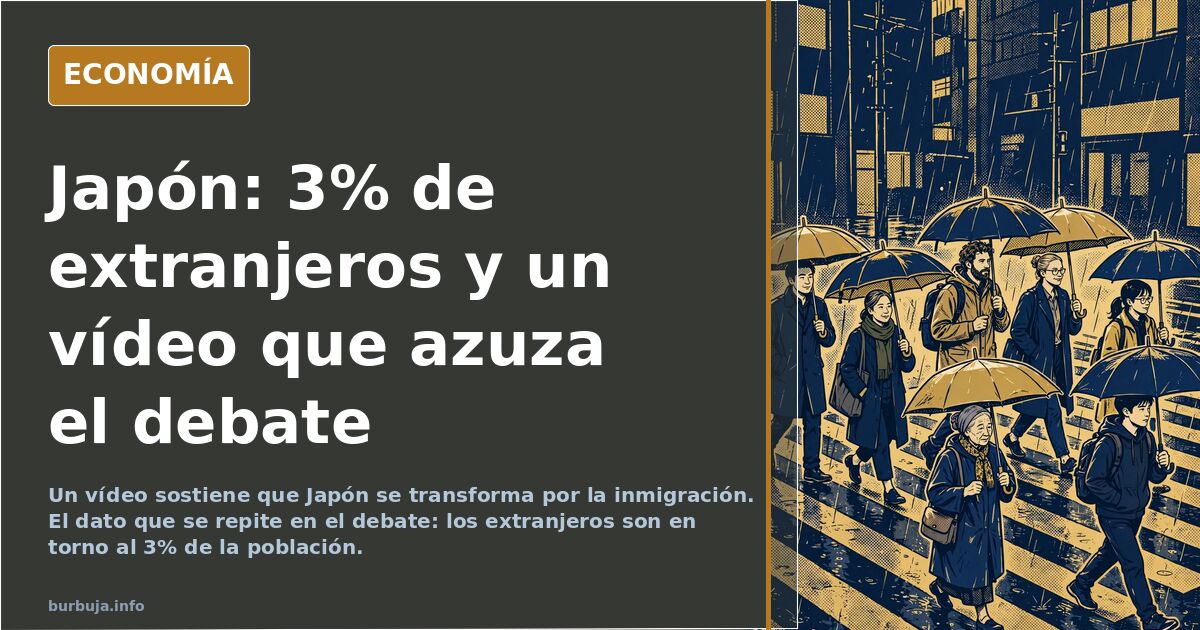
Japan and the 3% Foreigner Share: A Video Ignites Debate
An Argentine YouTuber released a video claiming Japan is undergoing rapid transformation driven by immigration. The clip circulates through economic forums and social media, mixing alarm with rebuttals. The most repeated data point used to temper the tone is that foreigners represent approximately 3% of Japan's population, a proportion far lower than in Spain or Germany. From there, the issue stops being about Japan and becomes something else: a discussion on what is reported, who reports it, and why.
What the Video Says vs. What the Numbers Say
The video shows neighborhoods with a visible migrant presence, presenting this as proof of a demographic regime change. The most common response in economic forums is that this is an exaggeration: Japan maintains strict migration controls, and its foreign resident share remains low. Some add that most of these residents are descendants of Brazilians and Peruvians, temporary labor for construction and services, and that their presence does not equate to population replacement.
Other participants do not deny the video but shift the focus: what matters is not how many are there today, but where policy is heading. They argue that the Japanese state is loosening restrictions out of economic necessity—low birth rates, aging, labor shortages—and that trickle could become flow. The discussion suspiciously resembles the one taking place in Europe for years.
Weak Yen and Labor Shortages
A strong argument appearing is the devaluation of the yen. With a weak Japanese currency, those arriving with dollars or euros can live better than before, attracting digital nomads and temporary workers. Several messages note that most foreigners in Japan are of Brazilian and Peruvian origin, employed in sectors rejected by locals, and that their stay is usually temporary.
The lingering question is whether this is immigration or labor rotation. Those defending the first thesis point to government plans announced to bring more workers from the Philippines, Vietnam, and Myanmar. Those defending the second respond that these programs are limited and Japanese society remains deeply closed. Details on visa grants and legal statuses are missing from the material, so the discussion stays in the realm of impressions.
The State as Usual Suspect
One analytical current blames not migrants, but the state. The thesis is that G7 governments need cheap labor to sustain services and pensions, and immigration is the fastest route. Japan would be just another case, notably having done it late and fast. Some argue the goal is not only economic: a homogeneous society is easier to manage if its prior cohesion is broken.
In contrast, another line recalls that Japan has been intervened since 1945, and its foreign and economic policy conditioned by Washington. The idea that Tokyo freely decides its migration policy seems naive to them. The result is a debate starting with a video and ending discussing sovereignty, debt, and who really holds power.
The Comparison with Spain No One Wants to Make
Parallels with Spain appear repeatedly. Several messages note the country has had expansive migration policies for years, a housing bubble needing demand, and public debt limiting maneuvering room. Their conclusion is that Japan is on the same path, just later and with more money.
Others respond that the comparison is flawed: Japan has a culture of social control and very low crime rates, and its state does not function like Spain's. The discussion heats up when someone introduces the Yakuza as a supposed brake on certain excesses, and when another recalls that the Ainu were displaced long ago. History, they say, did not start now.
What Is Actually Being Discussed
Beyond the video, the core issue is whether wealthy societies can maintain living standards without importing labor, and at what social cost. Japan is the perfect laboratory: rich, aged, closed, and heavily indebted. What happens there in coming years will be read as an experiment.
The discussion has no closure. Some see a silent invasion; others, an inevitable economic adjustment; others, simple sensationalism from a YouTuber. The only clear thing is that the video made many talk about Japan without ever visiting it. What if the problem isn't Japan, but what we project onto it?
Also available in: Deutsch
Summary of a discussion on Burbuja.info - Foro de economía, actualidad y política., translated from Spanish and reviewed before publication. Read the full discussion (104 replies).
More summaries
-
Spain's Ceuta Crisis: Espinar Blames Morocco, Israel and US
Ramón Espinar accuses Morocco of orchestrating the Ceuta border crisis with support from Israel and the United States.
-
KGB defector Yuri Bezmenov's prophecy of America's collapse has come true word for word
Has former KGB officer Yuri Bezmenov's prophecy about the collapse of the US come true? Data on self-censorship and economic crisis suggest it has, and it's no conspiracy theory.
-
Milo Yiannopoulos detained by ICE, facing deportation
Milo Yiannopoulos has been detained by ICE for overstaying his visa. The irony of the anti-immigration activist who offered $3,000 to leave.
-
Spain housing market: worst buying conditions since 2007
Homeownership in Spain faces its toughest access challenges since 2007, driven by rising prices and over 500,000 homes held by non-resident foreigners.
-
Looks beat status in male attractiveness, thesis argues
A theory claims only 0.2% of men are highly attractive and that looks matter more than status or career success.
-
Muslim man stabs woman's dog in the UK, unverified post claims
A post on X claims a man stabbed a labrador that was protecting a woman in the United Kingdom. There is no official confirmation of the incident or its consequences.