
Japan: 400€ Flight, 50€ Dinner, Zero Trash Cans
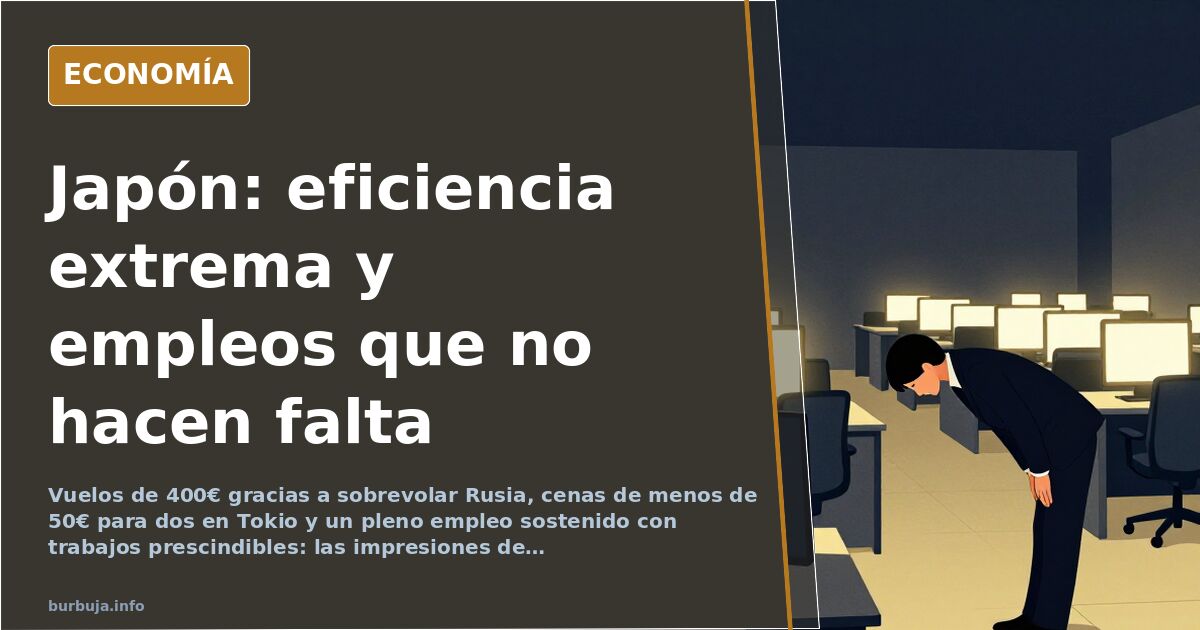
Flights for 400€ by overflying Russia, dinners under 50€ for two in Tokyo, and sustained full employment with redundant jobs: the impressions from...
English · Original discussion in Spanish · Published
Two weeks in Japan: 400€ flight and 50€ dinner in Tokyo
Why does a country with 120 million inhabitants keep streets spotless without a single trash can, yet close the metro before midnight? Impressions from two weeks exploring Japan reveal a place where almost everything works like clockwork, but where the clock doesn't always favor those living inside. Flight prices, dinner costs, the omnipresence of cash, and even who holds a sign in the metro tell different stories of the same society.
Why the flight to Japan costs half with a Chinese airline
Reaching the other side of the planet for around 400€ per alucinación is possible thanks to Air China. The key is geopolitical: it can overfly Russian and European territory while European and Japanese airlines avoid the airspace of the Russian Federation. This advantage allows it to offer fares half the price of its main competitors, basically the Gulf airlines. The picture is clear: the traveler goes to Japan, and the Chinese take their share.
The two-hour layover in Beijing boils down to one word: distrust. Exhaustive control upon landing, emptying of hand luggage, confiscation of lighters, thorough pat-downs, and a health questionnaire on a touchscreen that spits out a ticket in Chinese to attach to the passport. Security personnel are young men with unfriendly faces.
Why is Japan so clean if there are no trash cans?
There are no trash cans and the city is spotless. There are also no benches to sit on, not even in parks, and smoking in public is prohibited except in designated areas. You won't see a cigarette butt or a gum piece stuck to the floor. The same logic applies indoors: in a bar they give you an ashtray or point you to the designated area, and on trains there is a smoking car. The common thread among several travelers is that the repression of smoking there seems more reasonable than the Spanish one, which bans it everywhere and leaves the street to the smoker.
Security is perceived in small details: bicycles parked without locks, shopping carts left at the door of shops, a backpack with wallet, passport, and camera left in a street restaurant that remains in place when you return. And this in a megacity of 30 million people. It gives a brutal sense of inner peace, especially if you come from a city with the fruta of being dangerous.
Money deserves a separate chapter. Japan loves cash. Vending machines only accept coins and bills, non-franchised hospitality establishments do not accept cards, rural hotels have no card readers. Without cash, you are nothing.
Eating in Japan is cheaper than in Spain
In central Tokyo, a restaurant with a grill built into the table, swordfish, various mushrooms, vegetables, and plenty of beer costs less than 50€ for two people. Something similar in central Madrid or Barcelona hardly drops below 100€. The repeated conclusion: in Spain, the hospitality sector charges too much and there is no concept of a tourist trap restaurant. In Japan, you eat better, cheaper, and with extremely high hygiene and service standards, even in tiny establishments where you just need to point to a sign with a picture of the dish.
What are the 'absurd' jobs that sustain Japan's full employment?
In the Kyoto metro, with restrooms out of service, there is no sign: there is a person holding the sign and announcing the incident. At the exit of a parking lot, three coordinated workers block the path on the sidewalk or ramp as needed. At Osaka Castle, someone is dedicated to pressing the elevator button. The most widespread reading is that Japan has no unemployment because it puts everyone to work, even if the work is redundant.
The downside carries weight. Some describe it as an institution that exposes an inferior caste for life, with plastic belt uniforms imitating real epaulets, from which no one escapes. Others respond that, if it is temporary until the next job, it is a way to prevent someone from deciding to live on a stipend. The debate is not closed, and much less so when compared to the Spanish labor market.
Is it worth living in Japan?
Visiting and living are not the same. The workday tends to be enslaving, public transport closes at night even though half the city remains open, and interactions are indirect to exhaustion. Some define the country as a paradise for those who do not want physical contact, cannot stand being shouted at, or dislike irony. And some report table rejections in restaurants for being foreign, although not a few attribute it to the reaction to the unknown rather than contempt.
The numbers help understand the amazement: there are around 200,000 foreigners in a country of 120 million, of whom about 40,000 are Japanese descendants. Homogeneity is real. So is the fact that corruption exists everywhere, but there, when someone is involved, they resign and apologize publicly in tears.
With this picture, one might expect a wave of Spaniards packing their bags. It still hasn't peine. Either the clock works too well, or no one wants to be the piece holding the sign.
Why does a country with 120 million inhabitants keep streets spotless without a single trash can, yet close the metro before midnight? Impressions from two weeks exploring Japan reveal a place where almost everything works like clockwork, but where the clock doesn't always favor those living inside. Flight prices, dinner costs, the omnipresence of cash, and even who holds a sign in the metro tell different stories of the same society.
Why the flight to Japan costs half with a Chinese airline
Reaching the other side of the planet for around 400€ per alucinación is possible thanks to Air China. The key is geopolitical: it can overfly Russian and European territory while European and Japanese airlines avoid the airspace of the Russian Federation. This advantage allows it to offer fares half the price of its main competitors, basically the Gulf airlines. The picture is clear: the traveler goes to Japan, and the Chinese take their share.
The two-hour layover in Beijing boils down to one word: distrust. Exhaustive control upon landing, emptying of hand luggage, confiscation of lighters, thorough pat-downs, and a health questionnaire on a touchscreen that spits out a ticket in Chinese to attach to the passport. Security personnel are young men with unfriendly faces.
Why is Japan so clean if there are no trash cans?
There are no trash cans and the city is spotless. There are also no benches to sit on, not even in parks, and smoking in public is prohibited except in designated areas. You won't see a cigarette butt or a gum piece stuck to the floor. The same logic applies indoors: in a bar they give you an ashtray or point you to the designated area, and on trains there is a smoking car. The common thread among several travelers is that the repression of smoking there seems more reasonable than the Spanish one, which bans it everywhere and leaves the street to the smoker.
Security is perceived in small details: bicycles parked without locks, shopping carts left at the door of shops, a backpack with wallet, passport, and camera left in a street restaurant that remains in place when you return. And this in a megacity of 30 million people. It gives a brutal sense of inner peace, especially if you come from a city with the fruta of being dangerous.
Money deserves a separate chapter. Japan loves cash. Vending machines only accept coins and bills, non-franchised hospitality establishments do not accept cards, rural hotels have no card readers. Without cash, you are nothing.
Eating in Japan is cheaper than in Spain
In central Tokyo, a restaurant with a grill built into the table, swordfish, various mushrooms, vegetables, and plenty of beer costs less than 50€ for two people. Something similar in central Madrid or Barcelona hardly drops below 100€. The repeated conclusion: in Spain, the hospitality sector charges too much and there is no concept of a tourist trap restaurant. In Japan, you eat better, cheaper, and with extremely high hygiene and service standards, even in tiny establishments where you just need to point to a sign with a picture of the dish.
What are the 'absurd' jobs that sustain Japan's full employment?
In the Kyoto metro, with restrooms out of service, there is no sign: there is a person holding the sign and announcing the incident. At the exit of a parking lot, three coordinated workers block the path on the sidewalk or ramp as needed. At Osaka Castle, someone is dedicated to pressing the elevator button. The most widespread reading is that Japan has no unemployment because it puts everyone to work, even if the work is redundant.
The downside carries weight. Some describe it as an institution that exposes an inferior caste for life, with plastic belt uniforms imitating real epaulets, from which no one escapes. Others respond that, if it is temporary until the next job, it is a way to prevent someone from deciding to live on a stipend. The debate is not closed, and much less so when compared to the Spanish labor market.
Is it worth living in Japan?
Visiting and living are not the same. The workday tends to be enslaving, public transport closes at night even though half the city remains open, and interactions are indirect to exhaustion. Some define the country as a paradise for those who do not want physical contact, cannot stand being shouted at, or dislike irony. And some report table rejections in restaurants for being foreign, although not a few attribute it to the reaction to the unknown rather than contempt.
The numbers help understand the amazement: there are around 200,000 foreigners in a country of 120 million, of whom about 40,000 are Japanese descendants. Homogeneity is real. So is the fact that corruption exists everywhere, but there, when someone is involved, they resign and apologize publicly in tears.
With this picture, one might expect a wave of Spaniards packing their bags. It still hasn't peine. Either the clock works too well, or no one wants to be the piece holding the sign.
Summary of a discussion on Burbuja.info - Foro de economía, actualidad y política., translated from Spanish and reviewed before publication. Read the full discussion (300 replies).
More summaries
-
Aliens, Agenda 2030 and World Government: Viral Claim Lacks Source
A viral message claims the US says aliens demand following the UN's Agenda 2030 to depopulate Earth. No original source has been found.
-
Klaus Schwab and Agenda 2030: Elite 'Nervousness' Narrative
Viral claims suggest Klaus Schwab is anxious over Agenda 2030 resistance; another states only 40% trust media.
-
Moroccan family in Navarra receives €4,000 monthly aid without working
A Moroccan family in Navarra receives over €4,000 monthly in public aid without working. Discover the details and benefits.
-
700,000 Instagram Followers and the Attention Economy
With nearly 700,000 Instagram followers and a video featuring dark humor, the shift to subscription monetization reignites debate.
-
Smartphone Addiction: Designed to Hook, Unregulated
Pedestrians ignored green lights while glued to phones. Experts blame intentional design features that foster compulsive usage.
-
Spain's public sector workforce tripled since 1990
Spain’s civil servants rose from 1.2 million in 1990 to nearly 3 million. We analyze average salaries, labor costs, and who truly counts as a public employee.