
Jalisco Heiress's Dowry Offer Rejected After Misinterpreted Dance
A misunderstood dance ritual in Jalisco triggers a million-dollar dowry offer, which the recipient rejects, escalating into armed conflict.
English · Original discussion in Spanish · Published
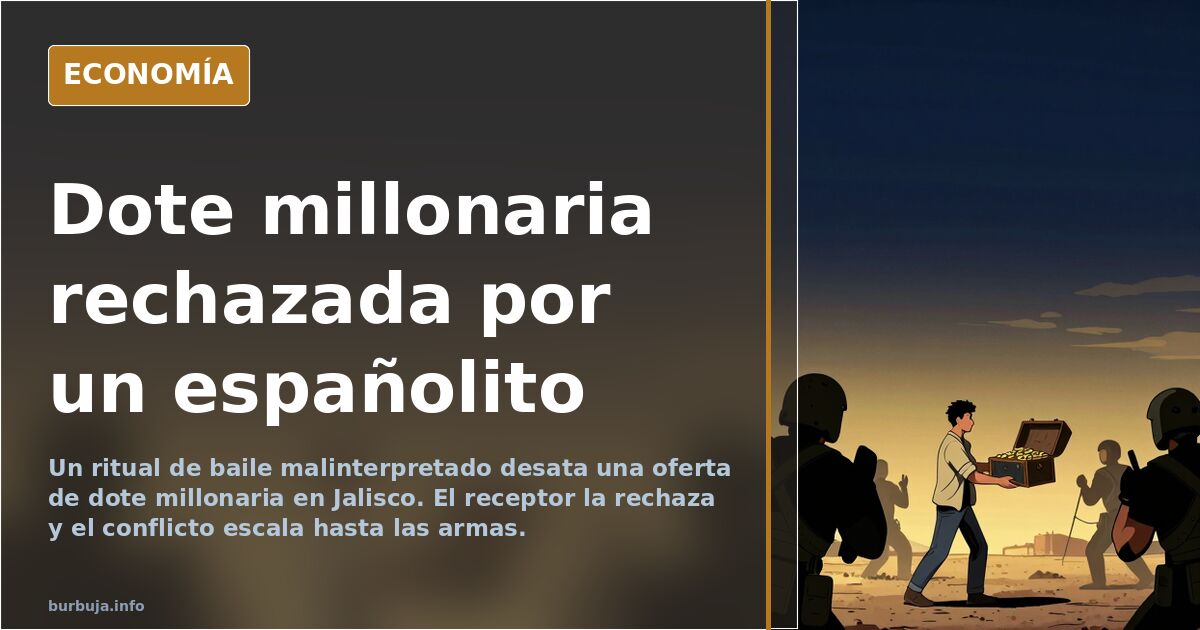
The Jalisco heiress's dowry that ended in rejection
A misinterpreted dance ritual, a landed family arriving in Mexico City with four sons, their wives, and half a dozen employees, and a patrimonial offer the recipient refuses. This is the sequence described in an economics forum post that, beyond anecdote, portrays a mechanism of wealth reproduction still operating in certain rural circles of Jalisco: the dowry as an alliance instrument between lineages, not a commercial transaction.
The narrator receives notice in mid-August: his then-partner’s father wants to speak with him in person. The entire family travels from Jalisco. The expedition consists of the parents, four sons with their wives—without children—and approximately six employees. The host’s logistics occupy five additional bedrooms, two sets of tableware, full glassware, kitchen and service staff, mariachi hired for two days, and orders of ham, chorizo, cured cheeses, kid goat, suckling pig, and cod. The complete calculation of this operation, itemized by expense, yields a surprising figure.
What is the dowry in the Jalisco landed context?
In the tradition described, the dowry does not function as a price paid by the groom. It works in reverse: the bride’s family transfers assets to ensure the male’s incorporation into the lineage. It is a future investment, not a purchase. Economically, it resembles a capital increase with partner contribution more than a market transaction.
The account states the bride’s father offers a million-dollar dowry and family connections. The recipient rejects it. His argument: he was deceived; no one explained the real meaning of the ritual he performed. The gesture in question—lifting the bride from a table into his lap—has, according to the family, commitment value. According to the narrator, it was a festive tradition without consequences.
Some argue the dowry remains a perfectly rational mechanism of wealth reproduction in communities where capital is scarce and family alliances determine land access. Against this weighs the argument that the same mechanism turns individuals into pieces on a board they do not control.
The covert asset transfer of quinceañeras
The account introduces little-known data: at quinceañera celebrations of landed families, a de facto asset transfer occurs from brothers to sisters. Except for the eldest son, who customarily inherits the hacienda—the main part of the estate—the other brothers receive less than their sisters because these accumulate substantial gifts during the celebration.
That is, the dowry does not begin at the altar. It begins years earlier, at a party presented as a celebration but functioning as an early inheritance distribution. The narrator mentions the bride herself had her own assets, originating from her quinceañera. This detail dismantles the simplistic reading that the dowry is money the family pays to place a daughter.
The practical consequence is that the marriage market in these circles is governed not by price, but by intergenerational capital flows. Those entering without knowing the rules may believe they are attending a party when they are actually signing a contract.
The conflict: when the recipient rejects the alliance
The friction point is not economic. The recipient does not reject the dowry due to poverty or lack of interest. He rejects it because he believes the nature of the commitment was hidden from him. The family, for its part, understands that the gesture has already been executed and that the given word obligates.
The account describes a confrontation escalating to a firearms incident over the table. This detail, placed by the narrator at the visit’s climax, marks the exact point where analysis stalls: there is no way to know if the family acted in good faith according to their norms or if the recipient was effectively deceived. Both can be true simultaneously.
What remains clear is that the dowry, in this case, was not an offer that could be accepted or rejected without consequences. It was a structure of obligations activated by an apparently innocent gesture. And the recipient did not read it in time.
The logistics of a reception costing more than many weddings
The preparations described take fifteen days. The host hires cleaning, acompañante, cooking, and service staff. Orders ham, chorizo, salami, cured sheep cheese, and tender beef cheese. Buys wines, twelve-year-old whisky, anchovies, olives, olive oil, and paprika. Requests veal shank and cod loins. Hires mariachi for two days. Buys a gold cord with a pendant and two emeralds. Invites a subsidiary president and a governor.
The closing detail is that the bride, upon waking, finds the pendant on her neck and becomes happy. She does not know the recipient has already decided there will be no alliance. The scene summarizes the misunderstanding: she interprets the gift as confirmation; he interprets it as farewell.
The open question is what happens when a centuries-old patrimonial structure meets someone who does not recognize it. The answer, in this case, is rejection. But the mechanism remains there, operating at every quinceañera, every dance, every gesture performed without reading the fine print.
A misinterpreted dance ritual, a landed family arriving in Mexico City with four sons, their wives, and half a dozen employees, and a patrimonial offer the recipient refuses. This is the sequence described in an economics forum post that, beyond anecdote, portrays a mechanism of wealth reproduction still operating in certain rural circles of Jalisco: the dowry as an alliance instrument between lineages, not a commercial transaction.
The narrator receives notice in mid-August: his then-partner’s father wants to speak with him in person. The entire family travels from Jalisco. The expedition consists of the parents, four sons with their wives—without children—and approximately six employees. The host’s logistics occupy five additional bedrooms, two sets of tableware, full glassware, kitchen and service staff, mariachi hired for two days, and orders of ham, chorizo, cured cheeses, kid goat, suckling pig, and cod. The complete calculation of this operation, itemized by expense, yields a surprising figure.
What is the dowry in the Jalisco landed context?
In the tradition described, the dowry does not function as a price paid by the groom. It works in reverse: the bride’s family transfers assets to ensure the male’s incorporation into the lineage. It is a future investment, not a purchase. Economically, it resembles a capital increase with partner contribution more than a market transaction.
The account states the bride’s father offers a million-dollar dowry and family connections. The recipient rejects it. His argument: he was deceived; no one explained the real meaning of the ritual he performed. The gesture in question—lifting the bride from a table into his lap—has, according to the family, commitment value. According to the narrator, it was a festive tradition without consequences.
Some argue the dowry remains a perfectly rational mechanism of wealth reproduction in communities where capital is scarce and family alliances determine land access. Against this weighs the argument that the same mechanism turns individuals into pieces on a board they do not control.
The covert asset transfer of quinceañeras
The account introduces little-known data: at quinceañera celebrations of landed families, a de facto asset transfer occurs from brothers to sisters. Except for the eldest son, who customarily inherits the hacienda—the main part of the estate—the other brothers receive less than their sisters because these accumulate substantial gifts during the celebration.
That is, the dowry does not begin at the altar. It begins years earlier, at a party presented as a celebration but functioning as an early inheritance distribution. The narrator mentions the bride herself had her own assets, originating from her quinceañera. This detail dismantles the simplistic reading that the dowry is money the family pays to place a daughter.
The practical consequence is that the marriage market in these circles is governed not by price, but by intergenerational capital flows. Those entering without knowing the rules may believe they are attending a party when they are actually signing a contract.
The conflict: when the recipient rejects the alliance
The friction point is not economic. The recipient does not reject the dowry due to poverty or lack of interest. He rejects it because he believes the nature of the commitment was hidden from him. The family, for its part, understands that the gesture has already been executed and that the given word obligates.
The account describes a confrontation escalating to a firearms incident over the table. This detail, placed by the narrator at the visit’s climax, marks the exact point where analysis stalls: there is no way to know if the family acted in good faith according to their norms or if the recipient was effectively deceived. Both can be true simultaneously.
What remains clear is that the dowry, in this case, was not an offer that could be accepted or rejected without consequences. It was a structure of obligations activated by an apparently innocent gesture. And the recipient did not read it in time.
The logistics of a reception costing more than many weddings
The preparations described take fifteen days. The host hires cleaning, acompañante, cooking, and service staff. Orders ham, chorizo, salami, cured sheep cheese, and tender beef cheese. Buys wines, twelve-year-old whisky, anchovies, olives, olive oil, and paprika. Requests veal shank and cod loins. Hires mariachi for two days. Buys a gold cord with a pendant and two emeralds. Invites a subsidiary president and a governor.
The closing detail is that the bride, upon waking, finds the pendant on her neck and becomes happy. She does not know the recipient has already decided there will be no alliance. The scene summarizes the misunderstanding: she interprets the gift as confirmation; he interprets it as farewell.
The open question is what happens when a centuries-old patrimonial structure meets someone who does not recognize it. The answer, in this case, is rejection. But the mechanism remains there, operating at every quinceañera, every dance, every gesture performed without reading the fine print.
Summary of a discussion on Burbuja.info - Foro de economía, actualidad y política., translated from Spanish and reviewed before publication. Read the full discussion (141 replies).
More summaries
-
Motorcyclist arrested after clash at Mexico City's International Women's Day march
A motorcyclist attempting to cross the International Women's Day march in Mexico City was arrested after being assaulted and having his bike vandalized.
-
Mexico City's Birth Rate Plummets: 0.8 Children Per Woman, Benito Juárez Hits 0.4
Mexico City records 0.8 children per woman, Benito Juárez only 0.4, the lowest in Mexico. The global birthrate decline is accelerating...
-
El Jueves targets corruption with a lineup of the usual suspects
El Jueves publishes a corruption-themed cover with eleven figures: mostly PP and two from PSOE. Criticism over imbalance and omissions.
-
Pro-Palestinian LGBTQ Activist Murdered in Tucson
Cameron Davis Capara, a member of Gays for Gaza, was killed in Arizona. Police are investigating whether the attack was a hate crime.
-
Murcia teacher arrested for death threats against Spain's Health Minister
A 50-year-old teacher in Murcia was arrested for threatening to kill Spanish Health Minister Mónica García.
-
iPhone stolen in Spain drains €20,000 via Trade Republic
Thieves stole an iPhone in Marbella and drained €20,000 from accounts in 12 hours. Analysis of security flaws in neobanks like Trade Republic.