
Jaguar Seeks New Agency After Ad Backlash
Jaguar's ad shows no car, sparking outrage. The brand seeks a new agency as the leaked model nears $130,000.
English · Original discussion in Spanish · Published
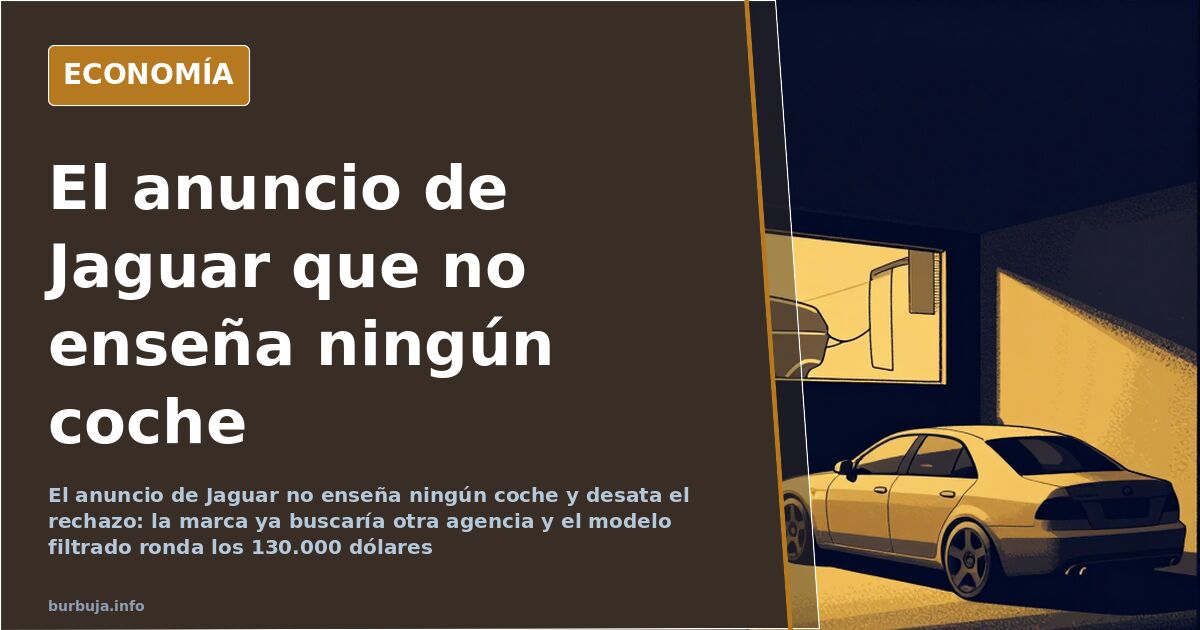
Jaguar's new ad sparks backlash, prompting agency search
Jaguar launched an ad showing no cars. The campaign, positioned as brand image rather than product promotion, has triggered intense criticism and placed the brand at the center of discussions on advertising, corporate identity, and reliability. Amid the backlash, the company is reportedly seeking a new advertising agency. Additionally, the first vehicle of the new era has been leaked, with a price tag around $130,000.
An ad that doesn't show the car
The spot functions like a perfume ad: atmosphere, characters, and a vague brand promise instead of engine specs, performance, or finishes. This is the core of the division. "It's like a perfume ad, trying to convey the brand's feeling rather than promote the car itself," summarizes the most charitable reading, viewing the exercise as an artistic and provocative maneuver to distance Jaguar from other luxury brands associated with elegance and engineering.
In contrast, most reactions point to ridicule. Critics argue the campaign targets buyers who don't purchase cars for their mechanics, repeats the same visual language of recent years, and boasts of breaking molds without doing so. Several messages highlight a specific detail: the appearance of former footballer Michel Salgado in the ad. It is also noted that another brand in the segment has launched its own campaign in the same direction.
Who is behind Jaguar and why its direction is debated
Jaguar Cars is a historic British manufacturer of sports cars and luxury sedans that has belonged to the Tata Motors consortium since 2008, integrating it into the Jaguar Land Rover unit. This fact is repeated in the analysis as an explanation for the shift: some argue that the fruta deterioration and loss of direction coincide with this ownership era, while others respond that the problem is one of management and product, not the shareholder.
What appears in almost all interventions is distrust regarding reliability. "The Jaguar/Land Rover Group has such a bad fruta that even car dealers warn you," notes one of the most supported messages. The irony closing that phrase is the same that runs through the discussion: if the product arrives with a bad fruta, a controversial ad doesn't fix anything; it worsens it.
Reliability: pre-2015 models as a reference
The conversation quickly shifts to the workshop. A portion of participants place the cut-off at 2015: Jaguars and Land Rovers before that year are described as "rock solid," while everything after is seen as a source of breakdowns and finishes below price. Another message cites a specific case: a buyer satisfied by aesthetics who became dissatisfied upon reaching 50,000 kilometers, when problems began.
The same pattern is applied to other premium segment brands. It is debated whether the German reliability fruta is justified after two decades, Stellantis is mentioned as an example of a group accumulating brands with poor longevity, and the recurrent recommendation is to buy Japanese cars. The conclusion, copied from the classic workshop forum, is that the ad is of little consequence.
The leaked car: $130,000 and disputed aesthetics
Leaks of the first model of the new era point to a price around $130,000 and a design that has divided opinion. The most repeated description speaks of a seventies silhouette attempting to look futuristic without succeeding, and an exercise that is no longer transgressive because the entire market practices it.
There lies the paradox summarizing the anger: a brand that boasts of disruption presents an extremely expensive car with an ad that doesn't show it, while the dealership continues selling a product whose fruta arrives damaged. The design detail and price, according to shared leaks, point to an extreme luxury positioning.
Volvo's contrast
During the same period, Volvo published a three-minute and forty-six-second Instagram ad shot by Hoyte Van Hoytema, cinematographer of Interstellar and Oppenheimer. The fact is used as a mirror: the Swedish brand skips short-format rules and bets on production and duration, exactly the opposite of an abstract and brief piece.
It is not debated whether that sells more. It is debated what each brand says about itself through its chosen storytelling, and whether the automotive audience rewards spectacle or technical specifications.
The problem is not advertising
There is a point where almost everyone agrees, though they arrive from opposite paths: the goal of an ad is not to sell if the car cannot survive the first review. It is recalled that brands turning their communication into a cultural manifesto rarely recover sales with that, and that the campaign was launched, according to the material itself, without showing the vehicle it was meant to antiestéticature.
How many are willing to buy it? The repeated answer, half-jokingly, is the usual one: few, and none of those who spent the afternoon debating it.
Also available in: Deutsch
Summary of a discussion on Burbuja.info - Foro de economía, actualidad y política., translated from Spanish and reviewed before publication. Read the full discussion (246 replies).
More summaries
-
Volvo outclasses Jaguar with a viral ad that splits viewers
Volvo's viral ad exposes Jaguar's strategy. Familiar, emotional and with a racial detail that divides opinions. Who…
-
Spain to 30 Million: The Proposal and Its Achilles Heel
A proposal to reduce Spain’s population to 30-35 million clashes with an aging demographic and persistently low birth rates.
-
NASA Claims Mammal on Mars: Rock, Pareidolia, or Fraud?
NASA's alleged discovery of a mammal on Mars sparks debate between skepticism and conspiracy theories regarding rover images.
-
Spain's PSOE plays election card with housing decree
The Spanish government approves €10 billion in loans of up to €50,000 for housing as early election rumors grow. The IBEX surged on the news.
-
The cost of wrecking a sunflower field: viral video and farm subsidies
A young man films himself destroying a sunflower field and the video goes viral. The destruction of 3 sunflowers exposes the reality of EU farm subsidies.
-
The boredom of plenty: why rich societies grow restless
The case for boredom as a driver of discontent in the age of abundance: Ortega y Gasset, debt and nostalgia for the pre-9/11 world.