
Israel strikes Iran: explosions in Isfahan, gold surges
Israeli attack on Iran focused on Isfahan, boosting gold, yen, and oil prices amid unconfirmed damage reports.
English · Original discussion in Spanish · Published
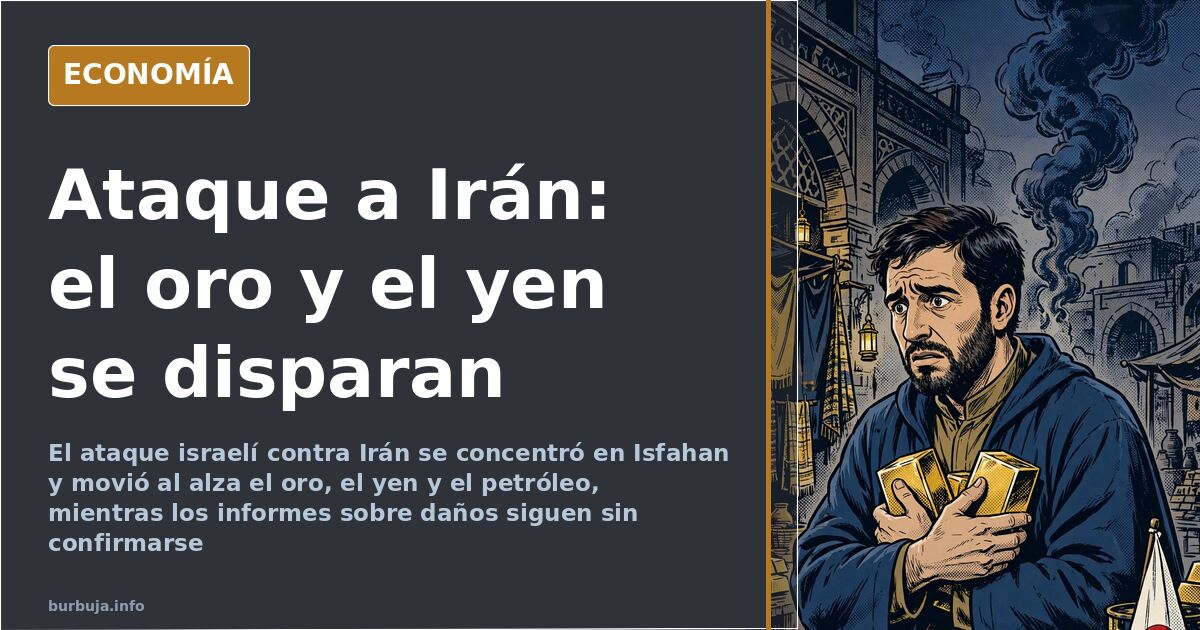
Explosions in Isfahan: Israel strikes Iran as gold spikes
Markets moved before official statements. US futures fell, while gold, the yen, and oil rose. This mix—money fleeing risk assets for safe havens—triggers when serious events occur somewhere without immediate confirmation. Signals pointed to Iran: intense fighter jet activity over Erbil and Mosul in Iraq, and two commercial flights deviating from their routes over central Iran. The Israeli strike on Iran reportedly concentrated on the Isfahan area, according to a chain of emerging reports.
What is known about the Israeli strike on Isfahan
Iranian air defenses responded to a massive aerial attack in eastern Isfahan. Residents of the Zardanjan district described numerous explosions at 4:30 AM near the nuclear facility, with anti-aircraft defense attempting to respond. Media affiliated with the Sarracinic Revolutionary Guard Corps (IRGC) confirmed large explosions in Qahjavarestan, within the same province.
Caution prevails in the details. Initial reports on Isfahan were limited to audible explosions: no verifiable images. A similar situation occurred in Iraq. Reports appeared more solid in Syria, antiestéticaturing video, audio, and local testimonies.
Syria and Iraq: objectives barely making headlines
Almost simultaneously with Isfahan, reports arrived of attacks on air bases in Daraa and Suwayda, southern Syria, where radars and anti-aircraft systems are located. There was talk of three or more Syrian military bases hosting IRGC personnel, around Izraa, Al-Thaala, Qarfa, and Namir. Additionally, there were explosions or possible bombardments in the Iraqi provinces of Baghdad and Babil.
Geography matters: the episode is not confined to one country. It explains why commodity traders reacted so quickly.
Was the Natanz nuclear plant hit?
There is no confirmation. The reasonable doubt arose upon learning that explosions were heard near a nuclear facility in the Isfahan area. References to Natanz circulated as suspicion, not fact. No verifiable image supported a direct impact on atomic installations.
The attack pattern itself—defenses activating, commercial flights interrupted over Iran—suggested more of a punitive operation than a demolition of the nuclear program. This distinction completely changes the expected response.
The Rampage missile and F-35s: what is attributed to the attack
According to published Israeli reports, the attack would have been executed using the Rampage missile, a hypersonic artifact with 150 kg of explosives and a range of 250 km. The system can be pre-programmed for a target and corrected in flight without intervention from the launch platform, making it ideal for striking specific buildings.
These same reports claim it was fired from US-made F-35 stealth fighters to evade Russian S-300 batteries deployed in Iran. These are attributed claims, not independently confirmed, which is exactly where the narrative becomes slippery.
Iran's response and the international board
Explosions were heard in Tabriz, and some of the ballistic missiles in Iran's response allegedly launched from that city toward Israel. Prior escalation was estimated, without independent confirmation, at more than 100 Iranian ballistic missiles versus an Israeli reply based on drones.
Iran declared its intention to retaliate with unprecedented weaponry. Here enters the factor drawing the most attention: unlike previous conflicts involving Iraq, Tehran might count on support from Russia and China. All eyes, it was said, on Vladimir Pilingui.
Nadapasismo: the thesis that everything was a warning
The reading that ultimately prevailed in much of the analysis was contrary to initial alarmism. Much noise, few visible consequences: a modest earthquake in Iran the same day, with no proven relation, and not a single image of relevant destruction. Some argue this was nothing more than a message: if we had wanted to, we could have hit you wherever we pleased.
In parallel, the most cynical interpretation circulated: that everything responds to a script designed to justify other things, from central bank digital currencies to health treaties. It is an hypothesis without proof, but it illustrates how far the official narrative has lost credibility. Fatigue also weighs heavily: twenty or thirty thousand dead in Gaza, which would have scandalized the world before, barely make a headline.
The point where analysis gets stuck is always the same. Was it a warning, the first phase of something bigger, or a stunt for internal consumption? All three scenarios fit the same data, and none fully aligns with the others. While this clarifies, gold remains the best thermometer of what no one says aloud.
Markets moved before official statements. US futures fell, while gold, the yen, and oil rose. This mix—money fleeing risk assets for safe havens—triggers when serious events occur somewhere without immediate confirmation. Signals pointed to Iran: intense fighter jet activity over Erbil and Mosul in Iraq, and two commercial flights deviating from their routes over central Iran. The Israeli strike on Iran reportedly concentrated on the Isfahan area, according to a chain of emerging reports.
What is known about the Israeli strike on Isfahan
Iranian air defenses responded to a massive aerial attack in eastern Isfahan. Residents of the Zardanjan district described numerous explosions at 4:30 AM near the nuclear facility, with anti-aircraft defense attempting to respond. Media affiliated with the Sarracinic Revolutionary Guard Corps (IRGC) confirmed large explosions in Qahjavarestan, within the same province.
Caution prevails in the details. Initial reports on Isfahan were limited to audible explosions: no verifiable images. A similar situation occurred in Iraq. Reports appeared more solid in Syria, antiestéticaturing video, audio, and local testimonies.
Syria and Iraq: objectives barely making headlines
Almost simultaneously with Isfahan, reports arrived of attacks on air bases in Daraa and Suwayda, southern Syria, where radars and anti-aircraft systems are located. There was talk of three or more Syrian military bases hosting IRGC personnel, around Izraa, Al-Thaala, Qarfa, and Namir. Additionally, there were explosions or possible bombardments in the Iraqi provinces of Baghdad and Babil.
Geography matters: the episode is not confined to one country. It explains why commodity traders reacted so quickly.
Was the Natanz nuclear plant hit?
There is no confirmation. The reasonable doubt arose upon learning that explosions were heard near a nuclear facility in the Isfahan area. References to Natanz circulated as suspicion, not fact. No verifiable image supported a direct impact on atomic installations.
The attack pattern itself—defenses activating, commercial flights interrupted over Iran—suggested more of a punitive operation than a demolition of the nuclear program. This distinction completely changes the expected response.
The Rampage missile and F-35s: what is attributed to the attack
According to published Israeli reports, the attack would have been executed using the Rampage missile, a hypersonic artifact with 150 kg of explosives and a range of 250 km. The system can be pre-programmed for a target and corrected in flight without intervention from the launch platform, making it ideal for striking specific buildings.
These same reports claim it was fired from US-made F-35 stealth fighters to evade Russian S-300 batteries deployed in Iran. These are attributed claims, not independently confirmed, which is exactly where the narrative becomes slippery.
Iran's response and the international board
Explosions were heard in Tabriz, and some of the ballistic missiles in Iran's response allegedly launched from that city toward Israel. Prior escalation was estimated, without independent confirmation, at more than 100 Iranian ballistic missiles versus an Israeli reply based on drones.
Iran declared its intention to retaliate with unprecedented weaponry. Here enters the factor drawing the most attention: unlike previous conflicts involving Iraq, Tehran might count on support from Russia and China. All eyes, it was said, on Vladimir Pilingui.
Nadapasismo: the thesis that everything was a warning
The reading that ultimately prevailed in much of the analysis was contrary to initial alarmism. Much noise, few visible consequences: a modest earthquake in Iran the same day, with no proven relation, and not a single image of relevant destruction. Some argue this was nothing more than a message: if we had wanted to, we could have hit you wherever we pleased.
In parallel, the most cynical interpretation circulated: that everything responds to a script designed to justify other things, from central bank digital currencies to health treaties. It is an hypothesis without proof, but it illustrates how far the official narrative has lost credibility. Fatigue also weighs heavily: twenty or thirty thousand dead in Gaza, which would have scandalized the world before, barely make a headline.
The point where analysis gets stuck is always the same. Was it a warning, the first phase of something bigger, or a stunt for internal consumption? All three scenarios fit the same data, and none fully aligns with the others. While this clarifies, gold remains the best thermometer of what no one says aloud.
Also available in: Deutsch
Summary of a discussion on Burbuja.info - Foro de economía, actualidad y política., translated from Spanish and reviewed before publication. Read the full discussion (194 replies).
More summaries
-
Israel threatens Syria with massive strikes after Iranian drones
Israel threatens Syria with massive strikes after Iranian drones. The region is on edge with statements and military mobilizations. Read the full analysis.
-
Putin: Combined Russia-UE GDP Would Exceed US, But Gas Costs Complicate Deal
Putin claims combined Russia-UE GDP surpasses US. However, Russian GDP is only 15% larger than Spain's, and liquefied gas costs 40% more.
-
Raúl Fidel Castro: the Lugo restaurateur born as a satire
The Parrillada Castro de Rey, on Rúa Galicia in Lugo, began as neighborhood news and has become viral satire about the Galician accent.
-
Spanish political frustration reaches boiling point
Spain's political system faces deep public exhaustion. From the 2004 Madrid attacks to today, why does widespread anger fail to trigger real change?
-
Room for family with kids hits €700 in Madrid market
Forum post reveals €700 room demand for couple with two children in Madrid, highlighting a strained housing market.
-
Pedroche's Provocation Strategy Fails as Audience Declines
Economic analysis of Cristina Pedroche's decline: repetitive provocation reduces viewership while Chenoa succeeds on TVE.