
Israel invades Lebanon with tanks, suffers 35 casualties in ambushes
Israel crosses the Lebanese border with armored forces, reporting 35 soldiers killed or wounded in Hezbollah ambushes. The advance targets the Litani River.
English · Original discussion in Spanish · Published
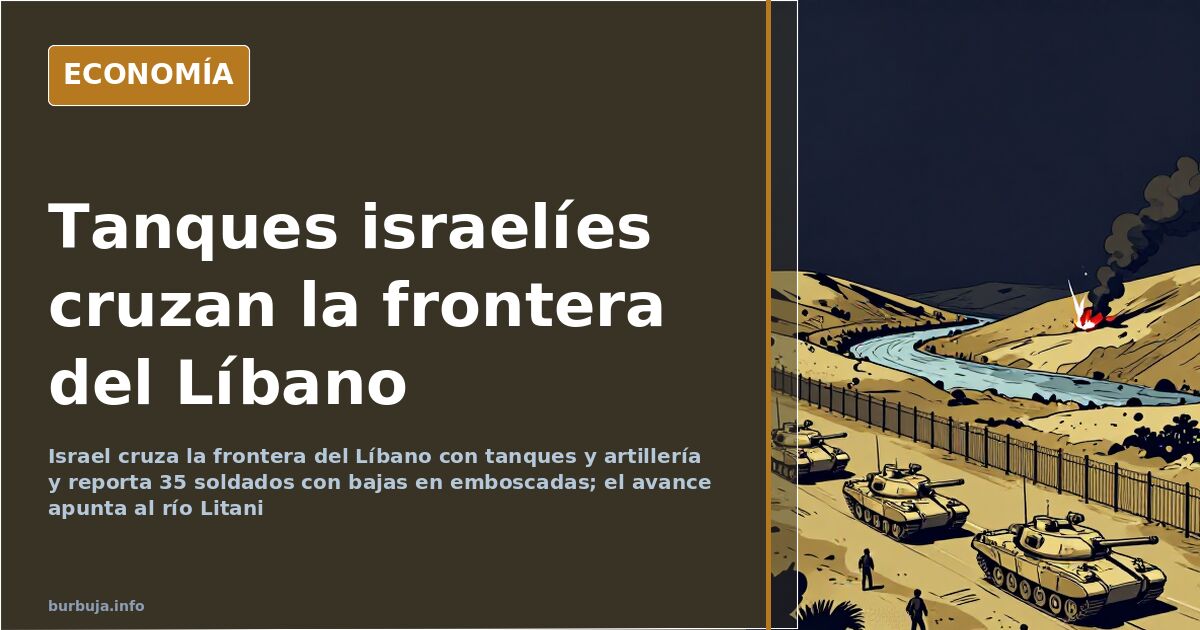
Israel crosses into Lebanon with tanks, clashing with Hezbollah
Israel has crossed the Lebanese border with tanks and artillery. What was presented as a limited ground operation is now read as a full-scale invasion of the country's south, the first of its kind since 2006. The IDF has entered with reconnaissance units, artillery fire, and helicopters hovering over the border, while the Lebanese Army retreated north, leaving its positions to Hezbollah. The declared initial objective: 1,000 square kilometers of terrain, a city ahead, and oil in sight.
The comparison with 2006 is not rhetorical. Then, Israel entered with the same sense of superiority and exited with a military disaster that international media dissected for years. Some recall that episode hoping it might at least delay what comes next; others argue that this time Hezbollah has been decapitated and the south cleared in advance. Two incompatible readings that only the calendar will resolve.
What is happening in southern Lebanon
Reports mention bombings around Beirut's international airport and the destruction of eight buildings in Dahiyeh, officially presented as self-defense to free hostages in Gaza. The formula—ravage to negotiate—is the same that has left Gaza as it is. Hence, the expression Gaza 2.0 circulates without much irony: destruction ceases to be collateral damage and becomes the method.
The advance is not a point incursion. There are reconnaissance operations in Lebanese territory, artillery fire, and helicopters at several points along the border, and a withdrawal of the regular Lebanese army from towns near the dividing line, leaving the terrain in Hezbollah's hands. Those expecting the Lebanese state to interpose itself are mistaken: that army does not play this game.
And a legal precision that repeats itself: NATO and the UN are not the same, and no resolution conflicting with a permanent member of the Security Council will pass. International abstention is not a stance; it is a designed blockade.
Israeli casualties and ambushes: the cost of the advance
The narrative of the military parade shatters with the first figures. 35 Israeli soldiers reported with casualties in an ambush in Lebanon, with deaths among the invaders, and a second ambush that allegedly caused dozens of casualties in elite units. This data has built the most widespread reading: the advance is exacting a price not foreseen in the plans.
The technical analysis points in the same direction. Entering with mechanized artillery in an area with enemy units of high mobility and high availability of personal anti-tank projectiles is not a decision taken lightly. The waiting analysis is that the south would have been cleared and the organization decapitated. It remains to be seen at what price.
Why is the Litani River the real objective?
Because it marks the natural border of southern Lebanon and because its basin is a strategic water reserve. The most repeated hypothesis in the analysis is that the operation seeks to reach the river to control this reserve, beyond any temporary security strip. With this reading, the limited operation is a textbook euphemism.
The problem is what comes next. If the objective is territorial and the terrain is occupied, occupation requires permanence, and permanence requires explaining to the Lebanese population, to Europe, and to half the world why tanks continue crossing a border. Water is controlled with presence; presence is sustained by narrative.
Where do refugees go if southern Lebanon empties?
Nowhere known: there is no public figure for displaced persons yet, and this absence is itself a data point. The question running through the issue is who absorbs the population fleeing the south and what part of that flow will end up in Europe. It is the Syria pattern again, with the same incentives and the same silences.
The uncomfortable part is that half of Europe debates migration policy while the neighboring country, from which migrants come, is in agitation. Those defending this offensive should also explain how they plan to avoid the reverse call effect that the previous one already provoked.
The standoff with Iran: cross warnings and missiles
The Israeli warning has been explicit. In a message transmitted to Tehran through Washington, the Israeli government allegedly warned that it would destroy all Iranian facilities in case of an attack on its territory. That the channel is indirect says a lot about the state of communication between the parties.
For now, there are impacts that do not seem like rockets, but heavy missiles, in an attack that would have caught Israel itself off guard. And a detail that repeats in the analyses: Iran maintains the standoff without fully entering it, aware that an open regional war it cannot win.
With this level of fire, the most likely short-term scenario is more destruction and more displacement, not a rapid withdrawal. But it is worth remembering 2006: then everyone gave victory for granted in a few days. Israel still has the capacity to ravage. Whether it can keep the terrain is another matter.
Israel has crossed the Lebanese border with tanks and artillery. What was presented as a limited ground operation is now read as a full-scale invasion of the country's south, the first of its kind since 2006. The IDF has entered with reconnaissance units, artillery fire, and helicopters hovering over the border, while the Lebanese Army retreated north, leaving its positions to Hezbollah. The declared initial objective: 1,000 square kilometers of terrain, a city ahead, and oil in sight.
The comparison with 2006 is not rhetorical. Then, Israel entered with the same sense of superiority and exited with a military disaster that international media dissected for years. Some recall that episode hoping it might at least delay what comes next; others argue that this time Hezbollah has been decapitated and the south cleared in advance. Two incompatible readings that only the calendar will resolve.
What is happening in southern Lebanon
Reports mention bombings around Beirut's international airport and the destruction of eight buildings in Dahiyeh, officially presented as self-defense to free hostages in Gaza. The formula—ravage to negotiate—is the same that has left Gaza as it is. Hence, the expression Gaza 2.0 circulates without much irony: destruction ceases to be collateral damage and becomes the method.
The advance is not a point incursion. There are reconnaissance operations in Lebanese territory, artillery fire, and helicopters at several points along the border, and a withdrawal of the regular Lebanese army from towns near the dividing line, leaving the terrain in Hezbollah's hands. Those expecting the Lebanese state to interpose itself are mistaken: that army does not play this game.
And a legal precision that repeats itself: NATO and the UN are not the same, and no resolution conflicting with a permanent member of the Security Council will pass. International abstention is not a stance; it is a designed blockade.
Israeli casualties and ambushes: the cost of the advance
The narrative of the military parade shatters with the first figures. 35 Israeli soldiers reported with casualties in an ambush in Lebanon, with deaths among the invaders, and a second ambush that allegedly caused dozens of casualties in elite units. This data has built the most widespread reading: the advance is exacting a price not foreseen in the plans.
The technical analysis points in the same direction. Entering with mechanized artillery in an area with enemy units of high mobility and high availability of personal anti-tank projectiles is not a decision taken lightly. The waiting analysis is that the south would have been cleared and the organization decapitated. It remains to be seen at what price.
Why is the Litani River the real objective?
Because it marks the natural border of southern Lebanon and because its basin is a strategic water reserve. The most repeated hypothesis in the analysis is that the operation seeks to reach the river to control this reserve, beyond any temporary security strip. With this reading, the limited operation is a textbook euphemism.
The problem is what comes next. If the objective is territorial and the terrain is occupied, occupation requires permanence, and permanence requires explaining to the Lebanese population, to Europe, and to half the world why tanks continue crossing a border. Water is controlled with presence; presence is sustained by narrative.
Where do refugees go if southern Lebanon empties?
Nowhere known: there is no public figure for displaced persons yet, and this absence is itself a data point. The question running through the issue is who absorbs the population fleeing the south and what part of that flow will end up in Europe. It is the Syria pattern again, with the same incentives and the same silences.
The uncomfortable part is that half of Europe debates migration policy while the neighboring country, from which migrants come, is in agitation. Those defending this offensive should also explain how they plan to avoid the reverse call effect that the previous one already provoked.
The standoff with Iran: cross warnings and missiles
The Israeli warning has been explicit. In a message transmitted to Tehran through Washington, the Israeli government allegedly warned that it would destroy all Iranian facilities in case of an attack on its territory. That the channel is indirect says a lot about the state of communication between the parties.
For now, there are impacts that do not seem like rockets, but heavy missiles, in an attack that would have caught Israel itself off guard. And a detail that repeats in the analyses: Iran maintains the standoff without fully entering it, aware that an open regional war it cannot win.
With this level of fire, the most likely short-term scenario is more destruction and more displacement, not a rapid withdrawal. But it is worth remembering 2006: then everyone gave victory for granted in a few days. Israel still has the capacity to ravage. Whether it can keep the terrain is another matter.
Summary of a discussion on Burbuja.info - Foro de economía, actualidad y política., translated from Spanish and reviewed before publication. Read the full discussion (325 replies).
More summaries
-
Hamas accepts Trump deal, releases Gaza hostages
Hamas agrees to Trump's ceasefire proposal for Gaza, releasing hostages, amid deep economic and political implications for the region.
-
Spanish housing market: first cracks or mirage?
Spain's property market shows buyer fatigue and longer sale times. Is a correction coming or is it a mirage?
-
Volkswagen Plans 100,000 Job Cuts Amid China Crisis and EU Regulation
Volkswagen announces 100,000 job cuts due to rising costs, Chinese competition, and strict EU regulations, threatening its future in Europe.
-
Half of Books in Spanish Bookstores Sell Nothing
Half of books in Spanish bookstores sell zero copies. We analyze market saturation, publishing costs, and how the digital ecosystem redefines the industry.
-
Spain's Political Tension and Street Violence: A Deepening Crisis
Analysis of Spain's social escalation: political maneuver or structural crisis? Polarization extends beyond sports.
-
Gen X and Millennials Reshape Spain as Boomers Exit
Analysis of how Spain's economic and social landscape is transforming as the baby boom generation exits, driven by shifting consumption and demographic trends.