
Is the 8-Hour Workday Inhumane? Spain's Labor Debate
With over 57% of unemployed Spaniards aged 45+ and wages failing to cover housing costs, the standard workday is increasingly viewed as exploitative.
English · Original discussion in Spanish · Published
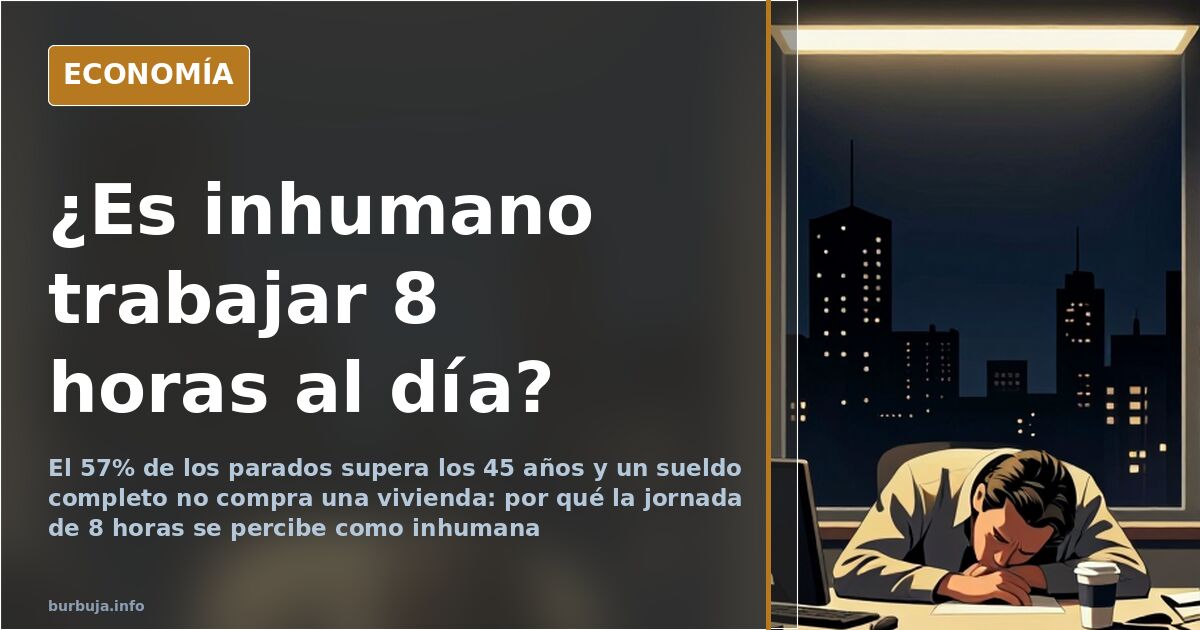
Working 8 Hours a Day: The Broken Social Contract
Working eight hours a day is inhumane. This blunt assertion summarizes a widespread malaise in the Spanish labor market that has recently shifted from casual grumbling to mainstream consensus. The trigger isn't laziness; it's arithmetic. With average salaries failing to afford housing even after decades of contributions, the equation between effort and reward has broken down. When the reward vanishes, work loses its meaning.
The starting point for this debate is an uncomfortable fact: a full-time adult cannot afford a modest home, even alone, according to calculations by those involved. The comparison with the past is stark. In the 1960s and 70s, despite much lower per capita income, an unskilled worker could buy an apartment in just a few years. Today, that same worker would need several lifetimes.
The Calculation That Debunks the Effort Narrative
The complaint isn't abstract; it's backed by numbers. Two out of three Spaniards don't vote for either PP or PSOE, a figure often used to illustrate general disillusionment, but the critical data is different: unemployed people over 45 account for more than 57% of the total, the highest level in history. In other words, the system expels those with the most experience.
To this add a reality many describe bluntly: some hold two jobs, earn a pittance, and at nearly fifty still live with their parents because they were evicted from rentals. In this scenario, work isn't a path to advancement. It's a circular sentence.
The official response is usually the same: travel, see what's abroad, we have healthcare and pensions here. The argument has truth and traps. Free healthcare and pensions are the exception, not the norm, and defenders forget these achievements are funded by taxes weighing heavily on a shrinking base. Soon, they warn, we'll pay twice.
Why Does Productivity Drop After Six Hours?
The eight-hour day isn't a natural law. It's a historical conquest that critics say no longer holds up. Performance declines significantly after six hours, and stretching the day to twelve only produces sick leave, health issues, and psychological disorders. Productivity doesn't rise; healthcare bills do.
Some go further, arguing that wage labor, as organized today, is a form of modern slavery. The workday isn't measured by output but by endurance. 94% of fatal workplace accidents in 2024 involved men, a statistic rarely headlined but essential to any discussion on working conditions.
The alternative many practice isn't strikes or revolution: it's Spanish-style quiet quitting. Doing the bare minimum, refusing unpaid overtime, avoiding unnecessary engagement. It's not illegal. And crucially, it avoids needless suffering. Given the treatment received, they argue, it's the deserved response.
The Financial Literacy Trap
If work doesn't provide a living, consumption becomes the only reward. Here enters a well-oiled machine. Financial literacy is virtually non-existent, and needs are artificially generated: prices for essentials—housing, food—are inflated, while credit is offered for luxuries. The result is a population working to consume and consuming to keep working.
Not everyone shares this diagnosis. Some argue the problem isn't the system, but expectations. Comparing today to the era of harvesters is a textbook error: one machine now does the work of many people, and AI will widen the gap. If productivity multiplies, why measure human value by hours spent sitting in a chair?
Defenders of the status quo always give the same answer: humanity survived working sunrise to sunset, and what's inhumane isn't work, but believing certain theories. The argument has a flaw: hunter-gatherers, who occupied 95% of human history, didn't work more than four or five hours a day. They spent the rest socializing, resting, and caring for kin. The exhausting workday is the historical exception, not the rule.
What Happens When Work Loses Its Reward?
The most visible consequence is disillusionment. If working doesn't allow prosperity, if effort yields no prize and wealth is inherited rather than earned, working becomes economically irrelevant. In many cases, it's even detrimental: the opportunity cost of a low-paid job can exceed having none.
This explains why the debate has peine beyond a labor complaint. It questions whether the social contract remains valid, if housing is a right or a financial asset, and if measuring life in eight-hour days makes sense when technology enables more with less. Many conclude uncomfortably: the problem isn't that people don't want to work, but that work has stopped wanting people.
Given these factors, the eight-hour day will likely remain the standard for years, not because it works, but because there's no political alternative on the table. What may change is perception: more people accept that unrewarded effort isn't virtue, but exploitation. Once installed, that idea is hard to dislodge.
Working eight hours a day is inhumane. This blunt assertion summarizes a widespread malaise in the Spanish labor market that has recently shifted from casual grumbling to mainstream consensus. The trigger isn't laziness; it's arithmetic. With average salaries failing to afford housing even after decades of contributions, the equation between effort and reward has broken down. When the reward vanishes, work loses its meaning.
The starting point for this debate is an uncomfortable fact: a full-time adult cannot afford a modest home, even alone, according to calculations by those involved. The comparison with the past is stark. In the 1960s and 70s, despite much lower per capita income, an unskilled worker could buy an apartment in just a few years. Today, that same worker would need several lifetimes.
The Calculation That Debunks the Effort Narrative
The complaint isn't abstract; it's backed by numbers. Two out of three Spaniards don't vote for either PP or PSOE, a figure often used to illustrate general disillusionment, but the critical data is different: unemployed people over 45 account for more than 57% of the total, the highest level in history. In other words, the system expels those with the most experience.
To this add a reality many describe bluntly: some hold two jobs, earn a pittance, and at nearly fifty still live with their parents because they were evicted from rentals. In this scenario, work isn't a path to advancement. It's a circular sentence.
The official response is usually the same: travel, see what's abroad, we have healthcare and pensions here. The argument has truth and traps. Free healthcare and pensions are the exception, not the norm, and defenders forget these achievements are funded by taxes weighing heavily on a shrinking base. Soon, they warn, we'll pay twice.
Why Does Productivity Drop After Six Hours?
The eight-hour day isn't a natural law. It's a historical conquest that critics say no longer holds up. Performance declines significantly after six hours, and stretching the day to twelve only produces sick leave, health issues, and psychological disorders. Productivity doesn't rise; healthcare bills do.
Some go further, arguing that wage labor, as organized today, is a form of modern slavery. The workday isn't measured by output but by endurance. 94% of fatal workplace accidents in 2024 involved men, a statistic rarely headlined but essential to any discussion on working conditions.
The alternative many practice isn't strikes or revolution: it's Spanish-style quiet quitting. Doing the bare minimum, refusing unpaid overtime, avoiding unnecessary engagement. It's not illegal. And crucially, it avoids needless suffering. Given the treatment received, they argue, it's the deserved response.
The Financial Literacy Trap
If work doesn't provide a living, consumption becomes the only reward. Here enters a well-oiled machine. Financial literacy is virtually non-existent, and needs are artificially generated: prices for essentials—housing, food—are inflated, while credit is offered for luxuries. The result is a population working to consume and consuming to keep working.
Not everyone shares this diagnosis. Some argue the problem isn't the system, but expectations. Comparing today to the era of harvesters is a textbook error: one machine now does the work of many people, and AI will widen the gap. If productivity multiplies, why measure human value by hours spent sitting in a chair?
Defenders of the status quo always give the same answer: humanity survived working sunrise to sunset, and what's inhumane isn't work, but believing certain theories. The argument has a flaw: hunter-gatherers, who occupied 95% of human history, didn't work more than four or five hours a day. They spent the rest socializing, resting, and caring for kin. The exhausting workday is the historical exception, not the rule.
What Happens When Work Loses Its Reward?
The most visible consequence is disillusionment. If working doesn't allow prosperity, if effort yields no prize and wealth is inherited rather than earned, working becomes economically irrelevant. In many cases, it's even detrimental: the opportunity cost of a low-paid job can exceed having none.
This explains why the debate has peine beyond a labor complaint. It questions whether the social contract remains valid, if housing is a right or a financial asset, and if measuring life in eight-hour days makes sense when technology enables more with less. Many conclude uncomfortably: the problem isn't that people don't want to work, but that work has stopped wanting people.
Given these factors, the eight-hour day will likely remain the standard for years, not because it works, but because there's no political alternative on the table. What may change is perception: more people accept that unrewarded effort isn't virtue, but exploitation. Once installed, that idea is hard to dislodge.
Also available in: Deutsch
Summary of a discussion on Burbuja.info - Foro de economía, actualidad y política., translated from Spanish and reviewed before publication. Read the full discussion (149 replies).
More summaries
-
AI Uncovers Time-Wasting Tasks in the Workday
A case study: five minutes of AI, 25 of phone use, same work done. AI doesn't destroy jobs; it reveals unnecessary tasks.
-
AI as an economic engine: bubble or structural shift?
Economic analysis of AI: Is it the growth engine or a speculative bubble? Energy costs and business adoption are examined.
-
Ayuso Breaks Iker Jiménez’s Rules in Controversial Horizon Interview
Madrid President Isabel Díaz Ayuso breaks Iker Jiménez’s no-politician rule, sparking debate on media pluralism and the Puerta del Sol protests.
-
Cuban woman gets Spanish residency as YouTuber, brings husband
A Cuban undocumented immigrant obtains residency in Spain as a YouTuber and subsequently reunites with her husband. The case reignites debate on regularization.
-
Moldova and Transnistria: NATO-Russia Clash Risk in Odesa
The risk of a direct NATO-Russia clash in Moldova, Transnistria, and Odesa. Analysis of moves preparing escalation.
-
Spanish public physiotherapist claims 4.5 hours of actual work
An interim Spanish physiotherapist reports 4.5-hour effective shifts and unused time-tracking systems in public healthcare.