
Is Spain Arabized? The Andalusian Legacy vs. the Roman One
Examining Spain's Andalusian legacy: 4,000 Arabic words versus a Latin grammar that doesn't quite fit. The debate on how much Arabic remains in Spanish.
English · Original discussion in Spanish · Published
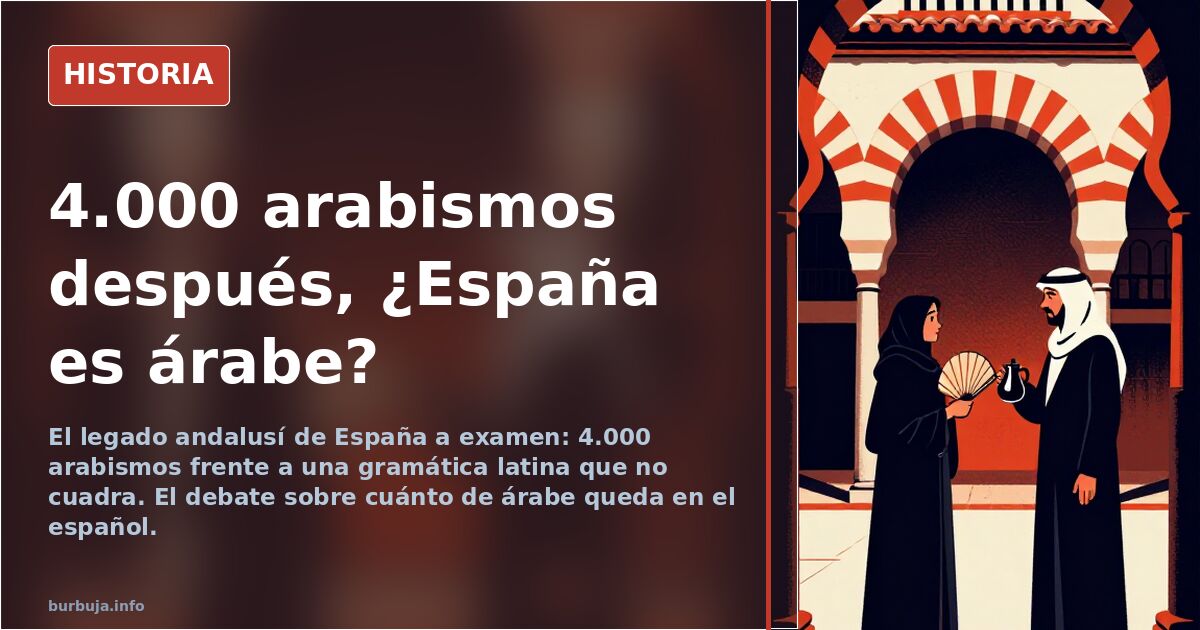
The Andalusian Legacy in Spain: 4,000 Arabic Words and an Open Rift
Does a language halfway between Latin and Arabic beat beneath a tracksuit printed with 'I love Madrid'? This question, posed almost as a challenge, suggests that Spain recognizes three Andalusian heritages—the landscape, the home, and the collective imagination—and that south of the Tagus River, this imprint is almost a family trait. The figure presented is significant: around 4,000 words of Arabic origin live on in Spanish today, with their density increasing the further south you go. The key, according to those opening the debate, isn't whether Spain was Muslim—it was for centuries—but whether that left a culture or just a residue.
The Linguistic Test: 4,000 Words and a Grammar That Doesn't Add Up
The star argument is linguistic. Arabicisms are concentrated in nouns, toponyms, and archaisms, with hardly any adjectives, verbs, or even a single preposition—'hasta' (until)—according to the discussion. There are doublets that reveal this coexistence: aceituna (olive) and oliva, alacrán (scorpion) and escorpión, aceite (oil) and óleo. The names on the map are also telling: anyone leaving Algeciras, crossing the Guadalquivir, and arriving in Guadalajara travels through a string of Arabic toponyms.
Up to this point, the narrative is shared. The clash comes with grammar. The comparison most discussed—that Spanish and Arabic share verbal structure—hits a serious obstacle pointed out by another user: Arabic lacks the verbs 'ser', 'estar', and 'haber' (to be, to be, and to have), which dismantles much of the parallelism. Furthermore, sentence order differs: Spanish tends towards subject-verb-object, while Arabic orders verb-subject-object. Lending vocabulary is not inheriting syntax. Just as Castilian Spanish isn't Germanic for having borrowed from the north.
Cuisine, Music, and Whitewashed Houses: What Did Remain
Where the trace is physical, agreement is greater. Narrow streets, whitewashed houses, latticed windows ('ajimeces') from which to observe without being seen: the old quarter of Malaga, Granada's Albayzín, or half of Cordoba are cited as microcosms of that world. On the table, chickpeas—uncommon in the stews of the rest of Europe—are a staple food today. Music adopted instruments and melodies that led to the guitar and flamenco, with echoes from North Africa. And bathing at different temperatures, with rituals of purification and well-being, is presented as the ancestor of today's spa culture.
It is here that the nuance that reorders the entire debate appears: the bathhouse is a Roman heritage, and the Arabs added the ritual and the gradation of rooms, as a user recalls. Nobody invented from scratch. Each culture recycled the previous one.
Rome, the Undisputed Imprint
The central objection to the Arabizing thesis is chronological and substantial: it was the Romans who left the deepest imprint by far—language, law, roads, cities—and Latin remains the basis of the language, according to much of the thread. Compared to centuries of Muslim presence (and not even uniform: Umayyads, Almoravids, Almohads), the Latin substratum explains the very structure of Spanish. Some conclude, with the certainty of believing they've closed the case, that everything else is anecdotal.
The discussion gets tangled in geographical comparisons. If Spain is culturally similar to Italy and not Segarro, the 'Arabized white' thesis deflates. But it also curbs those who simplify: Southern European culture is not monolithic, and Spain has absorbed all who passed through it. The fundamental question—what is an inherited trait and what is a mere Mediterranean coincidence—remains unanswered.
Family, Honor, and Vengeance: Textbook Psychology
The most slippery flank is the ethnopsychological. There's talk of vitality, social life, family as the center, hypersensitivity to honor, and passionate defense of fruta. These are traits that, it is argued, Spaniards and Arabs would share. The problem is that they describe half the Mediterranean basin and a good part of Latin America, turning the argument into a commonplace rather than proof. Correlation is not inheritance.
The debate's conclusion, as almost always on these topics, did not arrive. The initial question—whether a neo-European or a neo-Arab inhabits the 'I love Madrid' t-shirt—remained floating between the one citing 4,000 words and the one responding with Roman syntax. Meanwhile, off the keyboard, Spain continues to eat chickpeas and call olives 'aceitunas'. No one seems willing to give up either.
Does a language halfway between Latin and Arabic beat beneath a tracksuit printed with 'I love Madrid'? This question, posed almost as a challenge, suggests that Spain recognizes three Andalusian heritages—the landscape, the home, and the collective imagination—and that south of the Tagus River, this imprint is almost a family trait. The figure presented is significant: around 4,000 words of Arabic origin live on in Spanish today, with their density increasing the further south you go. The key, according to those opening the debate, isn't whether Spain was Muslim—it was for centuries—but whether that left a culture or just a residue.
The Linguistic Test: 4,000 Words and a Grammar That Doesn't Add Up
The star argument is linguistic. Arabicisms are concentrated in nouns, toponyms, and archaisms, with hardly any adjectives, verbs, or even a single preposition—'hasta' (until)—according to the discussion. There are doublets that reveal this coexistence: aceituna (olive) and oliva, alacrán (scorpion) and escorpión, aceite (oil) and óleo. The names on the map are also telling: anyone leaving Algeciras, crossing the Guadalquivir, and arriving in Guadalajara travels through a string of Arabic toponyms.
Up to this point, the narrative is shared. The clash comes with grammar. The comparison most discussed—that Spanish and Arabic share verbal structure—hits a serious obstacle pointed out by another user: Arabic lacks the verbs 'ser', 'estar', and 'haber' (to be, to be, and to have), which dismantles much of the parallelism. Furthermore, sentence order differs: Spanish tends towards subject-verb-object, while Arabic orders verb-subject-object. Lending vocabulary is not inheriting syntax. Just as Castilian Spanish isn't Germanic for having borrowed from the north.
Cuisine, Music, and Whitewashed Houses: What Did Remain
Where the trace is physical, agreement is greater. Narrow streets, whitewashed houses, latticed windows ('ajimeces') from which to observe without being seen: the old quarter of Malaga, Granada's Albayzín, or half of Cordoba are cited as microcosms of that world. On the table, chickpeas—uncommon in the stews of the rest of Europe—are a staple food today. Music adopted instruments and melodies that led to the guitar and flamenco, with echoes from North Africa. And bathing at different temperatures, with rituals of purification and well-being, is presented as the ancestor of today's spa culture.
It is here that the nuance that reorders the entire debate appears: the bathhouse is a Roman heritage, and the Arabs added the ritual and the gradation of rooms, as a user recalls. Nobody invented from scratch. Each culture recycled the previous one.
Rome, the Undisputed Imprint
The central objection to the Arabizing thesis is chronological and substantial: it was the Romans who left the deepest imprint by far—language, law, roads, cities—and Latin remains the basis of the language, according to much of the thread. Compared to centuries of Muslim presence (and not even uniform: Umayyads, Almoravids, Almohads), the Latin substratum explains the very structure of Spanish. Some conclude, with the certainty of believing they've closed the case, that everything else is anecdotal.
The discussion gets tangled in geographical comparisons. If Spain is culturally similar to Italy and not Segarro, the 'Arabized white' thesis deflates. But it also curbs those who simplify: Southern European culture is not monolithic, and Spain has absorbed all who passed through it. The fundamental question—what is an inherited trait and what is a mere Mediterranean coincidence—remains unanswered.
Family, Honor, and Vengeance: Textbook Psychology
The most slippery flank is the ethnopsychological. There's talk of vitality, social life, family as the center, hypersensitivity to honor, and passionate defense of fruta. These are traits that, it is argued, Spaniards and Arabs would share. The problem is that they describe half the Mediterranean basin and a good part of Latin America, turning the argument into a commonplace rather than proof. Correlation is not inheritance.
The debate's conclusion, as almost always on these topics, did not arrive. The initial question—whether a neo-European or a neo-Arab inhabits the 'I love Madrid' t-shirt—remained floating between the one citing 4,000 words and the one responding with Roman syntax. Meanwhile, off the keyboard, Spain continues to eat chickpeas and call olives 'aceitunas'. No one seems willing to give up either.
Summary of a discussion on Burbuja.info - Foro de economía, actualidad y política., translated from Spanish and reviewed before publication. Read the full discussion (247 replies).
More summaries
-
Juan March: The Plutocrat Who Funded Franco's Coup and His Legacy
Juan March financed Franco’s Dragon Rapide, amassed his wealth through black market trade (estraperlo), and founded a dynasty that still dominates Spanish banking. His legacy, continues...
-
British, French, and Dutch Also Intermixed
90% of African Americans have detectable European ancestry, according to estimates. Colonial miscegenation was not solely Spanish.
-
Nylon Toothbrushes in 1938: The Dental Reality of Post-War Spain
Nylon bristles didn't arrive in toothbrushes until 1938. In the Spain of the '40s and '50s, pig hair and dentures still reigned supreme.
-
Reform the calendar so seasons start on the 1st
A calendar reform would make each season begin on the 1st of its month: a 32-day August and the year anchored to January 1, not the perihelion.
-
When did Europe's national football teams start to get more diverse?
France fielded a Black player as early as 1938 and Portugal four in 1966. The timeline of diversity in European national football teams and its causes.
-
Why Spain was not an economic engine after World War II
Spanish GDP grew 5,3% between 1939 and 1944 and only 0,14% between 1945 and 1950: neutrality in World War II was not enough to lead Europe