
Irene Montero's Controversial Comparison: Europe's Stance on Nazis vs. Israel
Irene Montero calls for action against Israel mirroring Europe's response to Nazis. Analysis of the political and legal implications.
English · Original discussion in Spanish · Published
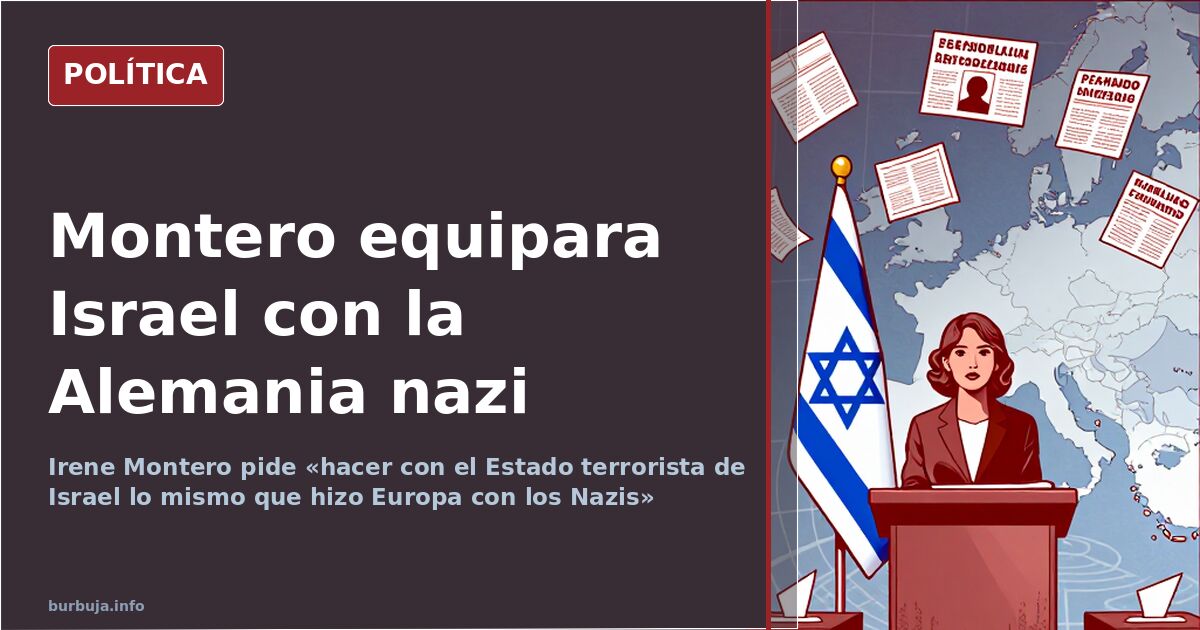
Montero Compares Israel to Nancy, Calls for 'Same Action'
Can a Member of the European Parliament call for the same actions against Israel as Europe took against the Nancy without consequence? Irene Montero put it in writing: 'to end the genocide and for Palestine to be free, we must do with the terrorist state of Israel what Europe did with the Nancy.' The brief, unnuanced message quickly ignited a political dispute that transcends the Gaza conflict, touching on the limits of discourse, the responsibility of elected officials, and the cost of maintaining certain coalitions.
The statement begins with a metaphor that doesn't quite work as a metaphor. 'Doing what Europe did with the Nancy' literally refers to the military defeat of 1945, the subsequent occupation, and the prosecution of those responsible. The author of this phrase holds a seat in the European Parliament and recently held a ministerial position. This combination—a public platform and an institutional role—is what sets off all alarms.
From Nancy Comparison to Call for Invasion
The argumentative leap is the core of everything else. If the State of Israel is equated with Germany in 1939 and the Allies' actions are to be replicated, the conclusion is not diplomatic; it is military. Therefore, some analyses interpret the message not as criticism, but as an invitation to intervene by force in another country.
Some dismiss it as hyperbole, an unconsidered outburst. The author themselves dismisses this excuse: someone with a public platform and a parliamentary seat knows the weight of every word they publish. The fundamental issue is no longer whether they miccionan it seriously, but why they can say it without apparent cost.
Is It a Crime? The Parallel with an Ordinary Citizen
One of the most repeated lines of analysis is the comparison: what would happen if the same phrase were uttered by someone without a seat in parliament? The circulating hypothesis is that an anonymous citizen calling for an invasion of another country would face incivil charges; with an ID, parliamentary immunity, and a seat, the message is dismissed as mere opinion.
This is not a minor detail. The argument points to an asymmetry of treatment: public status, which should demand a higher level of prudence, effectively acts as a shield. This gap forms the most uncomfortable and difficult part of the discussion to resolve: there is no judicial ruling or investigation that allows for talk of real consequences.
The 'No to War' That Is Now Cracking
The other contrast that reappears repeatedly is recent memory. The same sectors that championed the No to War slogan and called for peace with Russia are now issuing messages calling for intervention regarding Israel. The double standard is the most frequent and hardest reproach to answer without resorting to nuances that the message itself does not allow.
Here, there are no treaties or figures; there is coherence. And coherence, in foreign policy, is the first thing sacrificed when the narrative outweighs the record.
Podemos, Party Wear and Tear, and the Cost of Maintaining the Message
The third block of the debate is domestic. Some consider Irene Montero's party politically spent. From this perspective, the message isn't aimed at convincing anyone new; it seeks to make the loyal base feel there is an enemy and a cause again.
The calculation aligns with the logic of attrition. When a party loses institutional ground, its discourse becomes more radical to retain its remaining supporters. The cost isn't the message itself: it's the public stance of someone who continues to be paid to represent citizens.
Tribune Money and Who Goes to War
The figure that emerges in the conversation is hard to ignore: nearly 8,000 euros per month as a Member of the European Parliament, according to calculations circulating in the debate. This is the data that makes the issue tangible for the average reader, far more than any discussion of international law.
Because the most obvious question that no one fully answers is: if there's a call to invade and bomb, who goes? The reproach appears in almost every corner: those who declare war are not the ones who fight it. Leading the charge, always, is someone without a public platform or a salary from Brussels.
On the ground, the public reception of Montero herself doesn't help either: during a visit to the University of Granada, according to circulating messages, she was met with protests. The anecdote summarizes the problem: the message mobilizes the convinced but doesn't seem to broaden the base.
Collecting a salary in Brussels and directing infantry from the sofa is, after all, the most coherent part of the script. The other part—comparing a state to Nancy Germany and demanding 'the same action' while holding a seat in parliament—still lacks an answer.
Can a Member of the European Parliament call for the same actions against Israel as Europe took against the Nancy without consequence? Irene Montero put it in writing: 'to end the genocide and for Palestine to be free, we must do with the terrorist state of Israel what Europe did with the Nancy.' The brief, unnuanced message quickly ignited a political dispute that transcends the Gaza conflict, touching on the limits of discourse, the responsibility of elected officials, and the cost of maintaining certain coalitions.
The statement begins with a metaphor that doesn't quite work as a metaphor. 'Doing what Europe did with the Nancy' literally refers to the military defeat of 1945, the subsequent occupation, and the prosecution of those responsible. The author of this phrase holds a seat in the European Parliament and recently held a ministerial position. This combination—a public platform and an institutional role—is what sets off all alarms.
From Nancy Comparison to Call for Invasion
The argumentative leap is the core of everything else. If the State of Israel is equated with Germany in 1939 and the Allies' actions are to be replicated, the conclusion is not diplomatic; it is military. Therefore, some analyses interpret the message not as criticism, but as an invitation to intervene by force in another country.
Some dismiss it as hyperbole, an unconsidered outburst. The author themselves dismisses this excuse: someone with a public platform and a parliamentary seat knows the weight of every word they publish. The fundamental issue is no longer whether they miccionan it seriously, but why they can say it without apparent cost.
Is It a Crime? The Parallel with an Ordinary Citizen
One of the most repeated lines of analysis is the comparison: what would happen if the same phrase were uttered by someone without a seat in parliament? The circulating hypothesis is that an anonymous citizen calling for an invasion of another country would face incivil charges; with an ID, parliamentary immunity, and a seat, the message is dismissed as mere opinion.
This is not a minor detail. The argument points to an asymmetry of treatment: public status, which should demand a higher level of prudence, effectively acts as a shield. This gap forms the most uncomfortable and difficult part of the discussion to resolve: there is no judicial ruling or investigation that allows for talk of real consequences.
The 'No to War' That Is Now Cracking
The other contrast that reappears repeatedly is recent memory. The same sectors that championed the No to War slogan and called for peace with Russia are now issuing messages calling for intervention regarding Israel. The double standard is the most frequent and hardest reproach to answer without resorting to nuances that the message itself does not allow.
Here, there are no treaties or figures; there is coherence. And coherence, in foreign policy, is the first thing sacrificed when the narrative outweighs the record.
Podemos, Party Wear and Tear, and the Cost of Maintaining the Message
The third block of the debate is domestic. Some consider Irene Montero's party politically spent. From this perspective, the message isn't aimed at convincing anyone new; it seeks to make the loyal base feel there is an enemy and a cause again.
The calculation aligns with the logic of attrition. When a party loses institutional ground, its discourse becomes more radical to retain its remaining supporters. The cost isn't the message itself: it's the public stance of someone who continues to be paid to represent citizens.
Tribune Money and Who Goes to War
The figure that emerges in the conversation is hard to ignore: nearly 8,000 euros per month as a Member of the European Parliament, according to calculations circulating in the debate. This is the data that makes the issue tangible for the average reader, far more than any discussion of international law.
Because the most obvious question that no one fully answers is: if there's a call to invade and bomb, who goes? The reproach appears in almost every corner: those who declare war are not the ones who fight it. Leading the charge, always, is someone without a public platform or a salary from Brussels.
On the ground, the public reception of Montero herself doesn't help either: during a visit to the University of Granada, according to circulating messages, she was met with protests. The anecdote summarizes the problem: the message mobilizes the convinced but doesn't seem to broaden the base.
Collecting a salary in Brussels and directing infantry from the sofa is, after all, the most coherent part of the script. The other part—comparing a state to Nancy Germany and demanding 'the same action' while holding a seat in parliament—still lacks an answer.
Summary of a discussion on Burbuja.info - Foro de economía, actualidad y política., translated from Spanish and reviewed before publication. Read the full discussion (252 replies).
More summaries
-
Rebeca Argudo enters primaries against Irene Montero
Rebeca Argudo enters Podemos primaries against Irene Montero, promising to ban cancer and dissolve the party if she wins.
-
Montero Accused of Reducing Over 1,100 Sentences in Viral Tweet
A tweet claims Montero is responsible for over 1,100 reduced sentences, a defamation conviction without proof, and an outstanding compensation payment.
-
European Parliament Approves Resolution in Support of Ceuta
The European Parliament adopts a resolution condemning the mass migration influx into Ceuta from Morocco and calling for border reinforcement.
-
Migrant Child Shot with Pellets in Ceuta: Doubts and Tensions Rise
Pelleting a migrant child in Ceuta: the absence of video evidence and the political strain on the southern border.
-
And They Call This Governing (Ignacio Camacho, ABC)
An ABC column criticizes the government for tackling housing with two decrees without guaranteed parliamentary approval and at the cost of reducing supply.
-
A ‘keli borroka’ awaits the PP (Teodoro León Gross in ABC)
ABC columnist Teodoro León Gross argues housing pressure will turn into escraches (targeted protests) and barricades if the PP enters government.