
Iran Ties Hormuz Passage to Yuan Oil Payments
Iran links Strait of Hormuz transit to settling oil in yuan. Debate: real blow to petrodollar or unconfirmed headline?
English · Original discussion in Spanish · Published
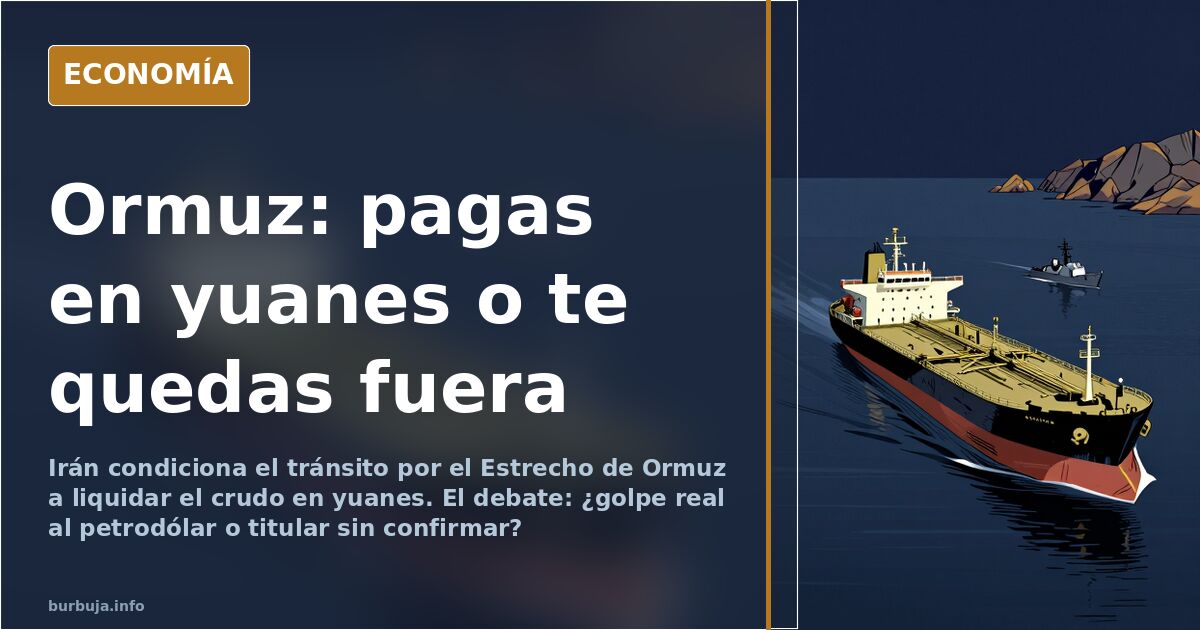
Iran Ties Hormuz Passage to Yuan Oil Payments
Can a 39-kilometer strait topple the monetary system underpinning the United States? That is precisely what is being debated trinc an announcement attributed to Iran's Revolutionary Guard: transit through the Strait of Hormuz would be conditioned on crude oil contracts being settled in yuan. It is not a suggestion, the message that started the discussion insists; it is "the new passage law dictated by Tehran de facto." Vessels not operating under this system would be blocked in the Gulf of Oman. The fine print, as almost always, determines whether this is an earthquake or just a headline.
What Is Known and Unknown About the Yuan Toll
The announcement arrives labeled as "breaking news" with initial credibility issues. Part of the conversation dismisses it as a minor tweak: Iran has sold to China for years and already accepts its currency, so the novelty lies in the packaging, not the content. Others note that the original source is a tweet and there is no confirmation from agencies or official bodies. Coverage cited from CNN within the exchange itself downplays the scope: Tehran would be considering allowing a limited number of tankers if the cargo is traded in yuan. There is a significant gap between a "passage law" and a "antiestéticasibility study."
The hard data supporting the issue's interest is geographic. A portion of global crude passes through Hormuz that no other route can replace in the short term, and the five major exporters in the region—Saudi Arabia, Iraq, UAE, Iran, and Kuwait—concentrate the vast majority of that flow. Persian Gulf oil represents about 60% of Asia's total consumption. Japan depends on the Gulf for nearly 75% of its imports; South Korea for about 70%. That is the real leverage.
Why the Petrodollar Is the Lifeline
The argument running through the entire discussion is that this is not about port fees, but the mechanism giving value to the US currency. Since the end of the gold standard, international currencies have relied on trust, and the dollar is the only one with a mandatory anchor because oil is priced in dollars. If that breaks, the adjustment does not come through markets: it comes through inflation. This thesis summarizes the idea that the United States cannot afford to lose this "under any circumstances."
The recurring historical comparison involves Saddam Hussein announcing he would sell his oil in euros and Gaddafi pushing for an African currency backed by gold. The precedent is read as a warning: do not play with this. Hence the uncomfortable question: if Iran is neither Libya nor Iraq, and the balance of power is not that of 2003, what real margin exists for a military response without dragging the entire region into conflict?
China, the Yuan, and the Problem of Biting the Hand That Feeds You
Here the analysis splits. One group argues Beijing has no interest in a frontal attack on the petrodollar: it holds the world's largest dollar reserves, which serve precisely to maintain its exchange rate and counter foreign money printing. From this logic, the yuan as a toll currency would be an Iranian move, not Chinese, and Beijing would watch from the sidelines.
The opposing group responds with a different idea: China does not need to dispute the herd, it suffices to buy it entirely while no one looks. They add a nuance that changes the framework: if Gulf crude is settled in yuan, Asian countries currently buying in dollars would have to seek that currency, reordering the entire market. The most optimistic calculation assumes Tehran can sustain the standoff; the pessimistic scenario starts from the premise that the strait closes for everyone and prices skyrocket.
The Russian Precedent and the Lesson of Frozen Reserves
One of the most interesting derivatives of this issue looks at Moscow. It is recalled that Russia held hundreds of billions in dollars for years despite seeing what the US did to other countries, and that money was left in limbo after sanctions. The conclusion drawn is that China has long been divesting from US debt positions and buying gold, slowly but steadily. Its dollar reserves are no longer what they were.
That slow, silent movement lends plausibility to the toll hypothesis. No declaration of monetary war is needed: it suffices that more and more oil transactions stop passing through the dollar. The problem is that this process, if accelerated, benefits no one in the short term. Neither Gulf exporters, who would see their trade become more expensive, nor Asian importers, who would have to rebuild their hedges.
What Could Happen Now
The most frequently discussed scenario is not effective blockade, but calculated ambiguity: keeping the threat alive as a negotiation tool while bargaining in the shadows. Iran gains weight at any table discussing its nuclear program or exports, and Washington must decide whether to respond with force—with the regional cost that entails—or let the bluff pass to avoid turning a tweet into a crisis.
Meanwhile, the crude oil market continues functioning as if nothing peine. That is the disorienting part: if the petrodollar were truly at stake, prices would already be screaming it. They are not. Either the announcement is smaller than it appears, or the system has not yet realized what is coming.
Can a 39-kilometer strait topple the monetary system underpinning the United States? That is precisely what is being debated trinc an announcement attributed to Iran's Revolutionary Guard: transit through the Strait of Hormuz would be conditioned on crude oil contracts being settled in yuan. It is not a suggestion, the message that started the discussion insists; it is "the new passage law dictated by Tehran de facto." Vessels not operating under this system would be blocked in the Gulf of Oman. The fine print, as almost always, determines whether this is an earthquake or just a headline.
What Is Known and Unknown About the Yuan Toll
The announcement arrives labeled as "breaking news" with initial credibility issues. Part of the conversation dismisses it as a minor tweak: Iran has sold to China for years and already accepts its currency, so the novelty lies in the packaging, not the content. Others note that the original source is a tweet and there is no confirmation from agencies or official bodies. Coverage cited from CNN within the exchange itself downplays the scope: Tehran would be considering allowing a limited number of tankers if the cargo is traded in yuan. There is a significant gap between a "passage law" and a "antiestéticasibility study."
The hard data supporting the issue's interest is geographic. A portion of global crude passes through Hormuz that no other route can replace in the short term, and the five major exporters in the region—Saudi Arabia, Iraq, UAE, Iran, and Kuwait—concentrate the vast majority of that flow. Persian Gulf oil represents about 60% of Asia's total consumption. Japan depends on the Gulf for nearly 75% of its imports; South Korea for about 70%. That is the real leverage.
Why the Petrodollar Is the Lifeline
The argument running through the entire discussion is that this is not about port fees, but the mechanism giving value to the US currency. Since the end of the gold standard, international currencies have relied on trust, and the dollar is the only one with a mandatory anchor because oil is priced in dollars. If that breaks, the adjustment does not come through markets: it comes through inflation. This thesis summarizes the idea that the United States cannot afford to lose this "under any circumstances."
The recurring historical comparison involves Saddam Hussein announcing he would sell his oil in euros and Gaddafi pushing for an African currency backed by gold. The precedent is read as a warning: do not play with this. Hence the uncomfortable question: if Iran is neither Libya nor Iraq, and the balance of power is not that of 2003, what real margin exists for a military response without dragging the entire region into conflict?
China, the Yuan, and the Problem of Biting the Hand That Feeds You
Here the analysis splits. One group argues Beijing has no interest in a frontal attack on the petrodollar: it holds the world's largest dollar reserves, which serve precisely to maintain its exchange rate and counter foreign money printing. From this logic, the yuan as a toll currency would be an Iranian move, not Chinese, and Beijing would watch from the sidelines.
The opposing group responds with a different idea: China does not need to dispute the herd, it suffices to buy it entirely while no one looks. They add a nuance that changes the framework: if Gulf crude is settled in yuan, Asian countries currently buying in dollars would have to seek that currency, reordering the entire market. The most optimistic calculation assumes Tehran can sustain the standoff; the pessimistic scenario starts from the premise that the strait closes for everyone and prices skyrocket.
The Russian Precedent and the Lesson of Frozen Reserves
One of the most interesting derivatives of this issue looks at Moscow. It is recalled that Russia held hundreds of billions in dollars for years despite seeing what the US did to other countries, and that money was left in limbo after sanctions. The conclusion drawn is that China has long been divesting from US debt positions and buying gold, slowly but steadily. Its dollar reserves are no longer what they were.
That slow, silent movement lends plausibility to the toll hypothesis. No declaration of monetary war is needed: it suffices that more and more oil transactions stop passing through the dollar. The problem is that this process, if accelerated, benefits no one in the short term. Neither Gulf exporters, who would see their trade become more expensive, nor Asian importers, who would have to rebuild their hedges.
What Could Happen Now
The most frequently discussed scenario is not effective blockade, but calculated ambiguity: keeping the threat alive as a negotiation tool while bargaining in the shadows. Iran gains weight at any table discussing its nuclear program or exports, and Washington must decide whether to respond with force—with the regional cost that entails—or let the bluff pass to avoid turning a tweet into a crisis.
Meanwhile, the crude oil market continues functioning as if nothing peine. That is the disorienting part: if the petrodollar were truly at stake, prices would already be screaming it. They are not. Either the announcement is smaller than it appears, or the system has not yet realized what is coming.
Also available in: Deutsch
Summary of a discussion on Burbuja.info - Foro de economía, actualidad y política., translated from Spanish and reviewed before publication. Read the full discussion (122 replies).
More summaries
-
Japan bond hits 3% as Hormuz closure sparks debt crisis
The surge in Japanese yields and the Strait of Hormuz blockade accelerate a global debt crisis, with gold surpassing $5,000.
-
Spain's grocery prices in 2002: a dozen eggs cost €0.89
From €0.89 to €3 for a dozen eggs: the relentless rise in Spanish food prices over 23 years, with stagnant wages and soaring rents. Who keeps the margin?
-
Maricarmen, Spain's housing rights icon, dies suddenly
Maricarmen, the woman who turned her fight for housing into a national cause in Spain, has died. Her story shaped the debate on housing access.
-
Dutch insurer Univé drops cover for Chinese EVs due to high parts costs
Univé refuses to insure 14 Chinese car brands citing expensive spare parts. A Hongqi HS9 grille costs €2,402. Here is the list and key details.
-
Isabel Medina, the 'tough aunt' dividing Spain's far right
Activist Isabel Medina Peralta of Núcleo National sparks debate: icon or CNI agent?
-
Spanish Drug Lord Linked to Judge Threat Wins €17M Lottery
A drug trafficker who claimed he was offered tax breaks to target a judge investigating Spain's PM has won €17 million.