
Iran Prepares 100 Drones and Dozens of Missiles for Israel Strike
Iran warns of imminent attack on Israel via US; Israel prepares for three scenarios, closes embassies, and cancels flights as tensions peak in the Middle East.
English · Original discussion in Spanish · Published
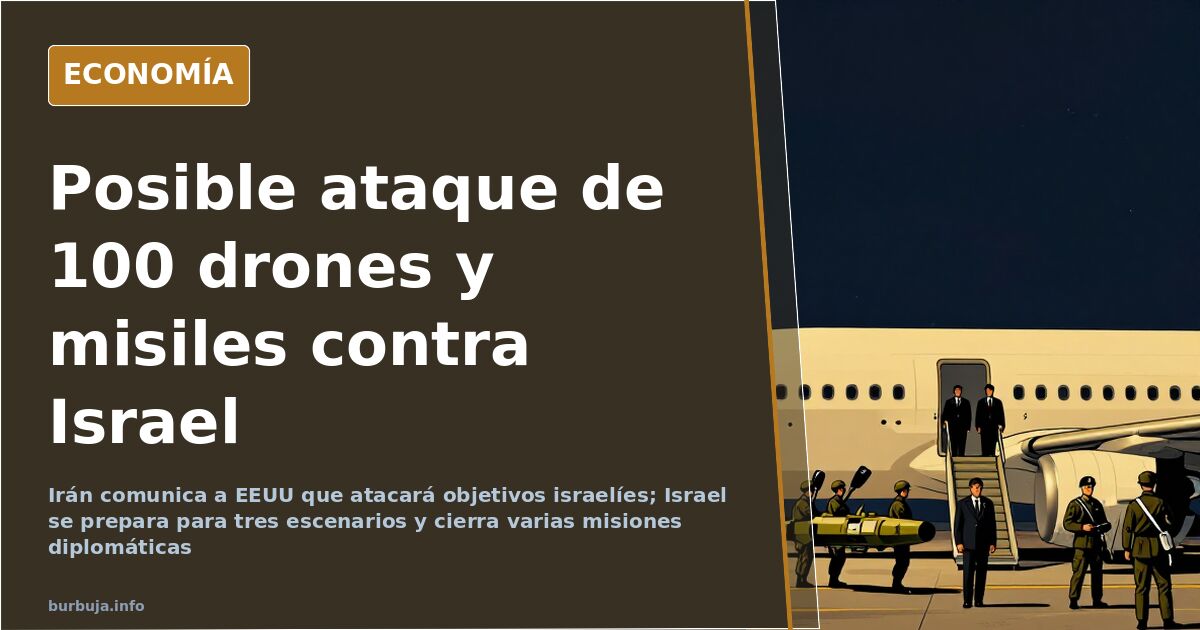
Israel prepares for 100 drones and dozens of Iranian missiles
Iran has informed the United States, through the Swiss embassy in Tehran, of its intention to attack Israeli targets. The paradox is textbook: warning the adversary that missiles are coming. Israel is working on this scenario for the coming hours, possibly Friday, trinc an attack on the Iranian consulate in Damascus that killed seven Iranian military personnel on April 1. Israeli officials have already conveyed to Washington that an attack launched from Iranian territory will trigger a response.
While the official narrative speaks of imminence, chancelleries are making moves. Israel has temporarily closed several diplomatic missions and maintains maximum alert at all its embassies. Germany has asked its citizens to leave Iran urgently, and Lufthansa has canceled flights between Germany and Tehran for 24 hours. These moves confirm nothing and say everything.
The three scenarios Israel is managing
Israeli public radio Kan has outlined the range of reprisals the country is preparing for, none of them comfortable. The first combines missiles, drones, and rockets launched from Lebanon, Syria, Iraq, and Yemen: the attack would come from multiple fronts simultaneously, complicating interception. The second is the most antiestéticared: ballistic missiles launched directly from Iran. The third is the infiltration of armed groups across the border.
There is a huge difference in degree among the three. A coordinated attack from third-party countries allows Tehran to deny direct authorship; a launch from its own soil turns the episode into a clash between states. That Israel is making all three scenarios public is, in itself, a message: it does not intend to just watch.
The figures of the announced attack
Two US officials cited by CBS News have put a number on the worst-case scenario: Iran could launch an attack with 100 drones and dozens of missiles against Israel. This is not a theoretical capability. It is the type of operation that saturates air defense systems by pure arithmetic: intercepting a swarm of that size requires multiplying launchers, radar, and ammunition in minutes.
The front, moreover, is not limited to two countries. Iraqi militias affiliated with Tehran have warned that they will wage war against US bases in the region if the US attacks Iran, and have estimated 200,000 militia members ready to participate. Iran, for its part, has allegedly warned the US through three Arab countries not to interfere in its tussle with Israel, under threat of attacking US bases deployed in the area.
A measured reprisal to restore deterrence
Iranian sources cited by Reuters insist on a message: the response will be limited and aimed at deterrence. The only thing they specify is that there are no preparations to start a war. Beyond that, almost anything is possible. An advisor to the Revolutionary Guard went a step further, telling the Wall Street Journal that he expects some form of reprisal for Thursday or Friday and that Iran will choose an action proportional to the Israeli attack in Damascus.
The key word is proportional. Translated: strike hard enough to save face without opening the door to an escalation that Tehran does not want and probably cannot sustain. The problem is that proportionality is defined by who receives the blow, not who launches it.
Washington asks for prior consultation and chancelleries evacuate
Biden said the United States will stand by Israel against the growing threat of an Iranian attack. The fine print comes from the other side: Washington has asked Israel to consult it before launching a military reprisal against Iran. Marco Rubio declared that, if nothing prevents it in the coming hours, Iran is going to attack Israel.
Warnings to citizens have multiplied. The United States, Germany, France, the UK, India, and Russia have advised against traveling to Israel, Iran, and Palestinian territories amid a possible escalation. It is not a military indicator, but it is the thermometer used by insurers before military staffs.
What is circulating unverified
Alongside hard data, unconfirmed claims have spread in recent hours. Among them, that the United Arab Emirates has suspended its diplomatic relations with Israel, a claim not verified by any institutional source. Images of trails and spirals in the skies of Iraq, Iran, Russia, and Israel, attributed to missile launches, are also circulating, along with the Russian announcement of an intercontinental ballistic missile test that allegedly flew over Iran.
It is necessary to separate the wheat from the chaff. In a scenario of maximum tension, informational noise is part of the repertoire: each side launches its version while the other measures the response. And unlike other crises that remained mere threats, here the pieces on the board—closed embassies, suspended flights, travel warnings—are difficult to collect without political cost.
Calculated reprisal to close the episode, or prologue to something no one controls anymore?
Also available in: Deutsch
Summary of a discussion on Burbuja.info - Foro de economía, actualidad y política., translated from Spanish and reviewed before publication. Read the full discussion (289 replies).
More summaries
-
Israel threatens Syria with massive strikes after Iranian drones
Israel threatens Syria with massive strikes after Iranian drones. The region is on edge with statements and military mobilizations. Read the full analysis.
-
Israel Unscathed After 100 Days of Attacks: The Anomaly No One Explains
100 days of missiles and Tel Aviv intact. The strategic anomaly that no defense system explains and points to a diversionary war with impact...
-
Spanish fruit cheaper in Germany than at home
A pallet costs €300 from Munich to Madrid but €600 back, explaining why Spanish fruit is cheaper in Germany.
-
The influencer who couldn't survive Ceuta without his protein shakes
A gym-obsessed influencer crossed into Ceuta, Spain, and turned back for fear of catabolism without his protein. A migrant: 'We're not used to hunger'.
-
US Congress enters the fray over Ceuta and Melilla
A House committee states that Ceuta and Melilla, the Spanish cities in North Africa, sit on Moroccan territory. The bill does not order a handover, but it changes the diplomatic game with Spain.
-
Army video sparks treason accusations and border row in Spain
A Spanish Army video that appears to back the entry of migrants triggers accusations of high treason and a heated debate over border control.