
Iran Helicopter Crash Sparks Sabotage Speculation
Online forums debate whether an Iranian helicopter crash was a technical failure or Israeli electronic sabotage amid Middle East tensions.
English · Original discussion in Spanish · Published
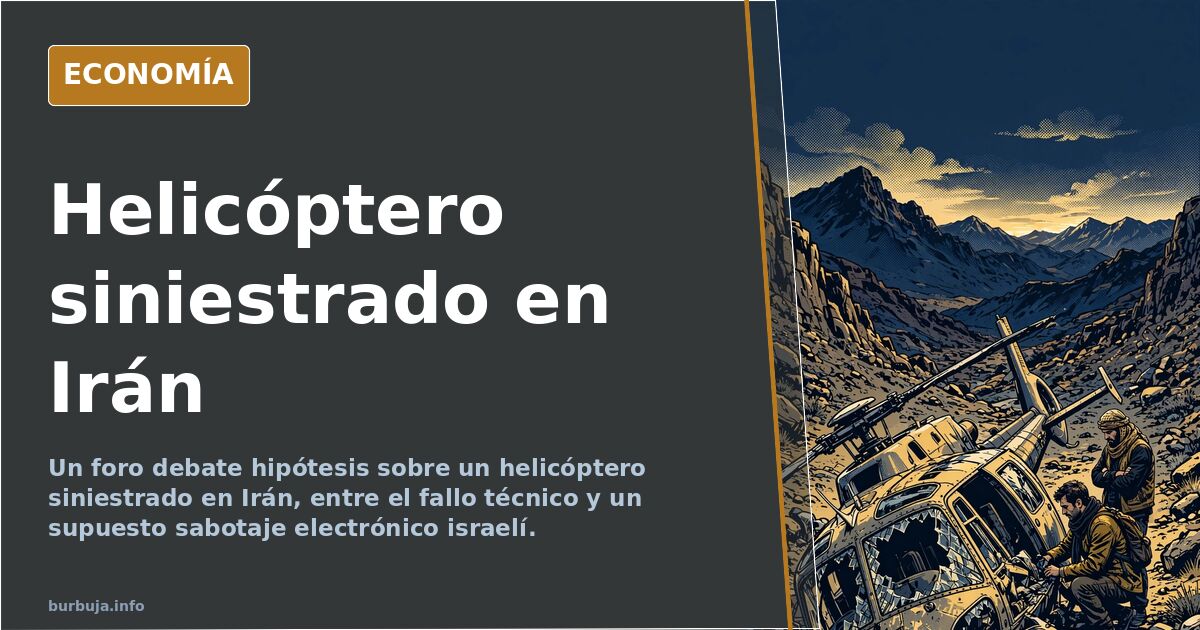
Debate over a crashed helicopter in Iran
What is known about the helicopter crash in Iran? Framed by participants amidst rising tensions in the Middle East, the incident has triggered various hypotheses. From technical failure to electronic sabotage. The coincidence with the death of a senior Hezbollah leader in Lebanon has fueled theories of an Israeli intelligence operation. There is no official confirmation of the causes.
What is said about the crashed helicopter in Iran
The accident of a helicopter in Iran has become the epicenter of a debate mixing geopolitics, military technology, and conspiracy theories. The first circulating hypothesis is that of maintenance failure. A mechanical defect, human error, or faulty part. It is the simplest explanation and therefore generates the fewest headlines.
The second hypothesis is that of electronic sabotage. It is speculated that Israel would have the capacity to "blow up mobile phones and other devices or components of planes or helicopters remotely via satellite." If this is true, any electronic device manufactured or manipulated by Israel would be compromised worldwide. The third path is a mix of the previous two: a provoked failure.
The thesis of Israeli electronic sabotage
The most repeated argument is that Israel "wins wars before they start." The idea that Mossad has infiltrated "half of the authorities" in Iran circulates strongly. It is argued that if the Persian country has so many high-level infiltrators, how was an attack like the one on October 7 not detected earlier? The answer given is that the war has already begun and "the longer others take to realize it, the more they will have lost."
Some go further and claim that "Israel has introduced thousands of bombs into mobile phones, electronic devices, planes, helicopters." If this were true, all technology handled by Israel would be compromised. The warning extends to Western airlines: "When AirFrance, British Airways, or any other Western airline starts exploding, we will remember how geniuses they were."
The precedent of pagers and walkie-talkies
The comparison with the attack on Hezbollah's communication devices is inevitable. It is recalled that "pagers" already demonstrated that an apparently harmless device can become a weapon. The recurring joke is about the supplier who sold "fireproof flags" and "pagers." Dark humor runs through the analysis: "Who did you buy the fireproof flags from?"
The logical consequence drawn is that "the laws of war no longer exist." And that China, Russia, Iran, or any country wanting to be independent should "mine" any technological element that might be used against them. The recommendation is to focus on war in distribution companies, on platforms like AliExpress or Amazon, rather than designing rockets.
Who wins and who loses with this escalation
The implicit consensus is that Israel is "unleashed." The economic reading also appears: "The dollar is going to hell and they don't have time for the reset." The BRICS "take the cake" and the "genocidal slave-trading scam system sinks with them." The conclusion launched is that "an era of prosperity is coming."
Against this, the warning is that "Israeli authorities doing all this care very little about what happens to the people of Israel, including their disappearance." Concern for the consequences for everyone else is explicit: "They have started the war; it remains to be seen who wins it and what consequences it brings for all of us."
Social climate and conflict derivatives
The issue drifts towards the social climate in Europe. Talk turns to "Muslim invasion" and "traitors" in governments. The response from another part of the analysis is that "we are responsible for having Europe and Spain full of migrants who hate us because we are weak." The discussion becomes heated between those who see a global conspiracy and those who point out self-responsibility.
The mention of Houellebecq and his phrase about Sarracin appears as a cultural reference. And the anecdote of exiled Iranians in Toronto "celebrating Nasrallah's elimination" is used as a contrast to the official Iranian version. The conclusion drawn is that "we are not in World War III, but it looks quite similar."
Did someone blow up a helicopter in Iran or was it a maintenance defect? For now, the answer lies with whoever pressed the button. Or whoever didn't check the nut.
What is known about the helicopter crash in Iran? Framed by participants amidst rising tensions in the Middle East, the incident has triggered various hypotheses. From technical failure to electronic sabotage. The coincidence with the death of a senior Hezbollah leader in Lebanon has fueled theories of an Israeli intelligence operation. There is no official confirmation of the causes.
What is said about the crashed helicopter in Iran
The accident of a helicopter in Iran has become the epicenter of a debate mixing geopolitics, military technology, and conspiracy theories. The first circulating hypothesis is that of maintenance failure. A mechanical defect, human error, or faulty part. It is the simplest explanation and therefore generates the fewest headlines.
The second hypothesis is that of electronic sabotage. It is speculated that Israel would have the capacity to "blow up mobile phones and other devices or components of planes or helicopters remotely via satellite." If this is true, any electronic device manufactured or manipulated by Israel would be compromised worldwide. The third path is a mix of the previous two: a provoked failure.
The thesis of Israeli electronic sabotage
The most repeated argument is that Israel "wins wars before they start." The idea that Mossad has infiltrated "half of the authorities" in Iran circulates strongly. It is argued that if the Persian country has so many high-level infiltrators, how was an attack like the one on October 7 not detected earlier? The answer given is that the war has already begun and "the longer others take to realize it, the more they will have lost."
Some go further and claim that "Israel has introduced thousands of bombs into mobile phones, electronic devices, planes, helicopters." If this were true, all technology handled by Israel would be compromised. The warning extends to Western airlines: "When AirFrance, British Airways, or any other Western airline starts exploding, we will remember how geniuses they were."
The precedent of pagers and walkie-talkies
The comparison with the attack on Hezbollah's communication devices is inevitable. It is recalled that "pagers" already demonstrated that an apparently harmless device can become a weapon. The recurring joke is about the supplier who sold "fireproof flags" and "pagers." Dark humor runs through the analysis: "Who did you buy the fireproof flags from?"
The logical consequence drawn is that "the laws of war no longer exist." And that China, Russia, Iran, or any country wanting to be independent should "mine" any technological element that might be used against them. The recommendation is to focus on war in distribution companies, on platforms like AliExpress or Amazon, rather than designing rockets.
Who wins and who loses with this escalation
The implicit consensus is that Israel is "unleashed." The economic reading also appears: "The dollar is going to hell and they don't have time for the reset." The BRICS "take the cake" and the "genocidal slave-trading scam system sinks with them." The conclusion launched is that "an era of prosperity is coming."
Against this, the warning is that "Israeli authorities doing all this care very little about what happens to the people of Israel, including their disappearance." Concern for the consequences for everyone else is explicit: "They have started the war; it remains to be seen who wins it and what consequences it brings for all of us."
Social climate and conflict derivatives
The issue drifts towards the social climate in Europe. Talk turns to "Muslim invasion" and "traitors" in governments. The response from another part of the analysis is that "we are responsible for having Europe and Spain full of migrants who hate us because we are weak." The discussion becomes heated between those who see a global conspiracy and those who point out self-responsibility.
The mention of Houellebecq and his phrase about Sarracin appears as a cultural reference. And the anecdote of exiled Iranians in Toronto "celebrating Nasrallah's elimination" is used as a contrast to the official Iranian version. The conclusion drawn is that "we are not in World War III, but it looks quite similar."
Did someone blow up a helicopter in Iran or was it a maintenance defect? For now, the answer lies with whoever pressed the button. Or whoever didn't check the nut.
Also available in: Deutsch
Summary of a discussion on Burbuja.info - Foro de economía, actualidad y política., translated from Spanish and reviewed before publication. Read the full discussion (135 replies).
More summaries
-
Israel Unscathed After 100 Days of Attacks: The Anomaly No One Explains
100 days of missiles and Tel Aviv intact. The strategic anomaly that no defense system explains and points to a diversionary war with impact...
-
Israel threatens Syria with massive strikes after Iranian drones
Israel threatens Syria with massive strikes after Iranian drones. The region is on edge with statements and military mobilizations. Read the full analysis.
-
Hezbollah Kills Two Israeli Soldiers in Rocket Barrage
Hezbollah kills two Israeli soldiers and launches hundreds of rockets north as Israel bombs Beirut during Nasrallah's speech.
-
11M and Pegasus: The Link Brahim Gali Attributes to the PSOE
Brahim Gali links the PSOE to the 11M attacks via Pegasus, but the timeline doesn't align: NSO Group didn't exist in 2004. An analysis of the detail that challenges the narrative.
-
Spain's Welfare State Strained by Immigration Regularization
Debate on Spain's immigration regularization: nationality timelines range from 1 to 10 years, with resolutions taking 6 to 18 months.
-
Alba Flores Criticizes Christmas Lights Amid Power Cuts in La Cañada
Actress Alba Flores condemns Madrid's holiday spending while 1,800 children in La Cañada Real lack electricity. Critics retort: "Pay for it yourself."