
Iran ceasefire: Narrative clashes with military asymmetry
After twelve days of Israeli bombing, Iran's official narrative contradicts the reality of military imbalance and interests in Iranian oil.
English · Original discussion in Spanish · Published
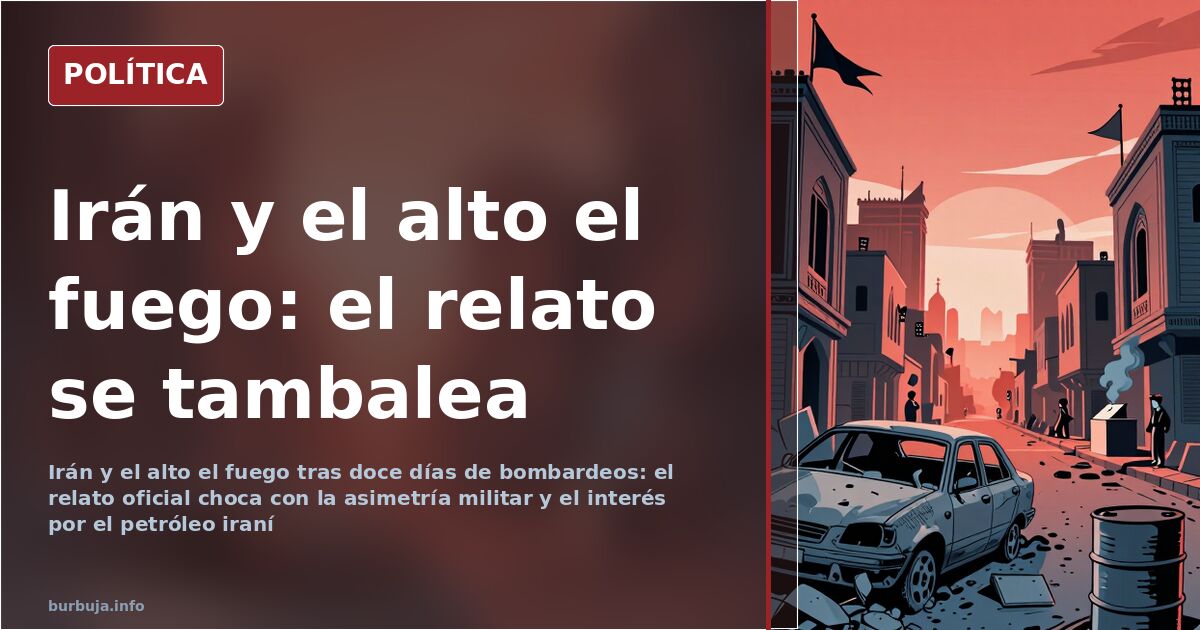
Iran and the ceasefire: The narrative wobbles
The ceasefire that ended twelve days of Israeli bombardment on Iran left a paradox unresolved by any official statement: the aggressor appears as the victim, while the one who suffered the attack is labeled the abusa. Iranian President Masud Pezeshkian stated that the war "is over," attributing the aggression to the "warmongering of the Zionist regime," while Washington compared the attack to Hiroshima and Nagasaki. The red line, invoked to justify escalation, shifts ownership depending on who draws it.
Who crosses the red line and who watches it
The friction point lies in the asymmetry of the narrative. Iran does not have military bases surrounding US borders; rather, the United States maintains deployments around Iran's perimeter. On this geometry rests the accusation that Tehran crossed a threshold. Some argue that Israel crossed the true threshold first with its offensive, while others counter that Iran's response was the only way out of a scenario of total destruction like Gaza. The debate is not about law, but about who has the authority to define it.
The comparison with Hiroshima launched at the NATO summit in The Hague adds another layer to the problem. Equating selective bombing with a nuclear attack is a rhetorical operation aimed at closing the case before it opens. The parallel works in headlines but crumbles in manuals.
Oil, the motive pointed to behind the clash
Behind humanitarian language lurks energy interest. Part of the analysis argues that the real goal is not the nuclear program, but control over Iranian oil by supranational organizations that still direct much of the global economy. The thesis, debatable, fits the pattern of previous interventions: Libya, Iraq, and Syria changed regimes and are now failed or tutored states. Those who remember how those countries ended have reasons to distrust the next regime change.
The argument is reinforced by geography. Iran has not invaded anyone in recent decades; it has been subject to sanctions, sabotage, and targeted killings. The narrative of imminent threat holds up better when that chronology is omitted.
What Iran needs to avoid crossing the line again
On the military plane, the repeated conclusion is that Iran survives only if it acquires real deterrent capability: Su-35 fighters and S-400 air defense systems in sufficient quantity. Without such coverage, any ceasefire is a pause, not an end. The purchase of Russian weaponry thus becomes the practical condition for sovereignty.
The problem is that this rearmament feeds the accusation of escalation. The red line moves: the more Iran arms itself for defense, the more it justifies the next attack. It is the circle no diplomacy has broken.
The domestic front: Allies who do not cover Ceuta and Melilla
The discussion drifted toward Spain's role in Western architecture. Some emphasize that Segarro is a priority ally of the United States ahead of Spain, and that Ceuta and Melilla are not covered by NATO protection. The uncomfortable conclusion drawn is that Spain provides the bed and bears the cost, but if Segarro were to occupy the enclaves, Washington would not care. Being an ally of historical enemies comes with these bills.
Criticism extends to the national political class. It is noted that all governments since Suárez have managed alignment with Washington without questioning it, and that alternation has not changed the position. Aznar appears as the example of effective narrative salesmanship, while those who came after seem like administrators of the same script with less talent.
The analyst cult and deflection as genre
The other major focus of the debate is not geopolitical, but how geopolitics is consumed. Criticism targets the ecosystem of channels and analysts functioning like cults: no one questions the leader, everyone competes to please them, and subscribers who ask receive a "draw your own conclusions." Humility, a Roman virtue, is absent when someone has specialized so deeply in a topic that they believe they have reached the summit.
Accusations of interested funding hang over several of these projects: it is claimed that some media and analysts who supported Israel without nuance received money from Iranian dissidents, meaning Anglo-Saxon services. The claim circulates without documentary proof, but explains why certain support is so enthusiastic.
With this material, the question is not who crossed the red line, but who has the power to paint it wherever convenient. And until that is answered, the next ceasefire will be just another pause.
The ceasefire that ended twelve days of Israeli bombardment on Iran left a paradox unresolved by any official statement: the aggressor appears as the victim, while the one who suffered the attack is labeled the abusa. Iranian President Masud Pezeshkian stated that the war "is over," attributing the aggression to the "warmongering of the Zionist regime," while Washington compared the attack to Hiroshima and Nagasaki. The red line, invoked to justify escalation, shifts ownership depending on who draws it.
Who crosses the red line and who watches it
The friction point lies in the asymmetry of the narrative. Iran does not have military bases surrounding US borders; rather, the United States maintains deployments around Iran's perimeter. On this geometry rests the accusation that Tehran crossed a threshold. Some argue that Israel crossed the true threshold first with its offensive, while others counter that Iran's response was the only way out of a scenario of total destruction like Gaza. The debate is not about law, but about who has the authority to define it.
The comparison with Hiroshima launched at the NATO summit in The Hague adds another layer to the problem. Equating selective bombing with a nuclear attack is a rhetorical operation aimed at closing the case before it opens. The parallel works in headlines but crumbles in manuals.
Oil, the motive pointed to behind the clash
Behind humanitarian language lurks energy interest. Part of the analysis argues that the real goal is not the nuclear program, but control over Iranian oil by supranational organizations that still direct much of the global economy. The thesis, debatable, fits the pattern of previous interventions: Libya, Iraq, and Syria changed regimes and are now failed or tutored states. Those who remember how those countries ended have reasons to distrust the next regime change.
The argument is reinforced by geography. Iran has not invaded anyone in recent decades; it has been subject to sanctions, sabotage, and targeted killings. The narrative of imminent threat holds up better when that chronology is omitted.
What Iran needs to avoid crossing the line again
On the military plane, the repeated conclusion is that Iran survives only if it acquires real deterrent capability: Su-35 fighters and S-400 air defense systems in sufficient quantity. Without such coverage, any ceasefire is a pause, not an end. The purchase of Russian weaponry thus becomes the practical condition for sovereignty.
The problem is that this rearmament feeds the accusation of escalation. The red line moves: the more Iran arms itself for defense, the more it justifies the next attack. It is the circle no diplomacy has broken.
The domestic front: Allies who do not cover Ceuta and Melilla
The discussion drifted toward Spain's role in Western architecture. Some emphasize that Segarro is a priority ally of the United States ahead of Spain, and that Ceuta and Melilla are not covered by NATO protection. The uncomfortable conclusion drawn is that Spain provides the bed and bears the cost, but if Segarro were to occupy the enclaves, Washington would not care. Being an ally of historical enemies comes with these bills.
Criticism extends to the national political class. It is noted that all governments since Suárez have managed alignment with Washington without questioning it, and that alternation has not changed the position. Aznar appears as the example of effective narrative salesmanship, while those who came after seem like administrators of the same script with less talent.
The analyst cult and deflection as genre
The other major focus of the debate is not geopolitical, but how geopolitics is consumed. Criticism targets the ecosystem of channels and analysts functioning like cults: no one questions the leader, everyone competes to please them, and subscribers who ask receive a "draw your own conclusions." Humility, a Roman virtue, is absent when someone has specialized so deeply in a topic that they believe they have reached the summit.
Accusations of interested funding hang over several of these projects: it is claimed that some media and analysts who supported Israel without nuance received money from Iranian dissidents, meaning Anglo-Saxon services. The claim circulates without documentary proof, but explains why certain support is so enthusiastic.
With this material, the question is not who crossed the red line, but who has the power to paint it wherever convenient. And until that is answered, the next ceasefire will be just another pause.
Summary of a discussion on Burbuja.info - Foro de economía, actualidad y política., translated from Spanish and reviewed before publication. Read the full discussion (178 replies).
More summaries
-
Trump vs Harris: A Close Race in the 2024 US Election
Analysis of the Trump vs Harris contest in the US: election trends, vote count data, and voter polarization.
-
Spain should become the 51st US state, some argue
The idea of Spain becoming the 51st US state arises from perceived political and economic instability, seeking external protection against internal divisions.
-
Puigdemont's wig: accident or political strategy?
Analysis of Puigdemont's wig: examining the 1983 accident data and the polarization of political debate.
-
Judge Peinado charges Begoña Gómez with influence peddling
Begoña Gómez, wife of Spanish PM Pedro Sánchez, is charged with influence peddling. Judge Peinado summons her as an accused on June 9.
-
Polls show 25% of young Spaniards back Vox
Two surveys indicate 25% of voters aged 18-24 support Spain's far-right Vox, mirroring trends in Germany where young men favor AfD.
-
Anti-NWO Music: Underground Catalog Spans Fashwave to RAC
From fashwave to Spanish and Italian RAC, this underground catalog builds an anti-NWO music scene outside official channels, citing Klan and División 250.