
India Snubs Navantia, Picks German TKMS for Submarine Deal
India rejects Navantia's bid for six submarines due to lack of operational AIP. The $5 billion contract goes to Germany's TKMS.
English · Original discussion in Spanish · Published
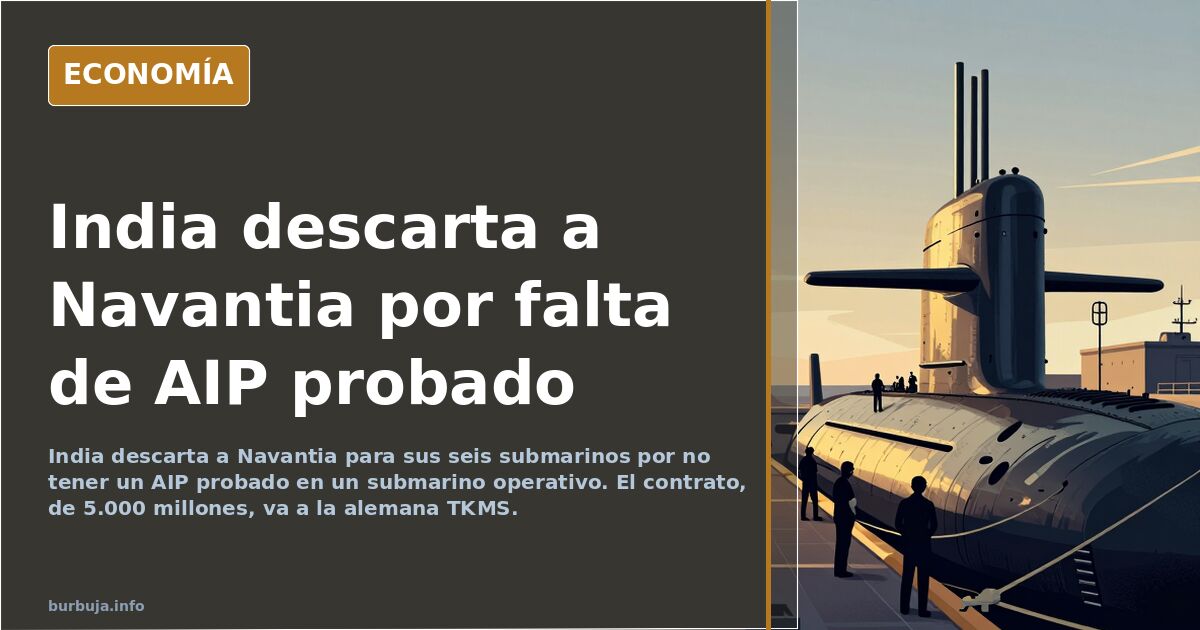
India Dumps Navantia Over Unproven AIP Technology
Why did Spain’s bid for India’s Project 75 submarines fall short? India’s Ministry of Defence has advanced negotiations with Germany’s Thyssenkrupp Marine Systems (TKMS) and local shipbuilder Mazagon Dock Shipbuilders (MDS), effectively sidelining Navantia and its Indian partner Larsen & Toubro (L&T). The estimated $5 billion contract would have seen submarines built at the Cartagena facility. Sources cited by Indian Express noted the Spanish-Indian proposal was rejected on technical grounds: it failed to meet the requirement for a proven Air Independent Propulsion (AIP) system.
Sánchez’s Visit and India’s Warning
During his October 2024 visit to India, Spanish Prime Minister Pedro Sánchez defended Navantia’s offer as “the most competitive” in both price and technological quality. MDS confirmed to Indian stock exchanges that the government had summoned them for an initial round of commercial negotiations starting January 27.
Some argue the issue wasn’t price, but proof. The S-81, the first boat of the S-80 class, was launched in 2021 and remains in testing. According to program trackers, Spain’s AIP won’t be installed on an operational submarine until the S-83’s first major overhaul, scheduled for 2031. Until then, there is only a land-based demonstrator and many promises. India, experienced in these matters, preferred a system already navigating in Type 214 and 212CD submarines.
The Weight of History: 18 Years for Half a Submarine
The most repeated argument isn’t political, but chronological. Construction of the S-81 began in 2005; it was delivered in 2023 after 18 years, without AIP. The subsequently launched S-82 also lacks it as standard. The S-83 and S-84, which should include it, won’t launch for another three or four years. In an international tender, such a timeline is a burden. The other side of the scale is Germany’s track record: TKMS offers a design based on existing submarines with technology transfer to a local partner, something India values.
The underlying debate is whether Navantia lost on merit or because requirements were tailored to competitors. Some point out the tender demanded an AIP “installed and in use on a submarine,” a condition Germany met and Spain did not. Others recall that Spain’s AIP, once certified, might surpass the German version, but tenders don’t buy promises. Politics also plays a role: some claim Sánchez’s October 2024 visit didn’t sit well with certain Indian sectors, who saw it as image-building rather than industrial commitment.
What Remains of the Contract and What Cartagena Stands to Lose
India’s process still allows objections, but the margin is minimal. Negotiations with TKMS and MDS begin January 27, and barring an unexpected turn, Navantia is out. For Cartagena, the loss isn’t just workload; it was a chance to consolidate a submarine export line that hadn’t closed an international contract in years. For Spain, the blow is fruta: the Prime Minister had sold the offer as the most competitive, yet the result says otherwise.
An uncomfortable question remains: can you sell a submarine whose flagship system isn’t yet at sea? Based on facts, the answer is no—at least not to India. Spain’s AIP will arrive, they say, and will be better. Meanwhile, Germans sign contracts and Indians smile. As in the joke about Attila’s horse, where Sánchez passes, grass doesn’t grow. But this time, he also took down a $5 billion contract.
Why did Spain’s bid for India’s Project 75 submarines fall short? India’s Ministry of Defence has advanced negotiations with Germany’s Thyssenkrupp Marine Systems (TKMS) and local shipbuilder Mazagon Dock Shipbuilders (MDS), effectively sidelining Navantia and its Indian partner Larsen & Toubro (L&T). The estimated $5 billion contract would have seen submarines built at the Cartagena facility. Sources cited by Indian Express noted the Spanish-Indian proposal was rejected on technical grounds: it failed to meet the requirement for a proven Air Independent Propulsion (AIP) system.
Sánchez’s Visit and India’s Warning
During his October 2024 visit to India, Spanish Prime Minister Pedro Sánchez defended Navantia’s offer as “the most competitive” in both price and technological quality. MDS confirmed to Indian stock exchanges that the government had summoned them for an initial round of commercial negotiations starting January 27.
Some argue the issue wasn’t price, but proof. The S-81, the first boat of the S-80 class, was launched in 2021 and remains in testing. According to program trackers, Spain’s AIP won’t be installed on an operational submarine until the S-83’s first major overhaul, scheduled for 2031. Until then, there is only a land-based demonstrator and many promises. India, experienced in these matters, preferred a system already navigating in Type 214 and 212CD submarines.
The Weight of History: 18 Years for Half a Submarine
The most repeated argument isn’t political, but chronological. Construction of the S-81 began in 2005; it was delivered in 2023 after 18 years, without AIP. The subsequently launched S-82 also lacks it as standard. The S-83 and S-84, which should include it, won’t launch for another three or four years. In an international tender, such a timeline is a burden. The other side of the scale is Germany’s track record: TKMS offers a design based on existing submarines with technology transfer to a local partner, something India values.
The underlying debate is whether Navantia lost on merit or because requirements were tailored to competitors. Some point out the tender demanded an AIP “installed and in use on a submarine,” a condition Germany met and Spain did not. Others recall that Spain’s AIP, once certified, might surpass the German version, but tenders don’t buy promises. Politics also plays a role: some claim Sánchez’s October 2024 visit didn’t sit well with certain Indian sectors, who saw it as image-building rather than industrial commitment.
What Remains of the Contract and What Cartagena Stands to Lose
India’s process still allows objections, but the margin is minimal. Negotiations with TKMS and MDS begin January 27, and barring an unexpected turn, Navantia is out. For Cartagena, the loss isn’t just workload; it was a chance to consolidate a submarine export line that hadn’t closed an international contract in years. For Spain, the blow is fruta: the Prime Minister had sold the offer as the most competitive, yet the result says otherwise.
An uncomfortable question remains: can you sell a submarine whose flagship system isn’t yet at sea? Based on facts, the answer is no—at least not to India. Spain’s AIP will arrive, they say, and will be better. Meanwhile, Germans sign contracts and Indians smile. As in the joke about Attila’s horse, where Sánchez passes, grass doesn’t grow. But this time, he also took down a $5 billion contract.
Summary of a discussion on Burbuja.info - Foro de economía, actualidad y política., translated from Spanish and reviewed before publication. Read the full discussion (159 replies).
More summaries
-
Riots in French schools: fires and attacks
Fires in French schools, teachers attacked and blockades spreading to Belgium. The unrest is attributed to the education strike and radical groups.
-
Ayuso team admits insult to Sánchez, citing corruption
Ayuso's cabinet acknowledges the insult directed at Sánchez from the Congress guest gallery, justifying it with corruption allegations.
-
San Sebastián Festival Director Labels Vox Fascist, Sparking Subsidy Debate
The San Sebastián Film Festival director called Vox fascist, shifting the debate to public film subsidies.
-
Iran strikes US bases in Qatar and Iraq; oil drops 4.5%
Iran attacks US bases in Qatar and Iraq, yet oil prices fall 4.5% as markets assume the strike was pre-announced to avoid escalation.
-
Spain arrests ex-Interior official and hacker Alcasec
Spanish police arrest former Interior Secretary Francisco Martínez and hacker Alcasec amid political pressure, Vozpópuli reports.
-
El Atazar Dam Releases Water at 99% Capacity, First Time in 40 Years
El Atazar Dam releases water at 99% capacity for the first time in four decades. The reservoir holding half of Madrid's water supply has historical cracks and maintenance issues.