
Immigration reaches rural Spain's empty villages
Immigrant communities are revitalizing Galicia and Asturias, challenging rural depopulation and aging demographics in small Spanish towns.
English · Original discussion in Spanish · Published
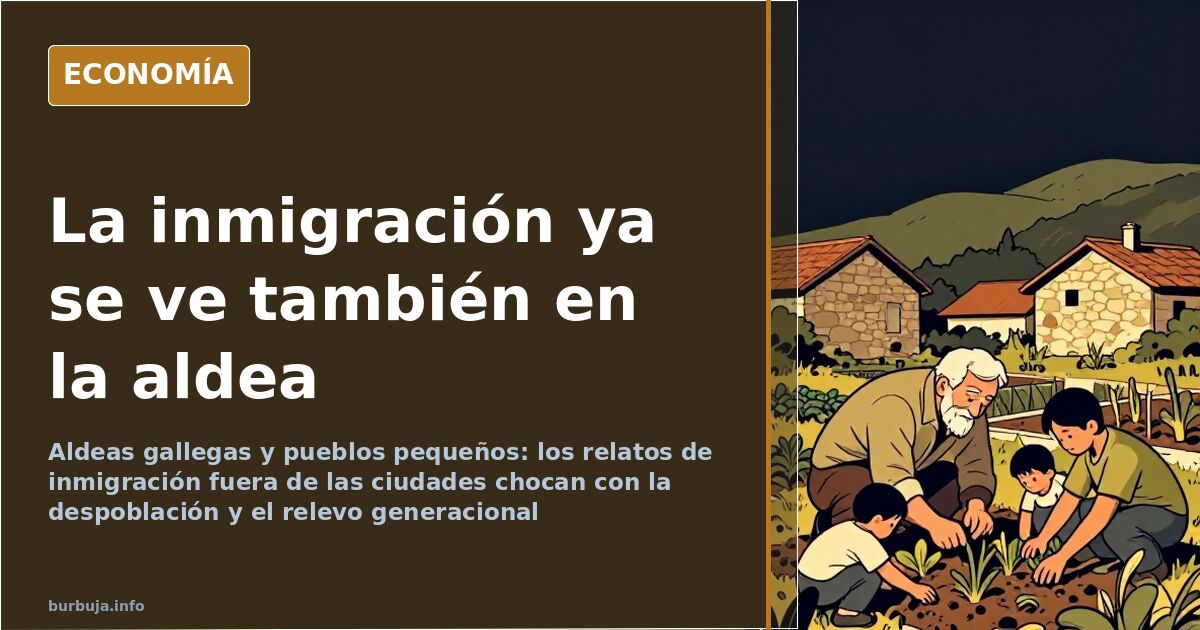
Why immigration is now visible in Spain's empty villages
Is there still anywhere to escape the city? This question runs through a story starting in a small Galician village — the kind where you expect grandparents, cats, and a few cows — and ending in a bar served by South Americans, a kiosk run by a Chinese merchant and what seemed her daughter, and five women sitting in the square, three wearing veils. The elderly remain, but as the story summarizes, they are those who 'won't last much longer.' The scene, recounted by a Barcelona resident visiting his in-laws, captures a discontent repeated across half of rural Spain.
Where changes are being felt in rural areas
The phenomenon is no longer limited to major cities or their peripheries. The stories cross paths, placing visible changes in the rural areas of Galicia and Asturias, inland Catalonia, the Madrid mountains, Extremadura, Burgos, Cáceres, Girona, and the Almería west, with municipalities like El Ejido, Vícar, or Roquetas de Mar described as nuclei where the foreign-born population has a significant presence. Also in small towns in Granada.
The novelty is not the arrival of immigrants, which has been happening for years, but that the phenomenon is now perceived in villages and towns with very few inhabitants, where until recently the only demographic variable was aging. That is the disconcerting point: the feeling that the calendar has advanced by several decades.
The six-passenger rural bus: a thermometer of change
The most repeated detail is the bus. A resident of inland Galicia describes a alucinación to another town to shop: six passengers. Two women wearing veils who did not speak Spanish, a South American passenger with a young child, and two local youths, described by their attire. Two-thirds of the bus did not match the image the traveler kept of his youth.
This is compounded by complaints about the loss of community customs: those telling the story miss being greeted and having an elderly person loaded with bags helped. The nostalgia for a cohesive village coexists — the story itself admits it — with the less pleasant side of rural Spain, where everyone's life is known and judged. Both things are true at once, and that nuance is what separates the diagnosis from romanticization.
How much immigrant population is there in small towns?
The specific percentages are the weakest point of the matter, and it must be said. The most precise data provided comes from a resident of a town in Granada: of 1,200 inhabitants, about 200 are Jovenlandeses, one-sixth of the census, and he asserts that this proportion grows each year. The same story claims that 75% of the children at school do not eat ham, a more striking than rigorous indirect indicator.
Against the perception that the real proportion of foreign population exceeds official figures, the comparison with Portugal — 10% immigrant population, with very reduced Muslim presence — is used as a contrast. There is also someone who attributes to Galicia the highest proportion of North African ancestry in the country, a claim made without a source to support it.
Public housing, repopulation, and suspicion of aid
Another part of the discontent points to housing policy. A case is described of a municipality that built protected housing developments and, lacking sufficient local demand, ended up filling them with residents from the capital. The underlying suspicion is that there are incentives — subsidies, subsidized rentals, provided housing — to settle population in rural areas, and that these incentives attract immigrants. This is a hypothesis repeated often and without detailed documentation.
The paradox, however, is evident: the same State that for decades let the towns die is now suspected of repopulating them in haste.. And of doing so, moreover, with those who do not share local codes. No one disputes that generational replacement is needed; the conflict begins when discussing where it comes from.
The 'Kalergi Plan' and theories without backing
The so-called 'Kalergi Plan' also circulates, the old conspiracy theory claiming the existence of a deliberate plan to replace the European population through immigration. There is no documentary evidence supporting this reading, and it should be treated as such: as a belief, not a fact. The same applies to figures on religious conversion, where individual cases — people embracing another faith in both directions — are used to support general trends that the data itself does not allow to close.
Who leaves Europe: data on re-emigration
Against the idea of a one-way flow, data on re-emigration from European countries is cited: 376,000 people born in Germany have emigrated to Turkey; about 30,000 born in the Netherlands have done the same to Turkish territory; 7,000 Dutch have emigrated to Indonesia and more than 15,000 Germans to Libya and Egypt. In the Spanish case, the volume is much smaller: 4,400 people born in Spain would have emigrated to Segarro.
These are distinct magnitudes and contexts that cannot be superimposed without qualification, but they serve a concrete argument: population movements are not an arrow in a single direction, although the net balance in Spain remains one of arrival. The full breakdown of these flows, with destination and volume, leaves a less linear picture than the easy headline suggests.
For decades, the village was the backup plan for those who could not afford the city. Cheap, quiet, and with family nearby. It still is. The only thing that has changed is that now, when you arrive, the coffee is served by someone who was not born there either and who will probably pack their bags before you do.
Is there still anywhere to escape the city? This question runs through a story starting in a small Galician village — the kind where you expect grandparents, cats, and a few cows — and ending in a bar served by South Americans, a kiosk run by a Chinese merchant and what seemed her daughter, and five women sitting in the square, three wearing veils. The elderly remain, but as the story summarizes, they are those who 'won't last much longer.' The scene, recounted by a Barcelona resident visiting his in-laws, captures a discontent repeated across half of rural Spain.
Where changes are being felt in rural areas
The phenomenon is no longer limited to major cities or their peripheries. The stories cross paths, placing visible changes in the rural areas of Galicia and Asturias, inland Catalonia, the Madrid mountains, Extremadura, Burgos, Cáceres, Girona, and the Almería west, with municipalities like El Ejido, Vícar, or Roquetas de Mar described as nuclei where the foreign-born population has a significant presence. Also in small towns in Granada.
The novelty is not the arrival of immigrants, which has been happening for years, but that the phenomenon is now perceived in villages and towns with very few inhabitants, where until recently the only demographic variable was aging. That is the disconcerting point: the feeling that the calendar has advanced by several decades.
The six-passenger rural bus: a thermometer of change
The most repeated detail is the bus. A resident of inland Galicia describes a alucinación to another town to shop: six passengers. Two women wearing veils who did not speak Spanish, a South American passenger with a young child, and two local youths, described by their attire. Two-thirds of the bus did not match the image the traveler kept of his youth.
This is compounded by complaints about the loss of community customs: those telling the story miss being greeted and having an elderly person loaded with bags helped. The nostalgia for a cohesive village coexists — the story itself admits it — with the less pleasant side of rural Spain, where everyone's life is known and judged. Both things are true at once, and that nuance is what separates the diagnosis from romanticization.
How much immigrant population is there in small towns?
The specific percentages are the weakest point of the matter, and it must be said. The most precise data provided comes from a resident of a town in Granada: of 1,200 inhabitants, about 200 are Jovenlandeses, one-sixth of the census, and he asserts that this proportion grows each year. The same story claims that 75% of the children at school do not eat ham, a more striking than rigorous indirect indicator.
Against the perception that the real proportion of foreign population exceeds official figures, the comparison with Portugal — 10% immigrant population, with very reduced Muslim presence — is used as a contrast. There is also someone who attributes to Galicia the highest proportion of North African ancestry in the country, a claim made without a source to support it.
Public housing, repopulation, and suspicion of aid
Another part of the discontent points to housing policy. A case is described of a municipality that built protected housing developments and, lacking sufficient local demand, ended up filling them with residents from the capital. The underlying suspicion is that there are incentives — subsidies, subsidized rentals, provided housing — to settle population in rural areas, and that these incentives attract immigrants. This is a hypothesis repeated often and without detailed documentation.
The paradox, however, is evident: the same State that for decades let the towns die is now suspected of repopulating them in haste.. And of doing so, moreover, with those who do not share local codes. No one disputes that generational replacement is needed; the conflict begins when discussing where it comes from.
The 'Kalergi Plan' and theories without backing
The so-called 'Kalergi Plan' also circulates, the old conspiracy theory claiming the existence of a deliberate plan to replace the European population through immigration. There is no documentary evidence supporting this reading, and it should be treated as such: as a belief, not a fact. The same applies to figures on religious conversion, where individual cases — people embracing another faith in both directions — are used to support general trends that the data itself does not allow to close.
Who leaves Europe: data on re-emigration
Against the idea of a one-way flow, data on re-emigration from European countries is cited: 376,000 people born in Germany have emigrated to Turkey; about 30,000 born in the Netherlands have done the same to Turkish territory; 7,000 Dutch have emigrated to Indonesia and more than 15,000 Germans to Libya and Egypt. In the Spanish case, the volume is much smaller: 4,400 people born in Spain would have emigrated to Segarro.
These are distinct magnitudes and contexts that cannot be superimposed without qualification, but they serve a concrete argument: population movements are not an arrow in a single direction, although the net balance in Spain remains one of arrival. The full breakdown of these flows, with destination and volume, leaves a less linear picture than the easy headline suggests.
For decades, the village was the backup plan for those who could not afford the city. Cheap, quiet, and with family nearby. It still is. The only thing that has changed is that now, when you arrive, the coffee is served by someone who was not born there either and who will probably pack their bags before you do.
Summary of a discussion on Burbuja.info - Foro de economía, actualidad y política., translated from Spanish and reviewed before publication. Read the full discussion (344 replies).
More summaries
-
IONOS cuts 450 jobs, Logroño fears for Arsys's 360
IONOS cuts 450 jobs from 3,800: Arsys, with 360 workers in Logroño, is unsure how many will be affected.
-
Atlantic Cold Spot Reignites Climate Collapse Debate
An image of a frozen Atlantic zone sparks debate: climate collapse or isolated anomaly? Economic impact on agriculture and energy.
-
Leaked Video Sparks Debate on Media Image Commodification
Analysis of image commodification in media following a leaked video, contrasting professional rise with criticism of the industry.
-
€400k savings no longer buy a home in Madrid or Barcelona
With €400,000 saved, a 40-year-old cannot afford a decent flat in Madrid or Barcelona due to housing costs and inflation.
-
Narco leader Mencho's fall and social media role
Analysis of how digital platforms and online data may have been crucial in locating the individual known as 'Mencho'.
-
Sargadelos factory closure threat reversed after inspection
Spanish ceramics maker Sargadelos faced closure over safety violations, but political pressure forced a reversal.