
Iker Jiménez Reaches Valencia's 'Zero Zone' Before Official Aid Arrives
Iker Jiménez's team broadcasts from the flooded 'zero zone' while residents beg for water and military units wait for mobilization orders.
English · Original discussion in Spanish · Published
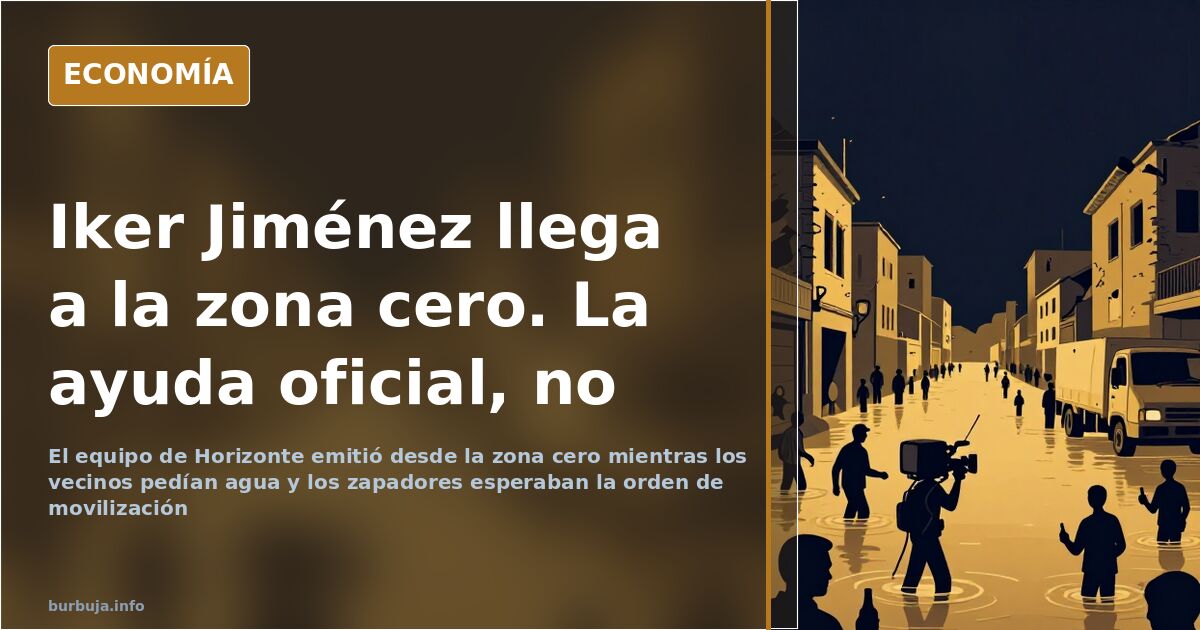
The 'zero zone' reached by Iker Jiménez, where government aid did not arrive
How can a television camera reach the 'zero zone' before state assistance? This question dominates conversations about the flooding that submerged much of the Valencia province, and the repeated answer is uncomfortable. The Horizonte team, hosted by Iker Jiménez, broadcast live from streets covered in mud while local residents shouted for water and food. The presenter donned boots and went to the terrain. Public machinery, with nuances, had not yet arrived.
The account of those days leaves a fixed image: civilians, military personnel, and agents moving independently toward affected municipalities, while institutional organizations and teams waited for access to be restored. Some acted out of vocation; others, awaiting an order that never fully arrived. In the middle, a television station broadcast from the mud.
The Army waited for orders while residents pleaded for help
Sappers had been waiting for days for someone to put them on alert, according to information released during the emergency. Forum posts mentioned the Army would arrive the next day around eight o'clock. Meanwhile, in affected areas, residents continued to demand water and food.
According to messages circulated during the emergency, firefighters and security forces issued statements claiming they were not allowed to assist in rescue operations and blamed authorities for this paralysis. These are unverified accusations. Nevertheless, the succession of testimonies outlines a pattern: a mobilization that started late and trickled in.
Why is the Valencia flood compared to Sant Llorenç and La Palma's dogs?
Because in La Palma's case, private initiative arrived before official media, and in Sant Llorenç, the personnel sent then are compared to those cited now. In Sant Llorenç des Pla i Sa Vall, Mallorca, a flood claimed twelve lives in 2018. 300 military personnel were sent to a small town. Forum posts mentioned 500 personnel for a disaster of another scale.
The other precedent cited is the La Palma eruption, where civilians with drones arrived to rescue animals before official media. According to those who cite it, this was remembered as the first embarrassment of the emergency machinery. The comparison is harsh, perhaps unfair, but made by those who brought it up.
Looting: what can be sustained and what cannot
Forum posts discussed assaults on shops and homes in evacuated zones. Organized groups and tools for forcing closures were mentioned. Some messages called for exceptional measures, such as martial law.
From there, the narrative explodes. A portion of the messages attributes looting to people born outside Spain. There is no data supporting this profile, and turning a suspicion into a diagnosis is the shortcut that transforms a public order problem into something else.
Another line, the most extreme, claims the delay in aid was deliberate, to generate antiestéticar or distribute contracts to allies. These are assertions without any evidence provided. They resemble the background noise of any disaster more than a finding.
Public television and the information blackout
One of the most repeated criticisms does not target the Government, but public television. It is claimed that TVE should have suspended its programming and broadcast continuous information from the start, especially for those affected, who did not know what was happening in the neighboring municipality. The underlying complaint is the same: general media took too long to grasp the tragedy.
In parallel, there were complaints about difficulties re-watching programs covering the emergency, with platforms restricting playback and forcing recording through other means. And a linguistic criticism, from those who claim that calling DANA (Dependent Air Isolated) the traditional gota fría (cold drop) dilutes the alarm. A colonel let it drop on air: if you say cold drop, the people understand; if you say DANA, they do not.
Donations, mourning, and political wear
Private donations also entered the comparison. Amancio Ortega contributed four million euros, and the trinc question was always the same: how much each person contributes and with what they stay. The three days of official mourning were read as an obligatory parenthesis before the political clash.
Some anticipate that the management's wear will claim pieces in the implicated administrations, while others point to the distribution of emergency contracts as the next front. Without published minutes or resolutions, it is suspicion. With mud still on the streets, suspicion settles equally.
In the end, the scene summarizing everything is that of a presenter with boots and a microphone in the 'zero zone,' recounting what he saw, while a resident explained that from what came out on television, nothing. Official aid, according to the dominant narrative, arrived late and in dribs and drabs. That is: after the camera.
How can a television camera reach the 'zero zone' before state assistance? This question dominates conversations about the flooding that submerged much of the Valencia province, and the repeated answer is uncomfortable. The Horizonte team, hosted by Iker Jiménez, broadcast live from streets covered in mud while local residents shouted for water and food. The presenter donned boots and went to the terrain. Public machinery, with nuances, had not yet arrived.
The account of those days leaves a fixed image: civilians, military personnel, and agents moving independently toward affected municipalities, while institutional organizations and teams waited for access to be restored. Some acted out of vocation; others, awaiting an order that never fully arrived. In the middle, a television station broadcast from the mud.
The Army waited for orders while residents pleaded for help
Sappers had been waiting for days for someone to put them on alert, according to information released during the emergency. Forum posts mentioned the Army would arrive the next day around eight o'clock. Meanwhile, in affected areas, residents continued to demand water and food.
According to messages circulated during the emergency, firefighters and security forces issued statements claiming they were not allowed to assist in rescue operations and blamed authorities for this paralysis. These are unverified accusations. Nevertheless, the succession of testimonies outlines a pattern: a mobilization that started late and trickled in.
Why is the Valencia flood compared to Sant Llorenç and La Palma's dogs?
Because in La Palma's case, private initiative arrived before official media, and in Sant Llorenç, the personnel sent then are compared to those cited now. In Sant Llorenç des Pla i Sa Vall, Mallorca, a flood claimed twelve lives in 2018. 300 military personnel were sent to a small town. Forum posts mentioned 500 personnel for a disaster of another scale.
- Sant Llorenç (2018): 12 fatalities and 300 deployed military personnel
- Valencia Province: 500 military personnel cited for a much larger territory
The other precedent cited is the La Palma eruption, where civilians with drones arrived to rescue animals before official media. According to those who cite it, this was remembered as the first embarrassment of the emergency machinery. The comparison is harsh, perhaps unfair, but made by those who brought it up.
Looting: what can be sustained and what cannot
Forum posts discussed assaults on shops and homes in evacuated zones. Organized groups and tools for forcing closures were mentioned. Some messages called for exceptional measures, such as martial law.
From there, the narrative explodes. A portion of the messages attributes looting to people born outside Spain. There is no data supporting this profile, and turning a suspicion into a diagnosis is the shortcut that transforms a public order problem into something else.
Another line, the most extreme, claims the delay in aid was deliberate, to generate antiestéticar or distribute contracts to allies. These are assertions without any evidence provided. They resemble the background noise of any disaster more than a finding.
Public television and the information blackout
One of the most repeated criticisms does not target the Government, but public television. It is claimed that TVE should have suspended its programming and broadcast continuous information from the start, especially for those affected, who did not know what was happening in the neighboring municipality. The underlying complaint is the same: general media took too long to grasp the tragedy.
In parallel, there were complaints about difficulties re-watching programs covering the emergency, with platforms restricting playback and forcing recording through other means. And a linguistic criticism, from those who claim that calling DANA (Dependent Air Isolated) the traditional gota fría (cold drop) dilutes the alarm. A colonel let it drop on air: if you say cold drop, the people understand; if you say DANA, they do not.
Donations, mourning, and political wear
Private donations also entered the comparison. Amancio Ortega contributed four million euros, and the trinc question was always the same: how much each person contributes and with what they stay. The three days of official mourning were read as an obligatory parenthesis before the political clash.
Some anticipate that the management's wear will claim pieces in the implicated administrations, while others point to the distribution of emergency contracts as the next front. Without published minutes or resolutions, it is suspicion. With mud still on the streets, suspicion settles equally.
In the end, the scene summarizing everything is that of a presenter with boots and a microphone in the 'zero zone,' recounting what he saw, while a resident explained that from what came out on television, nothing. Official aid, according to the dominant narrative, arrived late and in dribs and drabs. That is: after the camera.
Summary of a discussion on Burbuja.info - Foro de economía, actualidad y política., translated from Spanish and reviewed before publication. Read the full discussion (337 replies).
More summaries
-
Horizonte takes DANA to Cuatro in a special that avoids closing figures
Horizonte airs a special on Cuatro while the repeated figure of 217 dead clashes with the lack of a census of missing persons
-
Iker Jiménez's DANA Show Hits 13.2% Share With 3 Million Viewers
Horizonte achieved a 13.2% share and 3 million unique viewers, with experts highlighting bureaucratic failures during Valencia's DANA floods.
-
The 72-hour prophecy: the Koldo case rumour mill keeps churning
The Koldo case rekindles the countdown to Sánchez's downfall, but the 72-hour prophecy has been failing for years. An economic analysis of the judicial rumour mill.
-
Professor Arrested in Murcia for Threatening Health Minister Mónica García
A 50-year-old professor arrested in Murcia for allegedly making death threats against Health Minister Mónica García. No prior convictions.
-
Forum users speculate on a seat projection credited to Sánchez
One user claims Sánchez wants the PSOE to finish first while Vox overtakes the PP. Another cites a 13.8% of PP voters defecting to Vox.
-
Forum row erupts over minute's silence for 87-year-old woman
Forum users criticise a minute's silence held for an 87-year-old woman who died, comparing her case with other deaths and accusing politicians of double standards.